Archive for the ‘art’ Category
The City and the City
Filed under: art, Art, Street Art | Tags: China Mieville, city, Gorker Gallery, Miso, Street art, Tchusse
 Leave a comment
 Imagine that the city you live in actually intersects with another city… Every street, every building exists in your city, but also in another city, which occupies the same space as your own…
This is the premise of the wonderful novel by China Miéville, The City and the City, which I read during the summer vacation. It tells of a fictional city, Beszel, somewhere on the far edges of Eastern Europe, which intersects with another city, Ul Qoma, in the way I’ve described. People live in the same space, but they are citizens of one city and not the other. The inhabitants of Beszel speak a different language to that spoken in the other city; each citizen of Beszel has to learn to ‘un-see’ the presence of the citizens of the other place, and vice versa.
It’s a fascinating idea and makes for some amazing reading. But it has also made me think about street art and the city, and about some recent work by Miso, in her show in December (which I wrote about really briefly here just before the summer break). Although the show is no longer on, I think that there were some really interesting ideas going on in it, and wanted to write a little about it.
Miso’s show, Tchusse, was at Gorker Gallery in Fitzroy,. I went there on an extremely hot night in December, to see the show and to hear Miso speak about the work. The gallery was crowded, indicating how much interest there is in Melbourne in her work.
In some ways it’s hard to think of the show as having individual works within it (although it does), because it also worked very well as a large installation. Have a look at these pictures, from Miso’s website.The gallery was transformed into a street space, by virtue of the layers of drawings and objects hung on the walls and criss-crossing the corners of the space on string. There were many of Miso’s beautiful drawings, often showing women in the midst of various activities, and many object that she had made: for example, small models of buildings lit from within.
But there were also objects that had been brought into the gallery as part of the setting for the works, some of which had themselves been transformed by the artist. There were wooden doors, upon which pages from books, or posters and notices had been affixed. Items of clothing were suspended from string like laundry from washing-lines; tea-bags also hung drying in corners. There were pages taken from books, pinned upon the wall, next to framed photographs of some of Miso’s street-based art works (which brought other, real, locations into the simulated location within the gallery, but did so through the means of mediation themselves).
The result, when one walked into the gallery, was a sense of entering city space rather than gallery space, albeit a city whose dimensions had been compressed and constrained into multiple layers around and across the gallery.
And it was not simply any city that was being created here: it was in fact Kharkhov in the Ukraine, the city that Miso is originally from; a city which inspires much of her art and which her art in turn remembers and recreates.
On that hot, hot night in December when we all crowded into the gallery to hear Miso speak about the work, I was struck by the way she spoke about her aims – to bring Kharkhov into Melbourne, through her drawings of its inhabitants, through the wooden doors covered with notices of items for sale or pages torn from books, through the tiny scale models of buildings with bullet holes in them, through the clothing hanging from the string. It is not a literal Kharkhov that is being created, but rather a representation of the city, a city that is sensed and experienced through standing in the gallery.
And so Kharkhov becomes a part of Melbourne, rather than a city on the other side of the world. It seems to me that such an achievement testifies to what art is capable of – to make another city within the city that we all take for granted. Miso’s show is an example of what street art and graffiti can do to and for the cities we live in.
China Miéville’s book The City and the City describes what it’s like to live in a city which is inhabited also by ‘others’ (people who speak differently from us, people who think differently about the same streets and spaces). Miso’s work allowed us to see the city of Kharkhov by temporarily bringing it into the physical space of Melbourne. And street artists and graffiti writers do this for us over and over again, pointing out that for every person who inhabits Melbourne as a space determined by private property and ‘clean’ walls, there is another citizen of the city, one who sees walls as surfaces to be painted. Miéville’s book may be classified as an ‘ urban fantasy’ on amazon.com, but the split experience described in his novel is one which certainly applies both to the art created by Miso and to the day-to-day experiences of anyone living in Melbourne today.
‘Tchusse’: new show by Miso at Gorker Gallery
Filed under: art, Art, Street Art | Tags: Gorker Gallery, Melbourne, Miso, Street art
Comments (3) It seems like every recent post I have uploaded to this blog has begun with an apology about how busy/sick/distracted/hectic I have been…. Well, why break a pattern by doing something different! Apologies for taking such a long time to add a new post here. I had been holding off on doing so because I was due to travel overseas (to Berlin, Paris and London) and I wanted to create lots of posts about the street art I would be seeing there. Instead, my daughter got pneumonia, and I managed to catch it from her, so my trip was postponed, then postponed again, then I finally said, ‘I give up and admit it, I am too sick to travel this year’. So I have had to delay with visits to those amazing cities until next year.
And then just when I thought that I would resume blogging about the fabulous street art in my home town of Melbourne, my partner managed to get sick (yes, apparently I passed on the whole pneumonia thing to him) plus we decided on an impulse to move house, so we have been consumed by the obsessive, stressful and depressing process of selling and buying. And while that’s not over yet, some of it is (we sold our house last week), and it’s definitely good to be able to feel that there’s a little more time in the week as a result.
I wanted this first-post-in-ages to be about something very special, and I’m happy that it is indeed. Miso, one of my very favourite artists in the world is having a new solo show in Melbourne at Gorker Gallery in Fitzroy. It opened a little while ago so to some of you this will hardly come as news (did I mention that I have been crazy busy?) but it is on until 20 December and in fact on Wed 16th there will be an artist talk by Miso at the Gallery.
Some info about the show and what to expect, which I have taken from Miso’s website:
Miso – Tchusse

Miso – Tchusse
{Stanislava Pinchuk}
Opening Night: Thursday, 3rd December {6-9 pm}
Gorker Gallery – crnr Gore & Kerr Streets, Melbourne.
“‘Tchusse’ sees Miso re-create & condense her home city into a gallery.
Kharkov {Ukraine} becomes a floor to ceiling installation – portraits of
strangers in the street, of friends, folk stories and things otherwise
forgotten, turned into a city built from paper, material and decaying wood,
as Miso replicates buildings, street signs and notices, ladders, empty
bottles, criminal tattoos and clothesline and clothesline from memory.
In this way, Tchusse becomes an extension if Miso’s widely renowned
work as a street artist, as well as being her most ambitious installation &
gallery project yet.”
Miso will be doing an artists talk on the wine tasting evening – Wednesday,
16th of December, at 6 pm. ‘Tchusse’ will also be the launch of a
collaborative clothing project with Warren Harrison.
The exhibition will run until 20th December;
3-7 pm Wednesday-Friday // 11am – 7pm Saturday-Sunday.
If you click on the link for Gorker, you will see some shots from the opening night and get a sense of how amazing the show is. And if you know Miso’s work already, you will realise that this is definitely a show not to be missed.
It’s also a great way for Gorker to end the year. In 2009, they have put on some of the most interesting exhibitions in Melbourne, and I’m looking forward to see what they have lined up for 2010….

Three Variations on a Theme of Surveillance
So much street art and graffiti depends upon thwarting the technologies of surveillance. I was looking back through some photographs taken on a trip to London last July, and came across three images, each of which are to do with surveillance in different ways.
Here’s one, taken in Rivington Street:
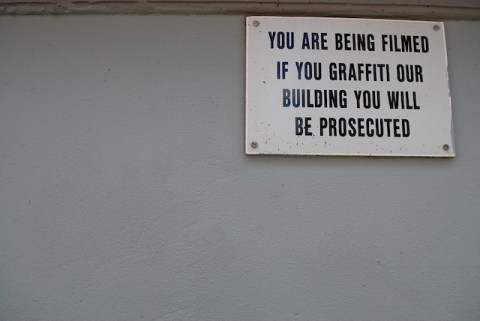
I like the double-layering that my photograph creates. The notice announces the fact of being filmed, at the same time as my camera films the notice.
This type of notice and device is typical of what can be seen all over London (and in many other cities around the world). London has filled itself with surveillance mechanisms, the most obvious of which is of course the closed circuit TV camera. They can be seen in so many streets, angling downwards from their elevated positions, like ugly metallic carbuncles on the walls of buildings. And the idea is certainly that in the streets where a camera can be seen, you can be seen on camera (although this Big Brother-esque cliché is often not true in practice: a few years ago I visited the control room for Melbourne City Council’s many CCTV cameras, and staff there admitted that there were so many screens and so few staff that it was impossible for them to properly see much of what was filmed).
The camera on the wall is just one type of surveillance device; there are others. One is the Oyster travel card that allows users to move between modes of public transport. As they travel, it deducts the cost of their journey from a prepaid account in their name. Super convenient, of course,, but when I was visiting there were a number of interesting stories in the media about how the Oyster system was being used to provide information about people’s day-to-day movements. Cases were cited of individuals who believe their spouse or partner is cheating on them looking at their Oyster statements to check where and when they travelled, in the hopes of revealing illicit trysts. Others believe that such computerized systems can be used for data profiling, either for more extensive marketing and advertising or for the straightforward surveillance of citizens that all governments engage in.
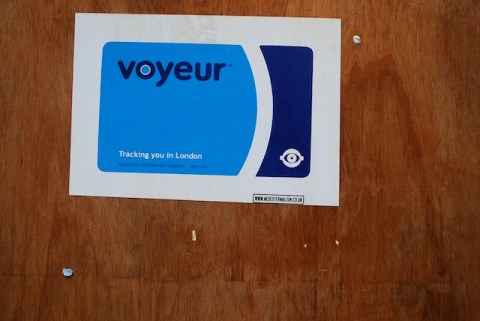
And one street artist in London was promulgating a critique of the surveillance systems surrounding citizens: Xylo’s stickers denouncing the Oyster system and mobile phone records were everywhere in 2008. Here’s one, in which he has transformed the very recognizable Oyster logo into the word ‘Voyeur’:
The final image doesn’t survey, and doesn’t denounce: instead, it transforms. The phrase ‘Bill stickers will be prosecuted’ is well known; it announces that bill posting or sticking is a crime and acts as a warning to anyone engaging in the activity. (It has also led to a commonly-seen variety of corny graffiti, in which individuals might write, as a riposte, ‘Poor old Bill Stickers’, or something similar.) In Brick Lane, I found this object affixed to a wall:
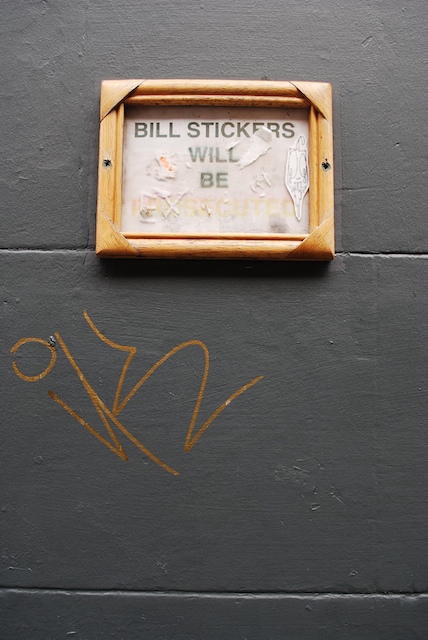
The artist has taken a printed version of the warning, and has edited it (illegibly now), and reconstituted it as part of an artwork itself. Thus the will to prosecute (to ‘put someone in the frame’, as the police might say) has been transformed into an image, itself framed and hung upon a wall, in public space, for all of us passers-by to see it, and to smile.
The Everfresh wall in Fitzroy
Filed under: art, Art, Street Art | Tags: crew, Everfresh, Fitzroy, Melbourne, Street art
Comments (4) Recently when I was reading the excellent blog by Very Nearly Almost, I came across a recent post which was celebrating some of Melbourne’s street art (which you can read here) and noticed that the Everfresh wall in Fitzroy was featured.
The post reminded me that I photographed this wall a few weeks ago, with the intention of dedicating a whole post to the amazing work of the Everfresh crew in creating this wall. So here is that post…
Everfresh will be well known to many readers of this blog, since their contribution to street art in Melbourne has been enormous. Their work, both commissioned and uncommissioned, can be seen on walls in many areas of the city (they are well represented in Hosier Lane, for example), but they are most closely associated with Fitzroy and Collingwood, and it’s in the streets of those suburbs that their works can be seen to best effect.
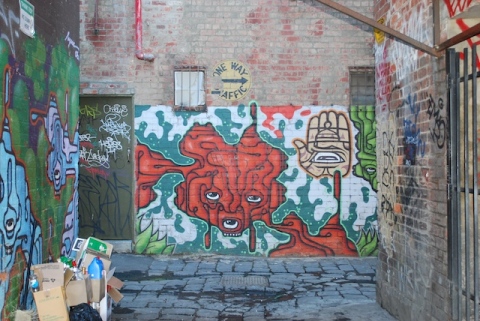
Everfresh are a crew of several artists (including Sync, Rone, Makatron, Reka, Meggs, and Phibs), who work as a group, solo, and in all possible combinations allowed by the group. They have evolved a very distinctive style, which, once you are familiar with it, is instantly recognisable. here’s one example, seen in a laneway in Fitzroy:
Last year, when I was in Amsterdam, I had the pleasure of looking up at a wall outside the Cafe Belgique in Gravenstraat and seeing an image that I immediately associated with Melbourne, and ‘home’:
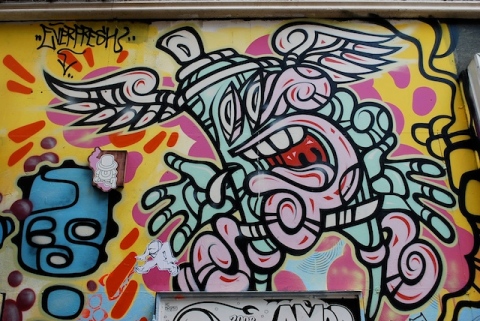
Quite a while ago, I had heard that there was a large wall in Fitzroy that Everfresh were going to paint, outside the Black Cat nightclub. I know this wall well, in that I drove past it every day for two years, on my way to work. It was like any other wall in this semi-residential, semi-industrial area: tall, brick, occasionally tagged, occasionally billpostered. But now – now it looks quite different… I guess the painting happened during the several weeks that I was ill with the dreaded whooping cough earlier this year. At any rate, I didn’t see any of the work being carried out, but one day when I drove by – there it was: quite wonderful. ‘Welcome to sunny Fitzroy’:
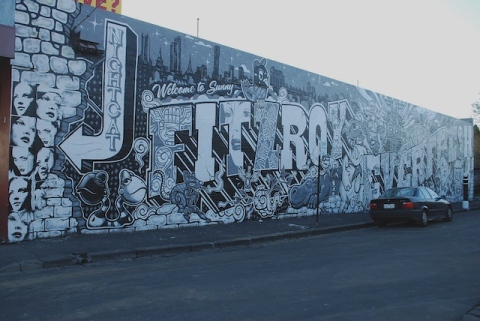
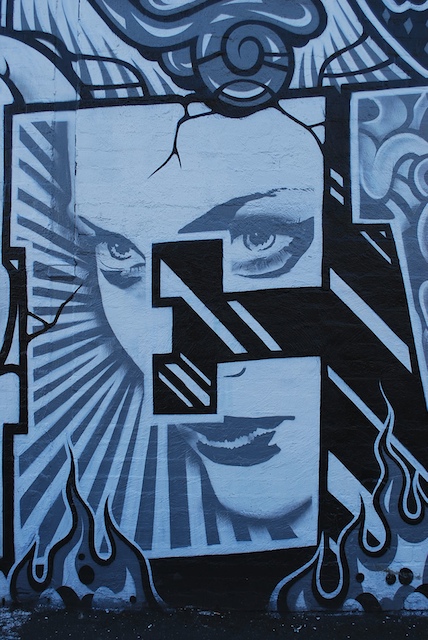
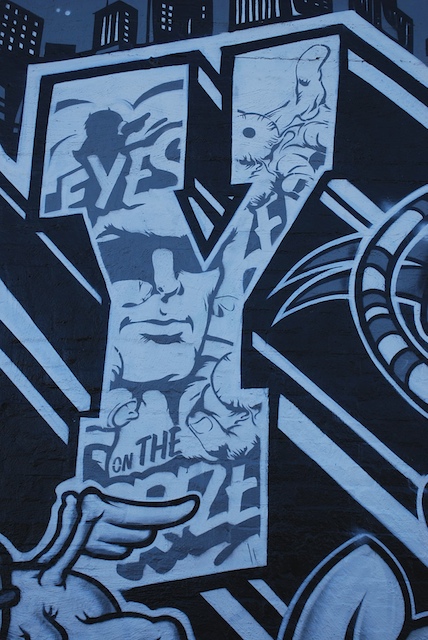
The car parked next to it gives you a sense of the wall’s scale and size. The artwork that completely covers it is an intricately designed homage to Melbourne in general and Fitzroy in particular. The fact that it is painted in black-and-white (and shades of grey) gives it a startling prominence amid the naturalistic colours of the street around it. It looks like a frame from an old film, somehow transported into the everyday ‘real’ world, located as it is opposite a petrol station and a row of terraced houses. It also manages to showcase the distinctive styles of the artists who worked on it (for example, by incorporating some of their signature images within the letters that comprise the words) within the overall sense of a single coherent visual style. It’s such a huge work that it’s hard to photographically do justice to all the complexities within it, but here are some examples.
A section by Rone:
And one by Meggs:
And here are a few more, just for good measure, because the work is so great:
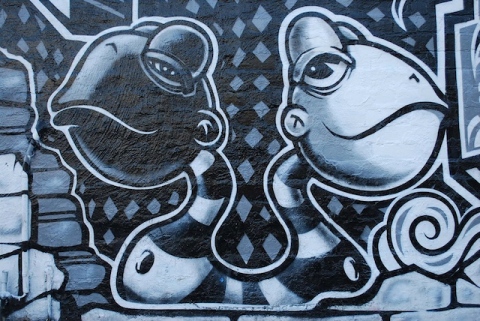
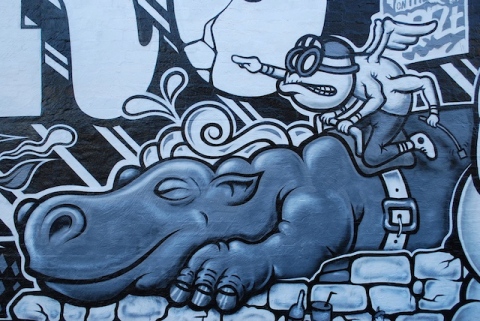
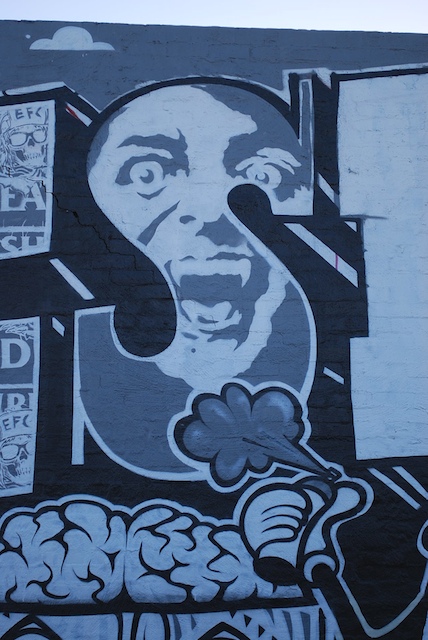
In this last image, you can really see the brickwork under the paint, a reminder that underneath there is a rather drab wall, now transformed into something which embodies the very idea and spirit of Fitzroy. Which is what Everfresh is all about, really.
You have been invaded….
Filed under: art, Art, Street Art | Tags: anti-graffiti, Invader, Lazarides, mosaic, Space Invader, Street art
Comments (1) To coincide with the about-to-open show at Lazarides’ Rathbone Place gallery in London, I thought it was a good time to post this little homage to the wonderful Invader.
For those of you who don’t know Invader’s work, Invader is a French artist who makes and remakes small mosaics of the ‘Space Invader’, star of countless video games in the 1970s.
I always think of Invader’s works as occupying space in the street very quietly: due to their smallness, they tend to be unassuming and easy to miss, often placed high up on a street corner, or in some hard-to-reach location. (I’ve written recently about the appeal of the small – have a look here).
Once you do notice them, they have great appeal: as mosaics, they have an artisanal quality that provides a nice contrast with the low-culture evoked by the video game referent.
On his website, Invader repeats the trope of ‘invasion’ in another way, so that cities become sites to be invaded by the artist and his mosaic tiles. It’s obviously a militaristic metaphor, and one which is often used by the opponents of graffiti, who see illicit imagery as something which ‘invades’ a previously ‘clean’ wall. It’s one of the great things about Invader’s artwork that it can pinpoint the hysteria that underlies anti-graffiti rhetoric, for here, indeed, are the fearful ‘invaders’, and it has to be asked, who could fail to love these little mosaics?
In addition to his dedicated work in invading (to date) 40 cities around the world, in recent years, Invader has also had a number of gallery shows. I’m unsure how successful his work is in the gallery setting, but it certainly draws a lot of strength from fine art movements such as Pop Art. For me, Invader is at his best in the street, and so, while I recommend that anyone who is in London over the next month takes a look at his gallery show, I wanted to pay tribute to the enduring charm of the Space Invaders that can be found all around us – in the streets. I believe that Invader has been busy adding some new works to the streets of London in the last little while, so keep your eyes open for those. But for now, here are some of my favourites.
In Amsterdam:
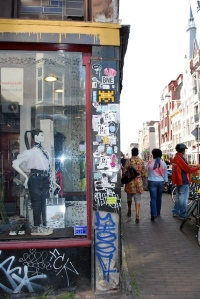
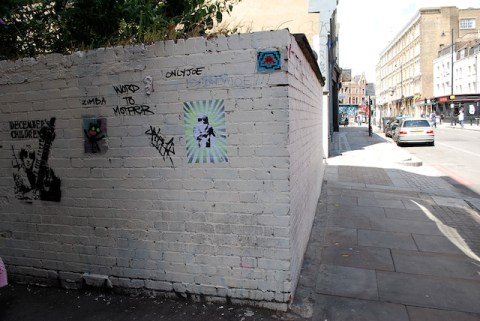
In Shoreditch, London:
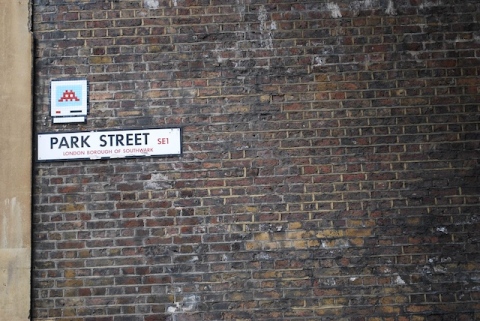
Not far from the Tate Modern, in London:
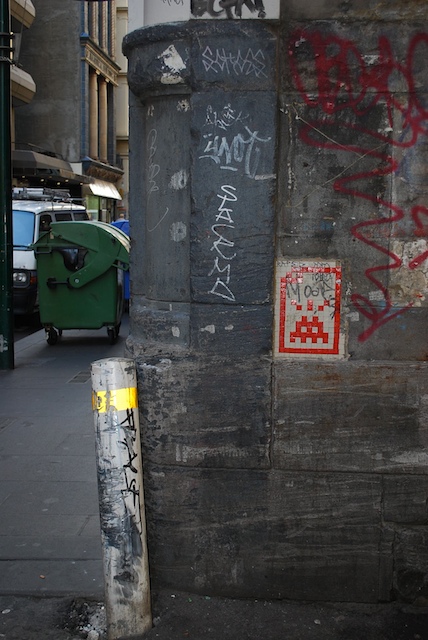
In Rothsay Place, in Melbourne’s CBD:
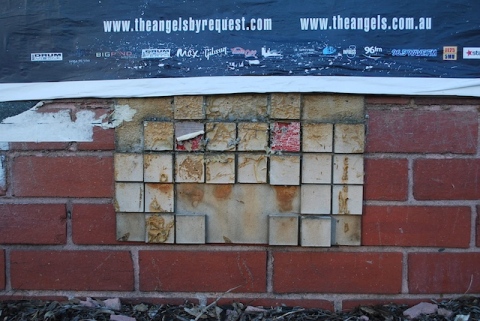
Just off Alexandra Parade, in Melbourne, a very faded example:
In SoHo, New York City:
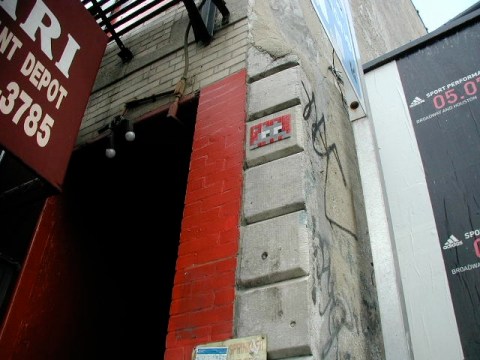
Enjoy the show, if you get to see it at Lazarides. But, even better, enjoy the streets if you are lucky enough to have been invaded!
Talking about street art….
Filed under: art, Art, Street Art | Tags: JR, Melbourne, public space, Street art
Leave a comment I’m giving a lunchtime talk in my department next week, called ‘Street Art and the Contestation of Public Space’.
Here’s what it will be about:
“Cities are sites of intense cultural and aesthetic production, engaged in the continual development and refinement of their self-image. This occurs by means of a range of aesthetic practices, such as architectural innovation, statuary, control of signage and advertising, and public art, underpinned by a network of planning regulations, local and municipal laws, and public order law.
For its citizens, a city’s processes of cultural production are sometimes unremarkable or even imperceptible; at other times, however, these processes become contested, subject to planning disputes, legal intervention, and shifts in public opinion. This talk focuses upon the contestation arises in connection with street art and graffiti writing.
The talk will focus upon two examples.
The first is the approach to street art taken by the City of Melbourne. Since 2003, local councils within Victoria have been required by the Department of Justice to develop plans for the regulation of graffiti within their municipalities. The City of Melbourne initially developed a strategic approach to graffiti based on the concept of zones of ‘tolerance’ for graffiti and street art, but then elected instead to pursue a policy of zero tolerance combined with a discretionary permit system.
The second example focuses upon the French street artist JR, who uses street art as a means of engagement with the politics of ethnicity, race and religion and as a platform to draw attention to the impact of war or emergency in ‘post-conflict’ cities and countries.”
If you are in Melbourne and are interested in coming along, here’s a link to the departmental homepage, where you can find details of the talk listed under ‘Events and Seminars’. Clicking on that link will open a downloadable pdf of a poster for the talk, which gives information about the venue and the time.
I’ve done a few talks on street art and graffiti over the last few years in Melbourne – Street Alliance, at Federation Square, or the Cultural Development Network’s forum on Permissible Art at the Famous When Dead Gallery. This one will be a more ‘academic’ one, given the setting, of course. Anyway, if you are interested, you are welcome to come along.
On being small
Filed under: art, Art, Street Art | Tags: art in a jar, Civil, small, stencil, Street art
Comments (1) Reading back through some of the previous posts on this blog, I realised there is a bit of a repeated theme, in that I’ve commented favourably on the large scale of many works (for example, the works in the Leake Street Tunnel in the Cans Festivals, JR’s paste-ups in London, or Bill Viola’s images, or the works on the façade of the Tate Modern).
Since I don’t want to give the impression that an artwork has to be huge in order to impress, I thought I would devote this post to images which demonstrate that an affective charge can arise from placement and composition as much as from scale.
One of these is something that I have been thinking of as ‘art in a jar’. Have a look:
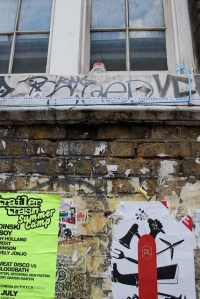
Perched on a window sill, high above ground level in Brick Lane in London, sits a little jar, with a lid on it. Inside the jar, there is a piece of paper, folded up, and on the piece of paper you can just about glimpse a drawing of a figure. I love the idea that someone not only did these little drawings but also placed them inside their own small containers and then placed the jar on a window sill, which functions as a kind of display shelf for the artwork. It’s the tiny size of the jar and its half-hidden drawing that gives the work its character, which would be lost if the jar were bigger.
I also like this stencil very much:
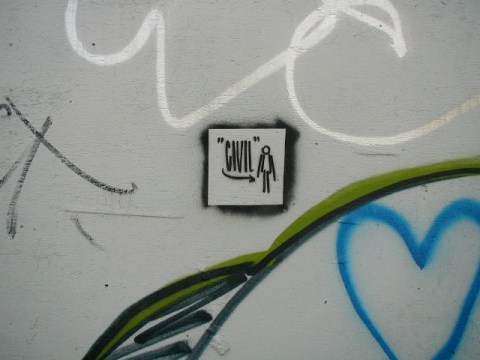
Taken in Richmond, Melbourne, back in 2003, it is signed by Civil and shows one of the little stick figures that have since become a signature motif, featuring in large numbers in much larger works. I like those larger images a great deal, but there’s something quite perfect about the simplicity of this: the figure, the name, and the frame.
And finally, here’s something I saw just last week. Actually, my daughter spotted it, as we were walking home from school. She suddenly stopped and pointed upwards, saying, ‘Look, mama, graffiti!’(She doesn’t make any distinction between street art and graffiti: controversial, I know, but since she is only seven, I figure she still has plenty of time to learn about the arguments as to whether graffiti is different from street art and vice versa.)
Here’s what she had spotted (and what I had missed):

And a closer view of it:

It’s a simple enough piece of work, nothing tremendously spectacular about it. But what I liked is the fact that it is placed so high on the wall (it’s a good fifteen feet up), and is thus easy to miss (as I did). It’s a great example of an artwork being there for the noticing (or not). Once noticed, its very presence brings pleasure: I now feel as though I’m party to a secret history for that little part of the street, since the presence of the artwork reveals that someone came here, probably with a ladder, and attached this image to the wall, placing it in such a way that it could be overlooked, just as it looks down at us from on high. Now I’ve seen it, it draws my gaze upwards, reminds me to be alert in the streets of the city, attentive to whatever small gifts might have been placed in public space for us to enjoy.
Guest post on Vandalog
I’ve been crazy busy teaching an intensive course the last few days, so not much time for posting here.
But I did manage to write a guest post for Vandalog, which is a fantastic blog about street art. RJ, Vandalog’s author, is currently away on holiday and he has asked a range of people to contribute guest posts while he is away.
You can read my contribution here.
And if you’re visiting Vandalog for the first time, it’s definitely worth browsing through it.
Thanks for the invite, RJ! Enjoy your holiday!
And more posts on Images to Live By coming soon, because my intensive teaching finishes in a few days time.
Art and the senses
Filed under: art, Art, Street Art, graffiti, law | Tags: AMF crew, art, artwork, Jose Parla, Nick Walker, sublime, the senses
Comments (5) I’ve been thinking for some time about the ways in which we experience an artwork, whether it’s located in the street or in a gallery. The most conventional way in which to think about this would emphasize vision – after all, we are used to the idea that an artwork is something that we look at.
But this leaves out other sensory dimensions, ones which are not so commonly talked about in relation to art. Is it possible to hear an artwork? Can we taste it?
In some works, image and sound are certainly inextricably combined, so that it’s not really possible to think in terms of simply looking at it or listening to it: Bill Viola’s work is a great example. Some artists entirely ignore the visual in favour of the auditory: in 2008, for example, an artwork called Speed of Sound Nau Interactive Bells was installed in Union Lane in Melbourne (this laneway was mentioned in a previous post, Street art and ‘authority’): the sound of bells, chiming at irregular intervals, played from speakers installed at different heights along the laneway walls, so that the sounds increased and receded according to one’s progress along the laneway.
And I’m also pleased to be able to report that I have had the experience of eating art. Felix Gonzalez-Torres, a Cuban-American artist, created installation pieces in which lollies (or candies, or sweets, depending on which continent you live on) were strewn across a gallery floor or piled in its corners. Spectators were able to dip their hands into the artwork and pull out a handful of sweets to take home or to eat. You can get a sense of what Gonzalez-Torres’s wonderful work looks like if you click here – the tiny golden objects piled against the walls constitute one of his works, Untitled (Placebo – Landscape for Roni). I can still vividly recall how transgressive it felt, to pick up a piece of an artwork and put it in my mouth and taste it (it was lemon-flavoured, in case anyone is interested).
The spectator’s relationship to that particular artwork involved touch as well as taste: touching art is definitely something that is actively prohibited by most museums and galleries as illicit behaviour in relation to art: think of all those signs on the wall, saying ‘Do Not Touch’.
One of the most memorable instances in which I was able to touch an artwork certainly had a sense of the illicit about it. I was visiting a gallery overseas to chat with its director, and was informed by him that he had just received a shipment of works by one artist who would be featured in their next show. The director was hugely enthusiastic about this artist and invited me not just to look at the works but in fact to touch one. As I ran my fingertips over a tiny section of the work’s surface, I felt acutely aware of how forbidden such an act usually is.
In addition to the simple transgressive pleasure that came from touching a painting, I also felt a strong sense of how much my relation to the image was altered by the act of touching it: instead of standing facing it, as it would hang on a wall with me looking directly at it, it was brought towards me and held close to me, lying at an angle, slightly tilted from the horizontal, the light slanting off its surface, my gaze directed downwards, and my hand drawn towards it. Much later, I realized that part of the extraordinary charge that arose for me in this moment derived from the experience of relating, momentarily, to the artwork as if I was in the position of the artist. I don’t mean that I experienced a sense of acquiring any of the artist’s skills or abilities, but rather simply some of the privileges that come with the position of the work’s creator: the ability to touch it, the ability to stand close to it (rather than behind a white line in a museum), the ability to look at it from different angles.
(Of course, anyone who buys an artwork acquires the rights and power to do all these things too, but it’s interesting that it is the artist that was evoked by my altered position in relation to this work, not someone with sufficient financial resources to purchase it.)
What about smell? Does art have an aroma, an odour? Artists themselves are usually well acquainted with the olfactory dimensions of their work (from spray paint, oils, acetone, lacquer, glue, and many other substances) but it’s something that isn’t often discussed when we think about spectatorship. And yet those smells can have a powerful affective impact on the viewing of an artwork. When I went to see an exhibition by the wonderful Jose Parla at Elms Lesters Painting Rooms in London last October, many of the works on display were recently painted: as a result, the gallery rooms were filled with a perfume of oil and varnish, which made me, as a spectator, feel extremely conscious of the works as things which had been brought into being through the artist’s exertions with canvas, and paper, and paint.
It was on the same visit to London that I had the good fortune to meet the charming Nick Walker (you can see more about Nick here). As we finished our conversation about his work, in a small room at Black Rat Press, Nick indicated a neat pile of prints sitting on a trestle table, awaiting his signature before sale. He removed the protective cardboard from the pile, so that I could see the image below. But when the cardboard was lifted, an amazing smell drifted from the pile of prints: it was an intense, concentrated smell of paper, and it was strangely beautiful. I’ll never forget standing next to that table, under a low-hanging spotlight, gazing at these prints and inhaling their smell – a potent reminder that artworks are utterly material, not ethereal images floating free of the world of things.
Much of what I’ve been describing relates to the phenomenon of gallery or museum display, in which the smell or feel of an artwork is rarely encountered. When an artwork exists in urban space, the commonplace prohibitions of gallery spectatorship usually don’t apply – if you can reach it, you are perfectly free to run your hands over a paste-up, or, if you wanted to, there’s even nothing to stop you having a good sniff of a stencil.
That freedom is definitely an important part of how we look at street art and the sense of democratic spectatorship that often attaches to it. But this freedom of access comes with a downside, of course, as the artists belonging to the AMF crew from Sydney discovered, when they were arrested painting trains in London last year. The six guys have been given prison sentences ranging from 8 to 16 months (click here for more details about the case). How did they get caught? Police officers said they were alerted to the artists’ presence by hearing the rattle of spray cans and smelling aerosol paint. When it comes to art, our senses may lead us to an encounter with the sublime, but they can also be the means through which the force of law comes to be exercised.
Street Art and the Museum Revisited: Banksy on the Inside*
Filed under: art, Art, Street Art | Tags: Banksy, Bristol, gallery, museum, outlaw, Street art
Comments (3) In November last year, I wrote about the exhibition, Street Art, at the Tate Modern in London. Artworks by street artists have been exhibited in commercial galleries on and off for many years, but this was the first time that a museum had showcased work by urban artists such as Blu, Nunca and Faile. After visiting the exhibition, I wrote about how I felt disappointed that the Tate had confined its exhibition of the works to the outer façade of the building. Although this provided the selected artists with a massive ‘canvas’ to work on, it also meant that when the exhibition ended, the works were buffed by the museum just as a council would buff these works if they appeared on walls around a city.
Less than a year after the exhibition on the walls of the Tate Modern, street art has been brought into a museum space, and to an extent that I think it’s fair to say could not have been predicted. Bristol City Museum and Art Gallery has just opened its summer exhibition, Banksy versus Bristol Museum.
The title of the show acknowledges the tension that exists when street art is displayed indoors, or when works that some might say are best viewed in passing, on a street wall, are instead placed inside the rarefied space of a gallery. The exhibition’s context is implied as a contest, a struggle between Banksy, artist of and for the people, and all that is represented by a council-funded, conventional museum (and remember that Banksy once painted ‘Mind the crap’ on the steps of Tate Britain, in a nose-thumbing gesture at the hierarchies of art institutions).
To a certain extent that is all true: much ink has been spilt and many blog entries posted about whether street art ‘belongs’ indoors, and whether Banksy has ‘sold out’, and whether museums are being forced to ‘dumb down’ (for example, in the critical reactions to the New York Guggenheim’s Art of the Motorcycle exhibit’, or to the increasing tendency for bankable ‘blockbuster’ exhibitions on ‘safe’ topics such as ‘Impressionism’ to tour from museum to museum). No doubt some will make similar criticisms here of Banksy, the show, and the museum. (And there’s some worthwhile critical comment on the Indoor Street Art blog.)
But what’s left out of these criticisms is any acknowledgement of the value in staging an exhibition such as this – in bringing Banksy’s work not just ‘home’ to Bristol, but inside one of Bristol’s museums.
Banksy’s work has been in museums before, but in a very different way: in March 2005 he visited the Metropolitan Musuem, the Museum of Modern Art, the Brooklyn Museum and the Museum of Natural History in New York City and hung works on the walls, which were viewed by the museum’s visitors until noticed by security guards. In October 2003 he hung his own artwork in the Tate Britain and placed a fake piece of prehistoric rock art (showing a cave man pushing a supermarket shopping trolley) in the British Museum in May 2005.
It’s a long way from those outlaw actions to the current exhibition, and here’s where the show’s title, Banksy versus the Museum, is both accurate and misleading. Rather than being displayed in selected series of rooms, as would be the norm, these artworks have taken over the entire space of the Edwardian building. The show features not just sculptures and paintings, but also a series of large installations, including a recreation of the pet store set up in New York City last October.You can get a sense of what the show is like from the videos on the UK Street Art website, or have a look at this:
And so it really is as if Banksy has taken on and taken over the space of the museum – if there was a contest, then he is the victor. But of course what we are actually seeing is the product of a fantastic collaboration rather than a contest: a closely guarded secret, in which the museum closed down in order to allow the artist to set up his work throughout the galleries.
And so, in coming not just home but also inside the portals of the museum, does this mean Banksy has sold out in some way? I think not: the exhibition has actually been brought about in a manner that maintains many of the values of street art: while these are obviously not illicit artworks in any way, they have appeared before the public just as a work on a wall might do, the result of clandestine preparations and the efforts of an anonymous (well, sort of anonymous) individual. Just as the Cans Festival came as a fabulous surprise last year, the Bristol City Museum show provides a summer treat for those in the northern hemisphere. Not to be missed. Bristol? Wish I was there.
* Thanks to Peter, for suggesting the sub-title for this post.
 Images to Live By