Archive for the ‘Street art’ Tag
Street/Studio: the Launch!
Filed under: art, Art, Street Art | Tags: artists, Melbourne, Street art, Street/Studio
 Leave a comment
 Last Friday was the launch at Federation Square of Street/Studio: the Place of Street Art in Melbourne (Thames & Hudson), the book that Miso, Ghostpatrol, TImba and myself have been working away on since last August.
The launch was amazing! We were completely overwhelmed at the numbers who turned up to buy a book, get it signed, have a beer or a glass of wine, and celebrate the publication with us.
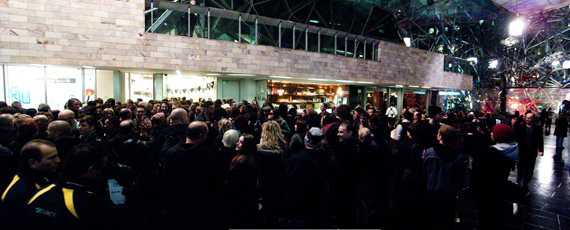

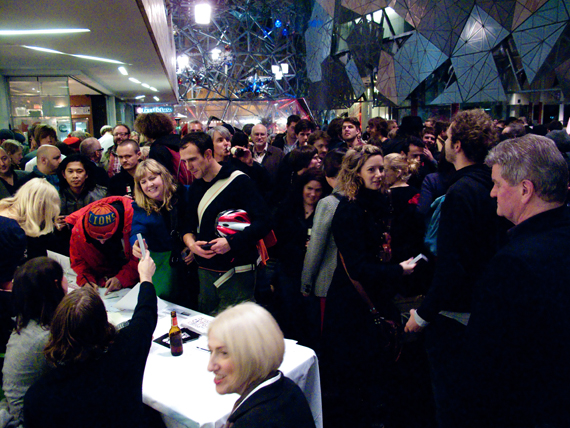
No Vacancy Gallery put on a really nice exhibition based around the book, which ran until Sunday:

Some of the artists featured in the book are overseas right now and couldn’t be there, but Niels Oeltjen, Twoone, and members of Everfresh came along to sign copies of the books.

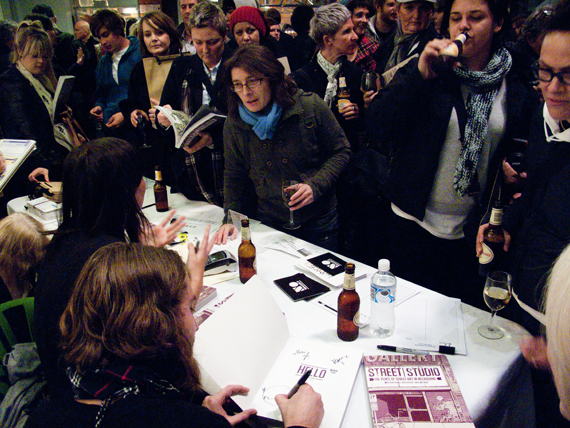
Thanks to Thames & Hudson for organising such a great night, and thanks to everyone who came along; apologies to those who weren’t able to get in because of the crowd.
And a huge thanks to Alex from NIce Produce for the amazing photos.
More Street/Studio events to come in the next couple of weeks….
Street/Studio: the Place of Street Art in Melbourne
Filed under: Art, Street Art | Tags: book, Ghostpatrol, Melbourne, Miso, Street art, Street/Studio, Timba
Leave a comment I’m really proud to announce my involvement in a book which is about to be published by Thames & Hudson Australia.
It’s called Street/Studio: the Place of Street Art in Melbourne.
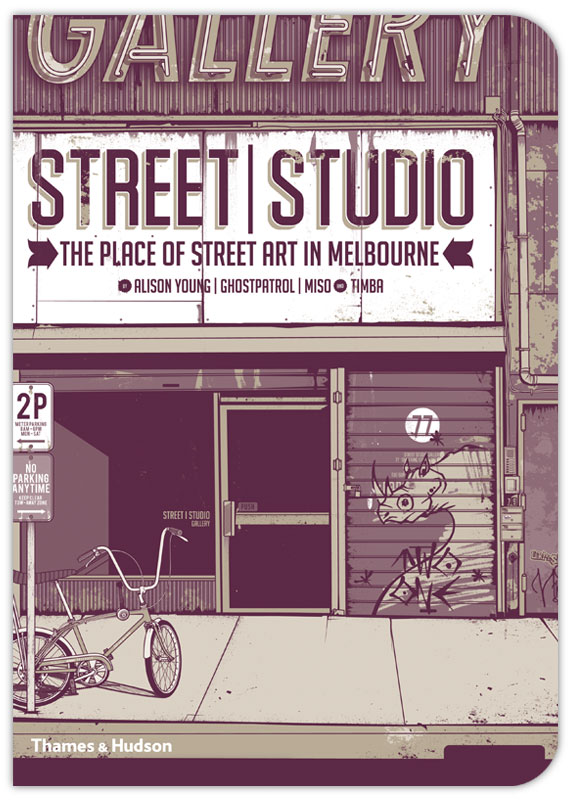
Here’s what it’s about:
“Through a series of intimate conversations, Street/Studio offers an exclusive behind-the-scenes look at how street art has entered the mainstream and become one of the most collectable new art forms. It offers an unparalleled insight into the work of ten of Australia’s most influential, dynamic and creative artists living in Melbourne.
Read about the adventures and challenges of the street as well as the demands of the studio and gallery as told by the artists themselves. Stylishly designed with extensive archival photographs, Street/Studio is an exceptional book written by artists about artists.”
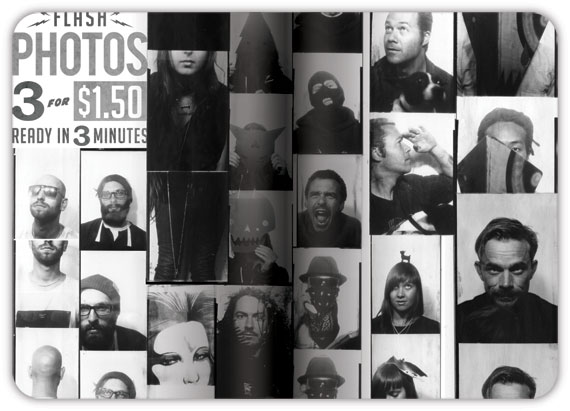
Ghostpatrol, Miso, Timba and I have been working on this since last August, and it has been an amazing experience to put the material together. The book features ten different artists (or group of artists, in the case of Everfresh): Ash Keating, Al Stark, Tai Snaith, Miso, Ghostpatrol, Everfresh, Mic Porter, Twoone, Tom Sevil and Niels Oeltjen, and their work is explored through conversations about their work and some really amazing photographs… There’s also a long essay describing the evolution and distinctiveness of the street art scene in Melbourne.
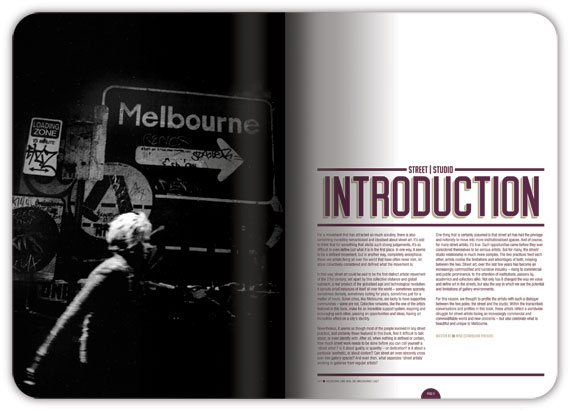
There are a few events coming up to mark the book’s publication:
Friday, 4 June 7:00 pm
Official launch of Street/Studio at No Vacancy Gallery, Atrium, Federation Square
Sunday, 6 June 2:00 pm
ACMI Screening of Exit through the Gift Shop followed by panel discussion including Miso and myself
Book signing at 5pm with the authors
Saturday, 12 June 1:00 pm
Outre Gallery, CBD
Book signing with Miso, Ghostpatrol and me
Tuesday, 15 June 6:30 pm
Readings, Lygon St, Carlton
Signing and discussion with Miso, Ghostpatrol, myself, Niels and Meggs
Details about these events, the artists, and the authors can be found on the Street/Studio website.
The book should be available in all good bookstores, as they say, in Australia, or, soon, from Thames & Hudson’s own website. You can also order direct from Ghostpatrol.
The textures of London
Filed under: Art, Street Art | Tags: Asbestos, London, Roa, sculpture, Shoreditch, Street art, texture
Comments (5) I spent a week in London recently. It’s always interesting to go back to a city after an absence of 18 months and see what’s changed. Usually it’s a matter of noticing which artworks have gone and which new ones are taking their place, but on this occasion I was struck by how much the area of Shoreditch itself had changed. Yes, there was still a lot of interesting art to see scattered through the streets, but whereas in July 2008 there were artworks around every corner, in May 2010 it would seem that the gentrification of Shoreditch has proceeded to the extent where entire streets have been so buffed that there is sometimes not even a sticker to be seen.
Fortunately there’s still a lot of work in areas such as Brick Lane, Hackney, and Bethnal Green, but you have to wonder what’s going to happen over the next 18 month as the Olympics approach. I’m guessing that there will be a huge buffing effort, and this, along with the increased surveillance (in the city that already has more cameras than any other I can think of) will inevitably have a chilling effect on the street art scene in East London. Hopefully it will simply move somewhere else in the city; it would be sad to see London lose the sense of productive possibility for street art that seems so characteristic of it.*
I don’t want to give the impression that things had already become bland – far from it. One of the striking things about this visit was seeing how lots of artists are producing works in which texture is a significant part of the visual experience: objects attached to walls, clever use of shapes and calls, a range of media, and extension of technique with paint. I know this is hardly big news, and I’m not meaning to pretend there has been any sudden shift in contemporary street art so that it’s suddenly all about texture or anything. Maybe it’s simply something that I was alert to, during this visit. Certainly some of the artworks I photographed are not necessarily ‘new’; some, in fact, have been up for a long time. But the overall effect for me was to bring out, in a very active way, the feeling of the city as existing in its textures and sensations – the material ‘things’ which make up everyday, urban life.
I’ve included a selection – see what you think.
Something simple to start with – simple, but I liked these cardboard hearts very much:

And someone is making mushroom sculptures, and placing them in high up, inaccessible spots, where they look down upon the passers-by:

More sculpture: I saw many of these amazing objects, each one different, attached high on walls, often near street corners. Great colours and shapes. Here’s a couple:
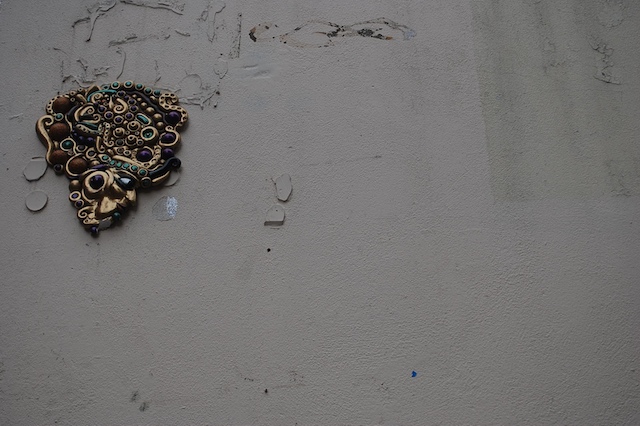
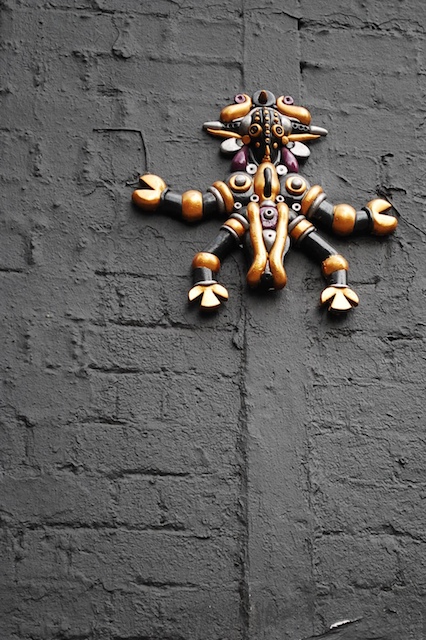
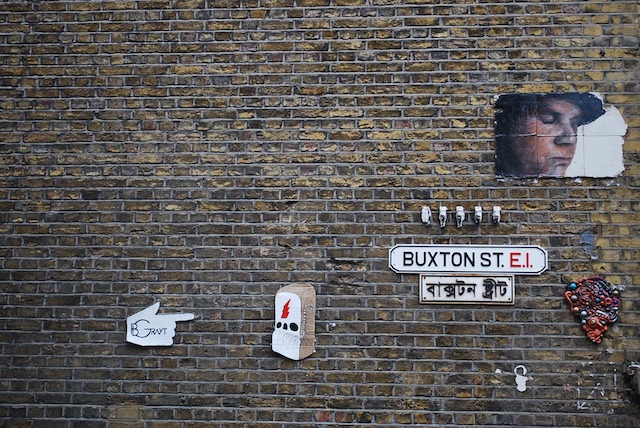
And here is one of my favourite street corners in London, and at the moment it contains a great selection of work, all placed high up, so that even the enthusiastic council cleaning crews can’t be bothered to remove them. This piece by Asbestos has been there for a couple of years now, and you can see another of the sculptures I just mentioned. There is also a little row of figures, now broken down to their torsos. You can find these on various London walls – I would love to know whose work this is.
I’m told this chair has been attached to the wall in Brick Lane for a long, long time, but now it has a satisfyingly chunky duck beside it for company:

On Rivington Street, opposite the entrance to Cargo and Black Rat Projects, there is a wall that has previously featured many paste-ups, stickers and so on. It’s pretty buffed at present, but it does have these two excellent additions.

One is a blue plaque, which reads: ‘This plaque was installed 6th May 2010’. The plaque mimics the historical marker plaques that provide information like ‘In 1856, so-and-so lived here for 2 months’, but it does so with a twist: the plaque commemorates the fact of its installation, rather than any particular event. Although it’s possible to read the plaque as having something to do with the election, the artwork is not about that as such (and it’s pleasing that the 6th of May was the day of the British general election which has subsequently acquired historical significance as the first election in Britain to result in a coalition government, but this certainly wasn’t known when the plaque was installed).
Next to the plaque, you can see a picture frame. Take a closer look:
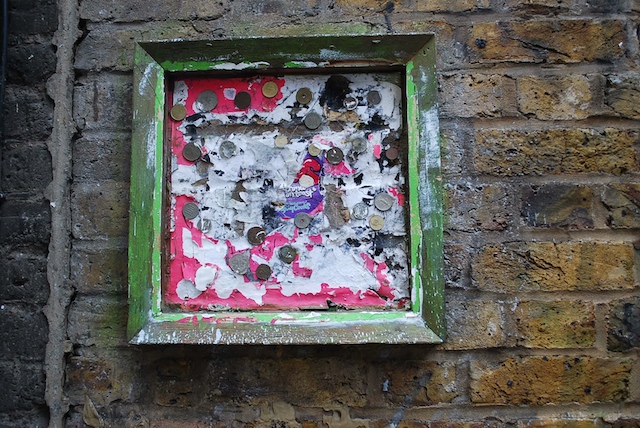
Apparent detritus becomes art, in a work which is all about showcasing the feel and texture of things that would normally be overlooked and thrown away.
Finally, one of my main memories of visiting London this time is seeing Roa’s work in the streets. Roa is a Belgian artist whose show at Pure Evil gallery (and subsequently at Factory Fresh in Brooklyn) was a huge success, but in addition to those gallery shows he has also spent a lot of time putting work on the streets. He paints animals, usually oversized, and what’s so striking about these images is how Roa harnesses colour and spraycan technique to give an amazing sense of the texture of feathers or fur. Here’s my favourite of the ones that I saw:
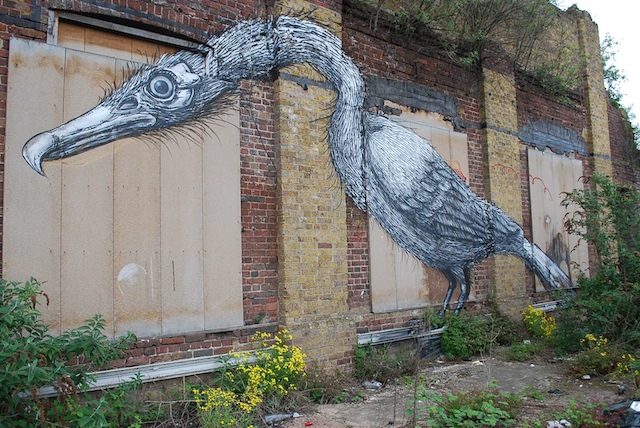
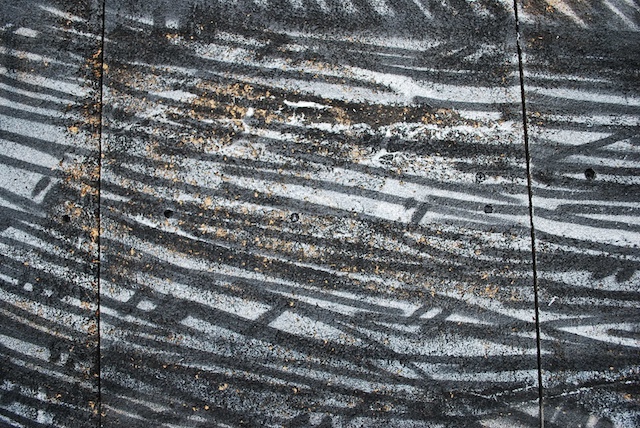
And take a close look at the precision and delicacy of these ‘brushstrokes’: wonderful work.
*Thanks to Mark, from Hooked blog, for walking around Brick Lane with me….
O Superman
Filed under: art, Art, Street Art | Tags: Anthony Lister, Banksy, Charlie Isoe, Meggs, Melbourne, New York, Street art, Superheroes
Leave a comment Sometimes travel provides an occasion to reflect upon the place you’ve left behind… While I was in New York recently, there were two different kinds of ‘home’ that I felt conscious of having left.
One was England (or Britain, I suppose). I left Britain in 1995, when I moved to Melbourne, but New York this April was full of buzz about the release of Exit Through the Gift Shop, Banksy’s movie, which I have written about here and here already, and I certainly think of Banksy as a quintessentially English (or British) artist…
New York was also full of visual reminders of Melbourne, the city that became my adopted home. As I mentioned before, one of them was Meggs’s stickers, which I saw in many places around New York.
I’ve written about Meggs before (see here), and in that entry I was discussing his work in conjunction with that of Anthony Lister, an Australian artist from Brisbane, living in New York these last several years. There are several different consonances between these two in terms of their artistic preoccupations, but in terms of simple coincidence it was amusing that while I was in New York, Anthony Lister was paying a visit to Melbourne, where he had a show at Metro Gallery.
But it’s not as though Lister was entirely gone from New York. His stickers are still very much present on the streets:

And the front of Faile’s studio was adorned with this wonderful Lister painting:

Lister also had a solo show, How to Catch a Time-Traveller, at Lyons Wier Gallery in April, running simultaneously with the Melbourne show.
Meggs and Lister are linked by more than a common nationality; there’s a strong thematic link in their fascination with the superheroes of popular culture, and comics in particular. Both create painted works as well as their own versions of action figures, miniatures and busts. Both Meggs and Lister show superheroes as figures of crisis, barely holding themselves together in the face of unknown assailants or obligations.
But in representing these highly familiar figures away from the context of comics, their methods with paint are very different, however. Meggs uses a combination of stencils and techniques from graffiti art; Lister is evolving a style that recalls Francis Bacon’s way of blurring the painted figure to create a sense both of movement and of the disintegration of the self.
In Lister’s show at Lyons Wier, its title alludes to the idea that these figures are in motion – the artist is the one with the power to stop time, to freeze the disintegrating superhero for an instant, for our scrutiny. Lister’s had a prolific career on the street for a long time, and it’s fantastic to see his painterly skills evolving. Maybe Lister’s thematic will start to broaden a little so that it is no longer simply the superhero which is subject to examination. Charlie Isoe’s current show at Lazarides in London, while containing a lot of works that seemed to me to be somewhat similar, disappointingly, to Lister’s style, showed at least what can be achieved when a wider range of objects are brought into the paintings.
What next, Mr Lister? Can’t wait to see.
Art, Value and Banksy’s Rats in Melbourne – visit Hyperallergic
Filed under: Art, Street Art | Tags: Banksy, buff, City of Melbourne, Melbourne, rat, Street art
Comments (2) If you have been following the recent street art debacle in which Melbourne City Council ‘accidentally’ buffed one of Banksy’s rats in Hosier Lane in Melbourne, you might be interested in reading my account of this event, over on the excellent site Hyperallergic.
Lapse of Time, Shift in Space: Street Art in Brooklyn
Filed under: art, Art, Street Art | Tags: Ad Hoc Art, Brooklyn, Brooklyn Street Art, C215, Elbow-Toe, Factory Fresh, Gaia, moss, New York, Ohm, os gemeos, Street art
Comments (6) In the last several years, there has been a shift in the location of much of New York’s street art. This is not to say that there is no street art in Manhattan: one of the reasons for writing the previous entry was to emphasise that people are still putting up work in Manhattan and that areas such as the Lower East Side, the East Village, NoLita and SoHo are still easily able to be distinguished from areas such as the upper West Side of Midtown by virtue of the ways in which people interact positively and creatively with the spaces around them.
But a shift has definitely taken place, and it’s a geographical one, driven by economics. Gentrification of the areas which had been prime sites for street art has meant that many artists have been compelled to seek studios and/or accommodation in other places. Those other places seem, in the most part, to be in Brooklyn (as can regularly be seen through posts on the sites Brooklyn Street Art, Wooster Collective, Hyperallergic and Arrested Motion).
I don’t mean to imply, by the way, that gentrification is necessarily the Big Bad. It’s a process, it’s economically driven (which usually means profit for some development corporation) and it can mean that many people get displaced, having to move from an area that has been their home for many years into other parts of town, often ‘further out’: at a greater distance from cultural, educational or other amenities (unless the areas they move to have already been fortunate enough to be enriched with those amenities). But gentrification also can have its benefits: for the traders and shop owners whose businesses may well start to make more money instead of struggling to survive, for the people who get jobs in the service industries that are required by a gentrified area, and for those who live in or pass through an area which had previously been troubled or rundown.
So it’s a complicated issue, one I can’t possibly do justice to here. And it’s an ongoing one: people I spoke to in Brooklyn spoke of how they were being obliged, by virtue of rising rents to move; at the same time, the economic downturn has meant that many development projects have been halted, with construction sites now standing idle (and providing useful canvasses for artists on their walls and hoardings).
Thanks to gentrification, I was also able to discover more of Brooklyn than I’d previously visited. I have been visiting Park Slope for many years because friends live there, but Park Slope is not where the street art is. So on this trip, I was given the opportunity to go to Greenpoint, Kensington, Fort Greene, Bedford-Stuyvesant, Bushwick and Williamsburg.
Williamsburg, as is well known to many readers, has been a hub for street artists for some years now. For anyone visiting New York, it would certainly be where I would suggest starting out: you can spend hours walking around its streets, and there’s a rapid turnover of work, which keeps things extremely fresh, at the same time as you can enjoy deciphering faded and tattered wheatpastes that are on their way to disappearing (the remnants of work by Faile, Swoon, Imminent Disaster and more can be seen in fragments on the walls).
But beyond Williamsburg there’s still much to see. there are some excellent galleries such as Mighty Tanaka in DUMBO, the Willoughby Windows in downtown Brooklyn, curated by Ad Hoc Art, Brooklynite gallery in Bedford-Stuy, Pandemic gallery, and the awesome Factory Fresh, run by Ali Ha and Ad DeVille, proprietors of the old Orchard Street Gallery in the Lower East Side.
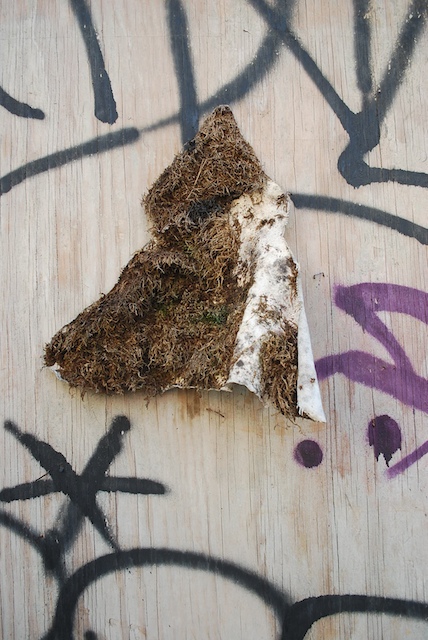
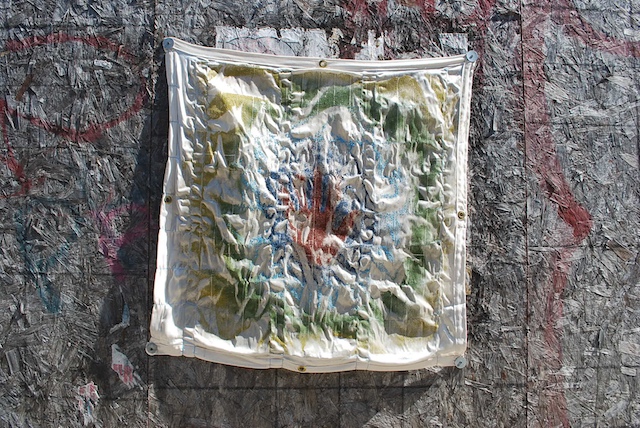
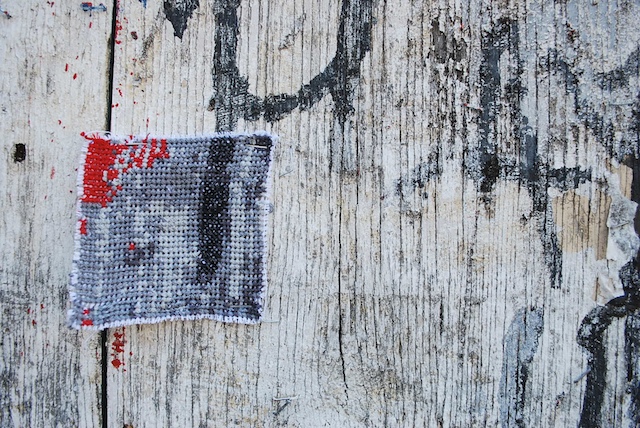
And here’s a selection of what was on the walls and hoardings around town. I was particularly interested to see the use of objects, fabrics and other media, including (of course) moss:
There’s some great drawing going on: Ohm, as can be seen on the left of this picture, has a nice hand:
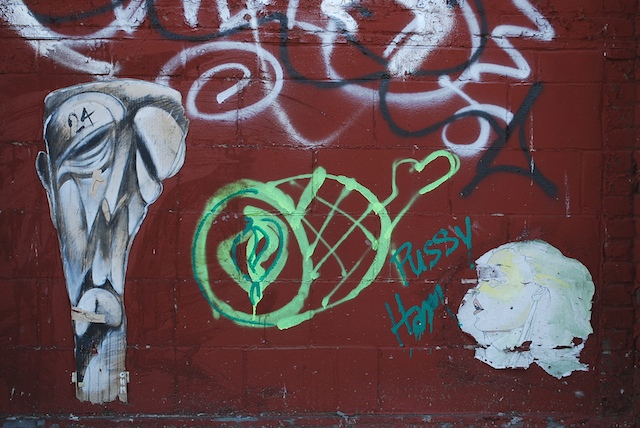
This is a section of a permitted work, but it showcases the beautiful art of Gaia:

And QRST’s figures (all different) are excellent. This one is in Bushwick, opposite Factory Fresh:

Here’s an Ellis G shadow figure, just off Bedford Avenue in Williamsburg:

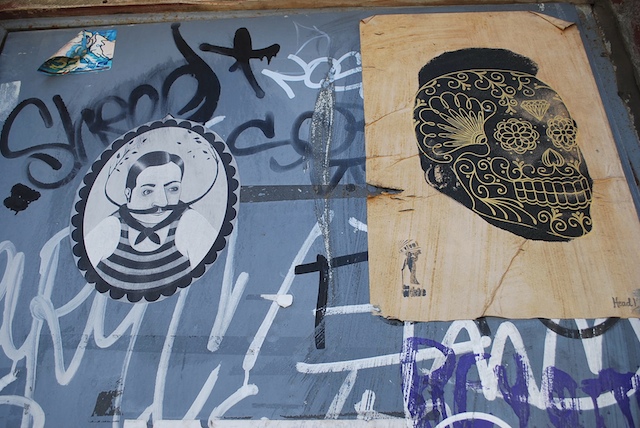
Lots of visiting artists have been here: there are works by C215, os gemeos, and in the third and fourth pictures you can see the work of artists that I’m told are a French duo (she does the oval portraits which are placed high on a doorway; her male collaborator makes the small wheatpastes of female figures which are placed on the lower sections of doorways. If anyone knows anything about these artists, I would love to hear from you – I really enjoyed seeing these works).



I’m typing this while waiting to go to the airport, to fly back to Melbourne. Fortunately, my flight is heading in the opposite direction to the volcanic ash cloud which is causing chaos for people in Europe. And while I’m looking forward to going home (I’m always happy to go back to Melbourne, the city which I love to live in more than all others), it would also be true to say that I feel sad to leave New York. It has been an utterly inspiring visit here: from the smallest sticker on a mail box to the largest wheatpaste on a hoarding. Thanks to everyone here who made my trip so fantastic: Jared and Tanley from Arrested Motion, Marc and Sara Schiller of Wooster Collective, Ali and Ad from Factory Fresh, Swoon, Jose Parla, Steve and Jaime from Brooklyn Street Art, Garrison from Ad Hoc Art, Elbow-Toe, Logan Hicks, Hrag Vartanian and the folks at Hyperallergic, Nick Riggle, and of course my friends Richard, Gilda, Christine, Tom, Matt, and Jill.
And now it’s true to say that not only do I heart NY, but also that I heart Brooklyn.
Lapse of time Part I
Filed under: art, Art, Street Art | Tags: Claw, Leon Reid, New York, Skewville, Street art, tags, Wooster Collective
Leave a comment While I’ve been walking around New York these last 2 weeks and looking at what’s on the walls right now, I’ve been remembering some of the amazing art I was fortunate enough to see in previous years here. Here are some of the highlights from a visit here back in 2005:
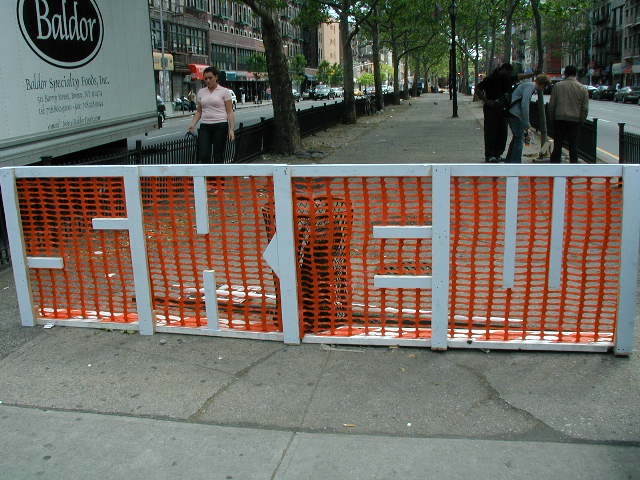
Skewville
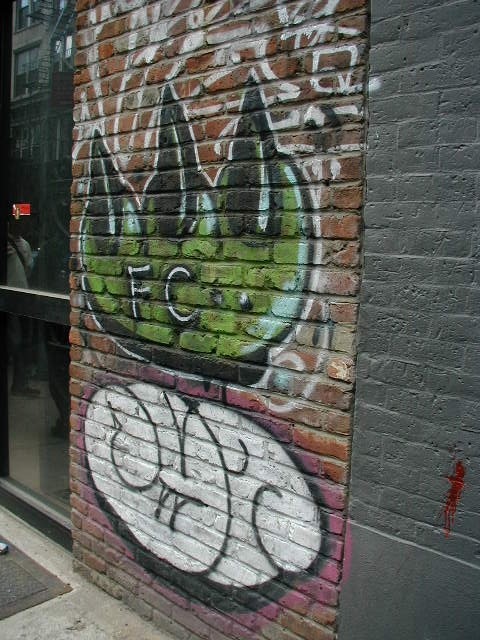
Claw
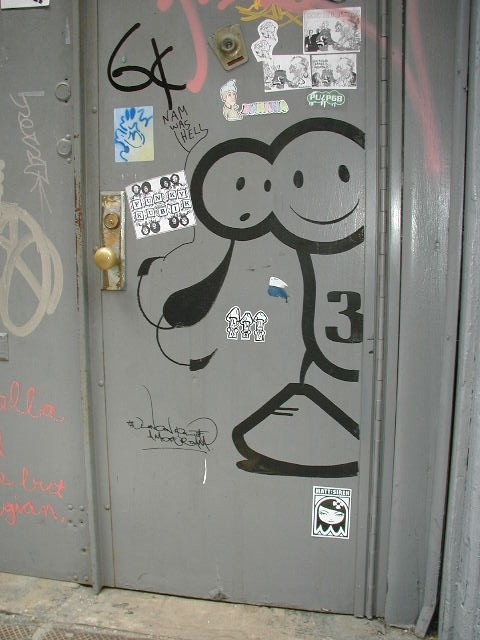
The London Police
'Crime Scene' by Leon Reid
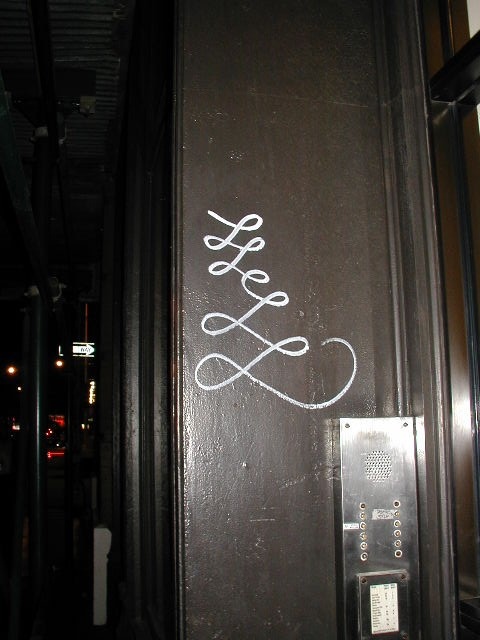
A super-elegant tag...
Some of these pictures were taken on a walking tour organised by Marc and Sara Schiller, of Wooster Collective (these occasional walking tours must have introduced hundreds of people to the pleasures of street art in New York over the years).
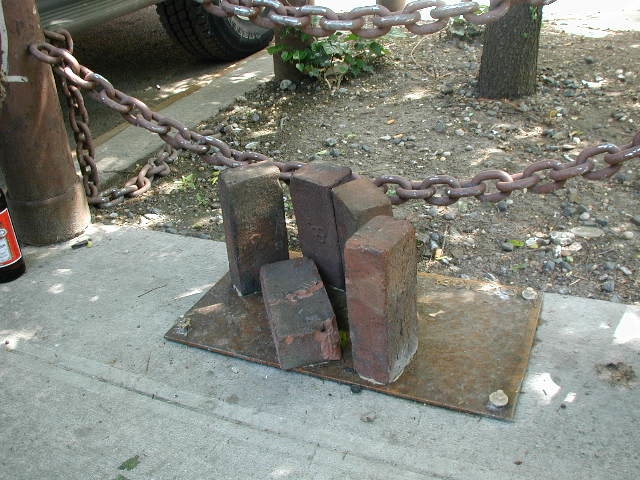
My visit to New York in 2005 took place during a time when a great diversity of techniques in street art were being explored. Metal scupltures bolted to the sidewalk, the manipulation of street furniture, the layering of tags and stickers and wheatpastes and tiles in doorways, the development icons as tags – it felt like a really exciting time and place. I think that’s one of the important things about street art: it has the potential to render any streetscape more interesting, and the artists who work in the street are continually adapting their techniques to new places, new constraints, new possibilities. Sometimes the result is disappointing, sometimes it’s a bit meh, sometimes it’s just astounding. But the flux that street art creates, whatever the aesthetic success of the end result, means that the contours of the city (which go unnoticed by so many of its inhabitants) are repeatedly drawn in sharp relief, for those whose eyes are open to them.
Post No Bills
Filed under: art, Art, Street Art, cinema, law | Tags: advertising and art, Banksy, Exit Through the Gift Shop, Mustafa Hulusi, Public Ad Campaign, Street art, Vandalog
Comments (3) 
In the above photo you can see posters advertising Banksy’s movie, Exit Through the Gift Shop, on a hoarding in SoHo in New York.
A brief post on Vandalog recently sparked an interesting conversation in the thread of comments – around the vexed qurelationship between street art and advertising.
On Vandalog, RJ wrote:
‘Banksy once said “‘Every time one of my friends borrows my ideas, mounts a huge art show and becomes a millionaire celebrity,’ a little bit of me wants him dead.” I’ll amend that to “Every time a street artist turns their back on their values, mounts a huge flyposting campaign and becomes what is essentially an advertising executive, a little bit of me wants to write over their work.”
But I suppose that’s the natural order of things.’
Comments in response to this were sharply divided between those who basically agreed with the point he made, a second group who interpreted Vandalog’s comments as unfounded criticism of their fave street artist, and a third group who thought that since the main objective was to get people to see a thoroughly worthwhile movie then bill posting was an effective way to inform people (especially people who might not be plugged in to networks and blogs within the street art community) about the movie.
Over the last week in New York, bill posters for the movie have gone up in a lot of places – Williamsburg, SoHo, the East Village, the Lower east Side (there may well be more that I haven’t seen). The question of where to draw the line (and in fact whether there is a line) between art and advertising is a tricky one. Sometimes artists certainly do use advertising – when they have an upcoming show, their gallery might advertise it in a listings magazine, or the artist might post a status update about the show on Facebook or tweet about it on Twitter. (There’s a whole lot of thinking to be done some day about the role of social media sites and their relation to art and to advertising.)
But bill posting – well, that’s often seen as something different, something done by clothing companies and by music promoters. Agencies pay bill posters to wheatpaste flyers around a city – an activity often done late at night because it is usually illegal. A number of years ago, the City of Westminster, one of the London municipal authorities, decided to crack down on fly posting as it’s called in the UK, issuing fines to the companies whose wares were being advertised rather than to the fly posters and the advertising agencies (not much came of this, and there’s as much fly posting in London as ever).
Anyway, Vandalog asked why use bill posting to advertise Exit Through the Gift Shop rather than something more directly related to street art, like stencils (or indeed, why not stickers?). Asking such a question assumes that bill posting is different from street art.
It’s worth thinking this through: what, if anything, makes bill posting different from street art? I think it’s complicated. Bill posting involves putting material into public space, usually without the permission of the owner of the property it’s placed on. It’s usually as illegal as street art. In 2008, when the Tate Modern ran a series of talks on street art, the curator, Cedar Lewisohn prompted discussion around exactly this issue by inviting former fly poster Mustafa Hulusi (who is now an artist who sometimes puts images on billboard spaces – click on the link and then on ‘Posters’ and then on ‘2007’ for some examples) to speak along with Brad Downey on art and the politics of public space.
But maybe it really does come down to aesthetics (and the relationship of the image to capital). The posters for Exit Through the Gift Shop are attractive posters, especially when positioned in multiples, and when placed on wooden hoardings (the wood makes an excellent background to the poster’s colours). But I’ve seen them now in several places around NYC and they’re almost always next to the same other posters, especially one claiming to involve a free MacBook giveaway. Here’s one in Williamsburg:
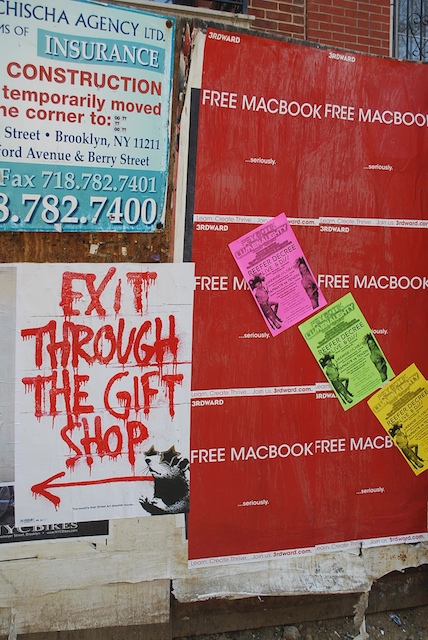
And that confirms that these are not aesthetic interventions in public space, however appealing the poster is. They weren’t put up by Banksy’s assistants or anyone connected with him; they must have been put up – I’m guessing – by the standard bill posters who work in the illicit economy putting up posters for anything, just pasting up whatever they are given.
And in another fascinating development, Vandalog published news today that some of these posters have in fact been gone over by Jordan Seiler of Public Ad Campaign (click the link for photos and for Jordan’s essay on this issue), replacing ads with street art….
I’m not trying here to provide any kind of definitive word about art and advertising. Far from it. In fact, I think it deserves more discussion. After the furore about Fauxreel recently (see the discussion of this by Hrag Vartanian on Hyperallergic), now Banksy (as ever) ups the ante and makes the need for such a debate even more compelling
Banksy at the movies: Part II (Banksy’s hands)
Filed under: art, Art, Street Art, cinema | Tags: art, artist, Banksy, Exit Through the Gift Shop, stencil art, Street art
Comments (2) Since the previous post, about expectations of what Exit Through the Gift Shop is about, turned out to be a long one, I thought I’d write a separate one dealing with what it’s not about.
So let’s go back to the second response that a lot of people seemed to have after seeing the movie – a feeling of surprise that it’s not ‘about’ Banksy, or at least not as much as they had expected.
It’s worth looking at this closely. Is the film ‘about’ Banksy? Well, the film is made by him, and thus it provides us with a text which tells us something about the artists and his concerns, just as his artworks, books and exhibitions do.
And then again, Banksy is in the movie: we see him in his studio; we see him stencilling; we see him with his crew of helpers creating the famous ‘vandalized telephone box’ in London (which goes on to sell for an extraordinary sum at auction); we see him installing a blow-up doll, hooded, shackled, and wearing an orange jumpsuit, at Disneyland, in a direct juxtaposition of American mass entertainment culture with the torture of detainees at Guantanamo. (All of these occurrences are filmed by Guetta.)
But of course, while all of these events are taking place, Banksy still withholds himself from any kind of identifying gaze – he wears the hood of his sweatshirt pulled over his head, his face is blanked by pixillation, his voice distorted (and his assistants’ identities are similarly masked).
So Banksy’s certainly in the movie, but he’s simultaneously on display and hidden from our view. But what we do see in plain sight are his stencils and his hands: as Banksy himself states in the film, ‘I told Thierry he could film my hands but only from behind’.
As he says these words in voice-over, the film shows us Banksy at work, cutting stencils (for one of his signature rats, to be put up on a wall in LA). And for me, that was one of the highlights of the film – watching those hands, whether at work on the stencil or gesturing along with the words spoken by Banksy’s distorted voice.
They’re slender hands, with long fingers. They’re the hands of an artist. What does the face matter, or the voice? Watch the film – and watch out for the scene of Banksy cutting stencils, with speed, and with great skill. That moment might not be central to the film, but it’s certainly what street art is all about.
Banksy at the Movies: Part I
Filed under: art, Art, Street Art, cinema | Tags: Banksy, commercialisation of street art, Exit Through the Gift Shop, Mr Brainwash, Shepard Fairey, Street art, Thierry Guetta
Comments (5) I’m in New York City right now, and last night I attended a preview screening of Banksy’s film, Exit Through the Gift Shop. The film is being released in a number of US cities from April 16th and if you click here you can find a list of release dates, cities and theaters. (If you’re reading this in Britain, the film’s been out for a few weeks; if you’re reading this in Australia, be patient a little longer because the film will be released there in early June.)
Given the intense interest in Banksy as an artist and in the mystery of his identity, it’s inevitable that this film will attract a lot of attention. What’s as interesting as the movie itself is the range of responses that people are having to the film. Among those who’ve seen it so far, people speak positively of the film (as they should, since it’s a highly enjoyable documentary), but they also seem, first of all, surprised that it is more about Mr Brainwash (aka MBW aka Thierry Guetta) than it is about Banksy; and, second, disappointed that, because the film is more about Mr Brainwash, Banksy doesn’t reveal much of himself in the movie.
Let’s start with the first of those reactions, that the film’s not ‘about’ Banksy, which certainly raises the question of what the film is about. Well, the film operates on many different levels, and one of its main ones is the story of how street art took off, from being something with an intense local significance which was shared through the networks of the global street art community for the enjoyment of those who practice or appreciate street art, to became an entrenched part of the mainstream art world, whereby paintings (and artists) are commodified for profit.
To tell that story, the film focuses on Thierry Guetta’s transformation from amateur film-maker into artworld succes du jour, as a means of demonstrating both the possibilities open to anyone with the will to put up art and the (slightly frightening) logical consequences of those possibilities (for example, having people queueing for hours to get into your art show, simply because they’ve been told by the media that your art is important).
The film treads a clever and careful line between condoning and critiquing the commercialization of street art, as its embodied in Guetta’s transformation: it really is left up to the viewer to work out where you stand on the issue. In some ways, the film seems to be criticizing the people who have bought Mr Brainwash’s work for vast sums of money and who have contributed to his art world stardom, but, then again, isn’t this the same art world that has made stars of Shepard Fairey and Banksy and Blek le Rat? If we want to critique the art world, it must be a critique that can specify why Mr Brainwash’s stardom is problematic when that of the others is not.
So: how do we think through that problem? Is it because Mr Brainwash doesn’t make all of his art himself? Neither does Shepard Fairey nowadays, nor Banksy (both of whom have assistants – and we see some of Banksy’s assistants at work in the film), and neither does Jeff Koons, for that matter. Is it because Mr Brainwash’s work is derivative (his work repeats many of the devices used by Andy Warhol, Banksy, Fairey, Nick Walker, Blek…)? Well, that might be a better founded criticism, but it still requires us to think through its implications: each of those artists borrow from other artists and art movements, re-presenting certain tropes in order to create a new art idiom. Perhaps Mr Brainwash’s endless borrowing (what some would even call plagiarism) from the borrowers lacks aesthetic merit because it does nothing new – no new idiom emerges from his pillaging of pop culture and street art.
At any rate, I think these issues form the heart of what the film is about – and I’d back this up by referring you to the movie’s title. By calling his film ‘Exit Through the Gift Shop‘, Banksy is both having a sly dig at museum culture, which often cynically seeks to extract more money from visitors after they have viewed an exhibit, but he is also pointing out to us the direction that street art may be heading in, now that its commercialization is so advanced – the only ‘exit’ is to find a way through the endless consumption offered to us as a poor substitute for the art itself.
 Images to Live By