You have been invaded….
Filed under: art, Art, Street Art | Tags: anti-graffiti, Invader, Lazarides, mosaic, Space Invader, Street art
 Comments (1)
 To coincide with the about-to-open show at Lazarides’ Rathbone Place gallery in London, I thought it was a good time to post this little homage to the wonderful Invader.
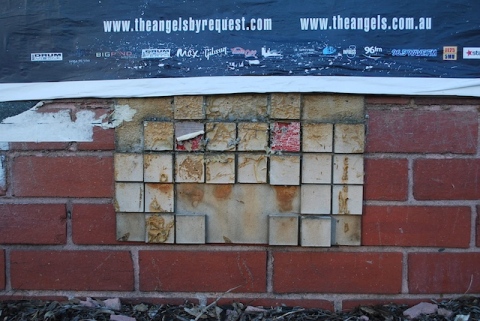
For those of you who don’t know Invader’s work, Invader is a French artist who makes and remakes small mosaics of the ‘Space Invader’, star of countless video games in the 1970s.
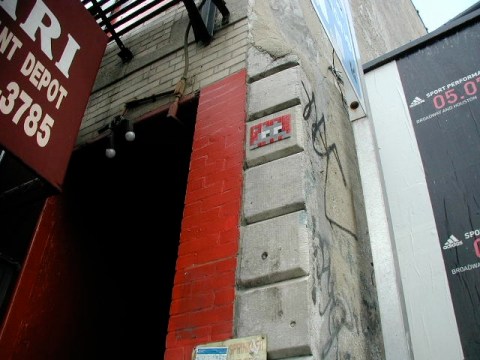
I always think of Invader’s works as occupying space in the street very quietly: due to their smallness, they tend to be unassuming and easy to miss, often placed high up on a street corner, or in some hard-to-reach location. (I’ve written recently about the appeal of the small – have a look here).
Once you do notice them, they have great appeal: as mosaics, they have an artisanal quality that provides a nice contrast with the low-culture evoked by the video game referent.
On his website, Invader repeats the trope of ‘invasion’ in another way, so that cities become sites to be invaded by the artist and his mosaic tiles. It’s obviously a militaristic metaphor, and one which is often used by the opponents of graffiti, who see illicit imagery as something which ‘invades’ a previously ‘clean’ wall. It’s one of the great things about Invader’s artwork that it can pinpoint the hysteria that underlies anti-graffiti rhetoric, for here, indeed, are the fearful ‘invaders’, and it has to be asked, who could fail to love these little mosaics?
In addition to his dedicated work in invading (to date) 40 cities around the world, in recent years, Invader has also had a number of gallery shows. I’m unsure how successful his work is in the gallery setting, but it certainly draws a lot of strength from fine art movements such as Pop Art. For me, Invader is at his best in the street, and so, while I recommend that anyone who is in London over the next month takes a look at his gallery show, I wanted to pay tribute to the enduring charm of the Space Invaders that can be found all around us – in the streets. I believe that Invader has been busy adding some new works to the streets of London in the last little while, so keep your eyes open for those. But for now, here are some of my favourites.
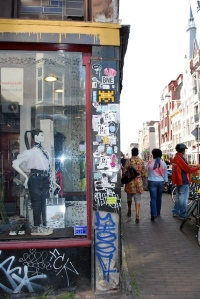
In Amsterdam:
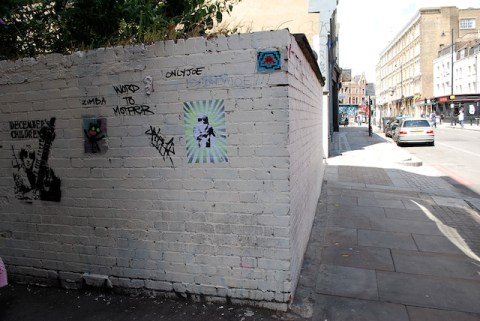
In Shoreditch, London:
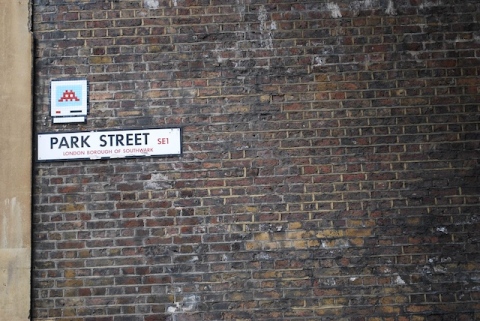
Not far from the Tate Modern, in London:
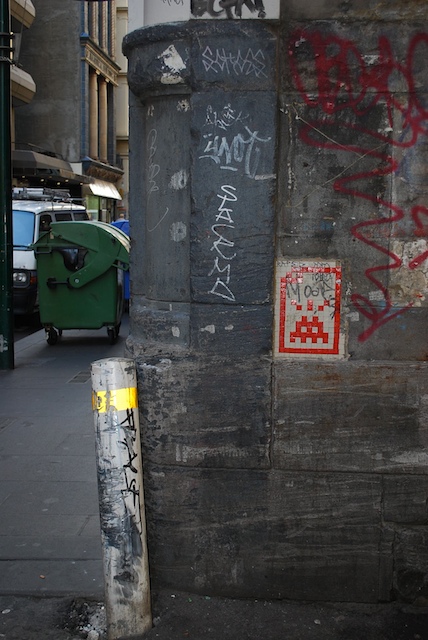
In Rothsay Place, in Melbourne’s CBD:
Just off Alexandra Parade, in Melbourne, a very faded example:
In SoHo, New York City:
Enjoy the show, if you get to see it at Lazarides. But, even better, enjoy the streets if you are lucky enough to have been invaded!
Talking about street art….
Filed under: art, Art, Street Art | Tags: JR, Melbourne, public space, Street art
Leave a Comment I’m giving a lunchtime talk in my department next week, called ‘Street Art and the Contestation of Public Space’.
Here’s what it will be about:
“Cities are sites of intense cultural and aesthetic production, engaged in the continual development and refinement of their self-image. This occurs by means of a range of aesthetic practices, such as architectural innovation, statuary, control of signage and advertising, and public art, underpinned by a network of planning regulations, local and municipal laws, and public order law.
For its citizens, a city’s processes of cultural production are sometimes unremarkable or even imperceptible; at other times, however, these processes become contested, subject to planning disputes, legal intervention, and shifts in public opinion. This talk focuses upon the contestation arises in connection with street art and graffiti writing.
The talk will focus upon two examples.
The first is the approach to street art taken by the City of Melbourne. Since 2003, local councils within Victoria have been required by the Department of Justice to develop plans for the regulation of graffiti within their municipalities. The City of Melbourne initially developed a strategic approach to graffiti based on the concept of zones of ‘tolerance’ for graffiti and street art, but then elected instead to pursue a policy of zero tolerance combined with a discretionary permit system.
The second example focuses upon the French street artist JR, who uses street art as a means of engagement with the politics of ethnicity, race and religion and as a platform to draw attention to the impact of war or emergency in ‘post-conflict’ cities and countries.”
If you are in Melbourne and are interested in coming along, here’s a link to the departmental homepage, where you can find details of the talk listed under ‘Events and Seminars’. Clicking on that link will open a downloadable pdf of a poster for the talk, which gives information about the venue and the time.
I’ve done a few talks on street art and graffiti over the last few years in Melbourne – Street Alliance, at Federation Square, or the Cultural Development Network’s forum on Permissible Art at the Famous When Dead Gallery. This one will be a more ‘academic’ one, given the setting, of course. Anyway, if you are interested, you are welcome to come along.
On being small
Filed under: art, Art, Street Art | Tags: art in a jar, Civil, small, stencil, Street art
Comments (1) Reading back through some of the previous posts on this blog, I realised there is a bit of a repeated theme, in that I’ve commented favourably on the large scale of many works (for example, the works in the Leake Street Tunnel in the Cans Festivals, JR’s paste-ups in London, or Bill Viola’s images, or the works on the façade of the Tate Modern).
Since I don’t want to give the impression that an artwork has to be huge in order to impress, I thought I would devote this post to images which demonstrate that an affective charge can arise from placement and composition as much as from scale.
One of these is something that I have been thinking of as ‘art in a jar’. Have a look:
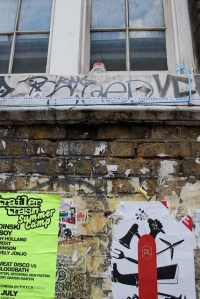
Perched on a window sill, high above ground level in Brick Lane in London, sits a little jar, with a lid on it. Inside the jar, there is a piece of paper, folded up, and on the piece of paper you can just about glimpse a drawing of a figure. I love the idea that someone not only did these little drawings but also placed them inside their own small containers and then placed the jar on a window sill, which functions as a kind of display shelf for the artwork. It’s the tiny size of the jar and its half-hidden drawing that gives the work its character, which would be lost if the jar were bigger.
I also like this stencil very much:
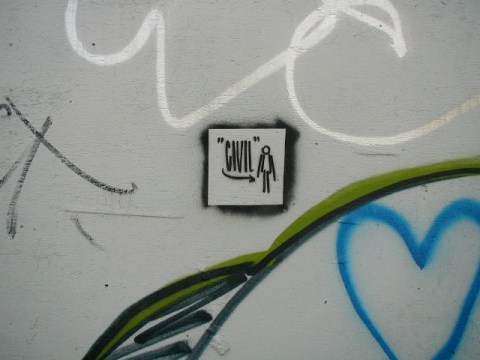
Taken in Richmond, Melbourne, back in 2003, it is signed by Civil and shows one of the little stick figures that have since become a signature motif, featuring in large numbers in much larger works. I like those larger images a great deal, but there’s something quite perfect about the simplicity of this: the figure, the name, and the frame.
And finally, here’s something I saw just last week. Actually, my daughter spotted it, as we were walking home from school. She suddenly stopped and pointed upwards, saying, ‘Look, mama, graffiti!’(She doesn’t make any distinction between street art and graffiti: controversial, I know, but since she is only seven, I figure she still has plenty of time to learn about the arguments as to whether graffiti is different from street art and vice versa.)
Here’s what she had spotted (and what I had missed):

And a closer view of it:

It’s a simple enough piece of work, nothing tremendously spectacular about it. But what I liked is the fact that it is placed so high on the wall (it’s a good fifteen feet up), and is thus easy to miss (as I did). It’s a great example of an artwork being there for the noticing (or not). Once noticed, its very presence brings pleasure: I now feel as though I’m party to a secret history for that little part of the street, since the presence of the artwork reveals that someone came here, probably with a ladder, and attached this image to the wall, placing it in such a way that it could be overlooked, just as it looks down at us from on high. Now I’ve seen it, it draws my gaze upwards, reminds me to be alert in the streets of the city, attentive to whatever small gifts might have been placed in public space for us to enjoy.
Guest post on Vandalog
I’ve been crazy busy teaching an intensive course the last few days, so not much time for posting here.
But I did manage to write a guest post for Vandalog, which is a fantastic blog about street art. RJ, Vandalog’s author, is currently away on holiday and he has asked a range of people to contribute guest posts while he is away.
You can read my contribution here.
And if you’re visiting Vandalog for the first time, it’s definitely worth browsing through it.
Thanks for the invite, RJ! Enjoy your holiday!
And more posts on Images to Live By coming soon, because my intensive teaching finishes in a few days time.
Art and the senses
Filed under: art, Art, Street Art, graffiti, law | Tags: AMF crew, art, artwork, Jose Parla, Nick Walker, sublime, the senses
Comments (5) I’ve been thinking for some time about the ways in which we experience an artwork, whether it’s located in the street or in a gallery. The most conventional way in which to think about this would emphasize vision – after all, we are used to the idea that an artwork is something that we look at.
But this leaves out other sensory dimensions, ones which are not so commonly talked about in relation to art. Is it possible to hear an artwork? Can we taste it?
In some works, image and sound are certainly inextricably combined, so that it’s not really possible to think in terms of simply looking at it or listening to it: Bill Viola’s work is a great example. Some artists entirely ignore the visual in favour of the auditory: in 2008, for example, an artwork called Speed of Sound Nau Interactive Bells was installed in Union Lane in Melbourne (this laneway was mentioned in a previous post, Street art and ‘authority’): the sound of bells, chiming at irregular intervals, played from speakers installed at different heights along the laneway walls, so that the sounds increased and receded according to one’s progress along the laneway.
And I’m also pleased to be able to report that I have had the experience of eating art. Felix Gonzalez-Torres, a Cuban-American artist, created installation pieces in which lollies (or candies, or sweets, depending on which continent you live on) were strewn across a gallery floor or piled in its corners. Spectators were able to dip their hands into the artwork and pull out a handful of sweets to take home or to eat. You can get a sense of what Gonzalez-Torres’s wonderful work looks like if you click here – the tiny golden objects piled against the walls constitute one of his works, Untitled (Placebo – Landscape for Roni). I can still vividly recall how transgressive it felt, to pick up a piece of an artwork and put it in my mouth and taste it (it was lemon-flavoured, in case anyone is interested).
The spectator’s relationship to that particular artwork involved touch as well as taste: touching art is definitely something that is actively prohibited by most museums and galleries as illicit behaviour in relation to art: think of all those signs on the wall, saying ‘Do Not Touch’.
One of the most memorable instances in which I was able to touch an artwork certainly had a sense of the illicit about it. I was visiting a gallery overseas to chat with its director, and was informed by him that he had just received a shipment of works by one artist who would be featured in their next show. The director was hugely enthusiastic about this artist and invited me not just to look at the works but in fact to touch one. As I ran my fingertips over a tiny section of the work’s surface, I felt acutely aware of how forbidden such an act usually is.
In addition to the simple transgressive pleasure that came from touching a painting, I also felt a strong sense of how much my relation to the image was altered by the act of touching it: instead of standing facing it, as it would hang on a wall with me looking directly at it, it was brought towards me and held close to me, lying at an angle, slightly tilted from the horizontal, the light slanting off its surface, my gaze directed downwards, and my hand drawn towards it. Much later, I realized that part of the extraordinary charge that arose for me in this moment derived from the experience of relating, momentarily, to the artwork as if I was in the position of the artist. I don’t mean that I experienced a sense of acquiring any of the artist’s skills or abilities, but rather simply some of the privileges that come with the position of the work’s creator: the ability to touch it, the ability to stand close to it (rather than behind a white line in a museum), the ability to look at it from different angles.
(Of course, anyone who buys an artwork acquires the rights and power to do all these things too, but it’s interesting that it is the artist that was evoked by my altered position in relation to this work, not someone with sufficient financial resources to purchase it.)
What about smell? Does art have an aroma, an odour? Artists themselves are usually well acquainted with the olfactory dimensions of their work (from spray paint, oils, acetone, lacquer, glue, and many other substances) but it’s something that isn’t often discussed when we think about spectatorship. And yet those smells can have a powerful affective impact on the viewing of an artwork. When I went to see an exhibition by the wonderful Jose Parla at Elms Lesters Painting Rooms in London last October, many of the works on display were recently painted: as a result, the gallery rooms were filled with a perfume of oil and varnish, which made me, as a spectator, feel extremely conscious of the works as things which had been brought into being through the artist’s exertions with canvas, and paper, and paint.
It was on the same visit to London that I had the good fortune to meet the charming Nick Walker (you can see more about Nick here). As we finished our conversation about his work, in a small room at Black Rat Press, Nick indicated a neat pile of prints sitting on a trestle table, awaiting his signature before sale. He removed the protective cardboard from the pile, so that I could see the image below. But when the cardboard was lifted, an amazing smell drifted from the pile of prints: it was an intense, concentrated smell of paper, and it was strangely beautiful. I’ll never forget standing next to that table, under a low-hanging spotlight, gazing at these prints and inhaling their smell – a potent reminder that artworks are utterly material, not ethereal images floating free of the world of things.
Much of what I’ve been describing relates to the phenomenon of gallery or museum display, in which the smell or feel of an artwork is rarely encountered. When an artwork exists in urban space, the commonplace prohibitions of gallery spectatorship usually don’t apply – if you can reach it, you are perfectly free to run your hands over a paste-up, or, if you wanted to, there’s even nothing to stop you having a good sniff of a stencil.
That freedom is definitely an important part of how we look at street art and the sense of democratic spectatorship that often attaches to it. But this freedom of access comes with a downside, of course, as the artists belonging to the AMF crew from Sydney discovered, when they were arrested painting trains in London last year. The six guys have been given prison sentences ranging from 8 to 16 months (click here for more details about the case). How did they get caught? Police officers said they were alerted to the artists’ presence by hearing the rattle of spray cans and smelling aerosol paint. When it comes to art, our senses may lead us to an encounter with the sublime, but they can also be the means through which the force of law comes to be exercised.
Street Art and the Museum Revisited: Banksy on the Inside*
Filed under: art, Art, Street Art | Tags: Banksy, Bristol, gallery, museum, outlaw, Street art
Comments (3) In November last year, I wrote about the exhibition, Street Art, at the Tate Modern in London. Artworks by street artists have been exhibited in commercial galleries on and off for many years, but this was the first time that a museum had showcased work by urban artists such as Blu, Nunca and Faile. After visiting the exhibition, I wrote about how I felt disappointed that the Tate had confined its exhibition of the works to the outer façade of the building. Although this provided the selected artists with a massive ‘canvas’ to work on, it also meant that when the exhibition ended, the works were buffed by the museum just as a council would buff these works if they appeared on walls around a city.
Less than a year after the exhibition on the walls of the Tate Modern, street art has been brought into a museum space, and to an extent that I think it’s fair to say could not have been predicted. Bristol City Museum and Art Gallery has just opened its summer exhibition, Banksy versus Bristol Museum.
The title of the show acknowledges the tension that exists when street art is displayed indoors, or when works that some might say are best viewed in passing, on a street wall, are instead placed inside the rarefied space of a gallery. The exhibition’s context is implied as a contest, a struggle between Banksy, artist of and for the people, and all that is represented by a council-funded, conventional museum (and remember that Banksy once painted ‘Mind the crap’ on the steps of Tate Britain, in a nose-thumbing gesture at the hierarchies of art institutions).
To a certain extent that is all true: much ink has been spilt and many blog entries posted about whether street art ‘belongs’ indoors, and whether Banksy has ‘sold out’, and whether museums are being forced to ‘dumb down’ (for example, in the critical reactions to the New York Guggenheim’s Art of the Motorcycle exhibit’, or to the increasing tendency for bankable ‘blockbuster’ exhibitions on ‘safe’ topics such as ‘Impressionism’ to tour from museum to museum). No doubt some will make similar criticisms here of Banksy, the show, and the museum. (And there’s some worthwhile critical comment on the Indoor Street Art blog.)
But what’s left out of these criticisms is any acknowledgement of the value in staging an exhibition such as this – in bringing Banksy’s work not just ‘home’ to Bristol, but inside one of Bristol’s museums.
Banksy’s work has been in museums before, but in a very different way: in March 2005 he visited the Metropolitan Musuem, the Museum of Modern Art, the Brooklyn Museum and the Museum of Natural History in New York City and hung works on the walls, which were viewed by the museum’s visitors until noticed by security guards. In October 2003 he hung his own artwork in the Tate Britain and placed a fake piece of prehistoric rock art (showing a cave man pushing a supermarket shopping trolley) in the British Museum in May 2005.
It’s a long way from those outlaw actions to the current exhibition, and here’s where the show’s title, Banksy versus the Museum, is both accurate and misleading. Rather than being displayed in selected series of rooms, as would be the norm, these artworks have taken over the entire space of the Edwardian building. The show features not just sculptures and paintings, but also a series of large installations, including a recreation of the pet store set up in New York City last October.You can get a sense of what the show is like from the videos on the UK Street Art website, or have a look at this:
And so it really is as if Banksy has taken on and taken over the space of the museum – if there was a contest, then he is the victor. But of course what we are actually seeing is the product of a fantastic collaboration rather than a contest: a closely guarded secret, in which the museum closed down in order to allow the artist to set up his work throughout the galleries.
And so, in coming not just home but also inside the portals of the museum, does this mean Banksy has sold out in some way? I think not: the exhibition has actually been brought about in a manner that maintains many of the values of street art: while these are obviously not illicit artworks in any way, they have appeared before the public just as a work on a wall might do, the result of clandestine preparations and the efforts of an anonymous (well, sort of anonymous) individual. Just as the Cans Festival came as a fabulous surprise last year, the Bristol City Museum show provides a summer treat for those in the northern hemisphere. Not to be missed. Bristol? Wish I was there.
* Thanks to Peter, for suggesting the sub-title for this post.
Women and Cities: Swoon
Filed under: art, Art, Street Art | Tags: CELLspace, Street art, swimming cities, swoon, urban art, Urban space, women in the city
Comments (1) Twitter is emerging as another way of getting information about urban art and street artists (I’m on Twitter as @scotinoz), and it was through Twitter that I learned today that Swoon’s Swimming Cities of Serenissima has arrived in Venice. For those of you who don’t know Swoon’s work, she specializes in large (life-sized) block-printed paper cut-outs, which are then wheat-pasted onto surfaces, which might be the walls in a gallery or in the street. She is based in New York City, but her work appears in cities all over the world. Here’s a great video of Swoon giving a presentation about her work at the Museum of Modern Art in New York:
While walking through Haight Ashbury with Russell Howze, veteran archivist of stencil art, I saw this piece by her:

It’s a quintessential Swoon piece: a woman, rendered in intricate detail, beautifully drawn, and placed with care in a space in which she appears to be glimpsed by the passer-by while she is engaged in some quotidian activity.
While I was in San Francisco, Russell also took me to the Luggage Store Gallery. This gallery has featured in an earlier post on this blog (see ‘On tagging’, January 2009), and the gallery is certainly worth visiting just for a look at the archive of tags provided by its stairwell, but on the day that I was there it was also the site of an exhibition of Swoon’s work.
Instead of simply being pasted onto walls, as happens when Swoon (or any other artist) puts up work in the streets, here she had pasted them onto cardboard or wood, or other found objects, which were then displayed in a manner which lent them depth, perspective, dimensionality. These photos will give you an idea of what the works looked like:
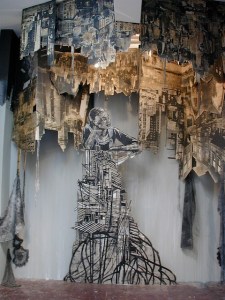
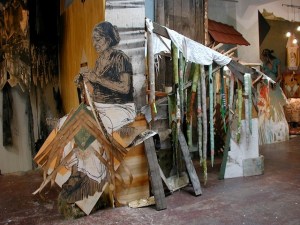
Swoon had made use of all the space available, even extending her work over the gallery’s windows:

For the spectator, this provided the novel experience of standing inside and looking through an artwork to the street outside (a neat re-working of the constraints enforced on much urban art, in which the artwork can exist either in the street or in the gallery, but not in both places).
While one strand of Swoon’s work focuses on figures in the everyday, The Swimming Cities of Serenissima derives from what is emerging as another major interest, the built environment. As the website for The Swimming Cities of Serenissima states, the vessels are inspired by ‘dense urban cityscapes and thickly intertwined mangrove swamps from [Swoon’s] Florida youth’. It involves three vessels, ‘built from salvaged materials, including modified Mercedes car motors with long-tail propellers’, which have been sailed by a crew of 30 artists from Slovenia to Venice. The vessels resemble ships but also evoke the floating skyscrapers of Gotham or the counter-intuitive wonders of Venice itself.
This is the third floating sculpture made by Swoon (previously, she created the Miss Rockaway Armada which sailed down the Mississippi River, and The Swimming Cities of Switchback Sea, seven rafts which sailed from Troy, NY, to New York City). Reading about the remarkable floating cities created by Swoon made me remember another highlight from my visit to San Francisco, visiting CELLspace. This is a fantastic place combining studios and gallery space for at-risk youth and artists in the Mission District, to see Card Burg, a city being constructed from cardboard:
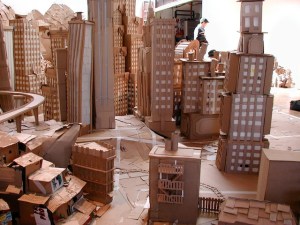

It was absolutely wonderful to wander among the towering skyscrapers and to see the small spaces of everyday lives within the metropolis – an incredible urban artwork about the nature of life in urban space.
I’m pretty sure that for anyone lucky enough to see one of Swoon’s swimming cities, the experience will be similar: wonder, awe and sheer pleasure. But I’ve also been thinking about these two separate strands in Swoon’s work: the individual and the urban. Individuals going about their business, sitting on the stoop, walking through the city. And cities: fantastic, miraculous spaces wrought by the imagination. It makes me wonder whether it’s possible for the two to be brought together: if the contemplative woman can be allowed to exist within the urban setting.
Of course, you could argue that this is exactly what Swoon’s street images do: the paste-up of a woman is placed in urban space. But I wonder if we need more than that. When I saw Card Burg, I realised that part of the pleasure in visiting that imaginary city was brought about by the exhilaration of – literally – walking tall among the city’s buildings. The altered dimensions of Card Burg meant that I stood almost as tall as the skyscrapers.
Similarly, Swoon’s swimming cities shift perspective and dimension: the city is produced in inevitable miniature, and is thus, somehow, tamed. To me, what’s important here is the transformation that’s brought about of the experience of being a woman in the city. For far too many women, city spaces are still the location for sensations such as anxiety, fear, intimidation. Is it possible for an artist to create an image of being a woman in the city that can acknowledge that reality and that can still seem beautiful? This isn’t a criticism of Swoon’s work, which I find inspiring and hopeful and lovely. But it’s important to note how difficult it is for art to do justice to the fact that, for many women, ‘walking tall’ in the city is fraught with risk as much as pleasure.
Street art and ‘authority’
Filed under: art, Art, Street Art, graffiti | Tags: art, authority, graffiti, Obama administration, Street art, Union Lane, Wooster Collective
Comments (8) Once again, it’s been a long time between posts. The main reason for this is that I contracted whooping cough just before Easter: it turns out that whooping cough is a highly nasty illness and there’s good reason why we vaccinate kids against it. Anyway, while convalescent, I spent a lot of time online: reading blogs, browsing through some great street art websites, and, of course, spending a bit of time on Facebook. Amidst the productive procrastination of all those mad quizzes, recently there’s been some fascinating reading provided by the responses to questions being asked on Facebook by the Wooster Collective (questions which range from ‘what’s your favourite hangover cure’ to ‘what is the best city for street art’). One recent question asked respondents to say what impact they thought it would have if street art were legal. Reading the comments (most of which indicated that something would be lost if street art were legalized) started me thinking about street art and its relation to authority and to the various government bodies and organizations that we might call the ‘authorities’.
Around the same time that the Wooster Collective were asking this question, I received an email from Russell Howze, stencil artist and author of Stencil Nation (it’s also well worth checking out both his blog and Stencil Archive, his fabulous resource on stencil art). In the email, he described the Anti-Graffiti Super Huddle (website here), a recent initiative in San Francisco designed to reduce, contain and eliminate graffiti in the city. Russell’s concerns were that the anti-graffiti strategies seemed to be coming thick and fast, and he asked whether any arts organizations were participating in these debates (to provide a counter-voice) and whether any politicians might want to develop initiatives that recognized the positive value street art could have for a city.
So here we have a great example of how the encounter between street art and authority is usually configured (the Anti-Graffiti Super Huddle with its objectives of zero tolerance and graffiti prevention) and we can also see how difficult it is to imagine ways in which that encounter might be transformed – an enterprise which would certainly be challenging but which could have many benefits for artists (perhaps reducing the chances of being fined or prosecuted) and for inhabitants of urban spaces (in allowing street art to flourish rather than struggle in the periods in between massive buffing exercises).
Certainly of relevance to the possibility of transforming the encounter between street art and authority is the news that recently the Wooster Collective were invited to the White House. Earlier in May, Marc and Sara, along with around 60 representatives from grassroots arts organizations, attended a briefing session with aides from the Obama administration and participated in workshops focusing on a range of key issues to do with the arts. As they say in the post on their website recounting the event, the issue they wanted to raise was ‘the need to better understand the issues around public and private space’ (for the full post, look here and scroll down to the entry for 13 May 2009).
In some ways, it’s no surprise that the Obama administration would invite individuals interested in street art to such a meeting. The Obama campaign demonstrated that it understood the positive capacities of street art – particularly so in relation to the widespread appearance in public space of the image of Obama created by Shepard Fairey. (You can read about this image and its role in the campaign here.) Fairey talks about his creation of the image in this video:
But in other ways, of course, it’s nothing short of mind-boggling that a government would engage in this sort of outreach towards individuals who have championed artwork that is oftentimes illicit. After reading about the Wooster Collective’s visit to the White House, I tried to imagine the equivalent in other countries – Gordon Brown including Banksy in a round table on the future of the arts in the UK, say, or Kevin Rudd inviting the Everfresh boys to Canberra for a discussion about arts funding.
The comparison isn’t quite an exact one, however: the Wooster Collective are not artists themselves; they are enormously supportive of street art in general and have promoted the work of a wide range of artists in many countries, and have generally raised awareness about street art in the community on an incredible scale. But they are not themselves known for engaging in the production of illicit images, and I’m guessing that this distinction is still important for those in authority, when they issue invitations to participate in such debate.
I am only speculating here – I don’t know who else was invited to the White House: there may have been a street artist there as well (but I’m guessing that Marc and Sara would have said if there had been). But once we get over the surprise and delight that such a meeting took place, what are the outcomes that we might hope for when street art, like Mr Smith, ‘goes to Washington’?
It’s an interesting question – partly because I’m still unsure of what this could lead to. I can see that there are a lot of things that can be gained in terms of the symbolic support it gives to street art(ists) and the potential for parlaying this kind of recognition into all sorts of consciousness-raising efforts. It’s hard to think of concrete outcomes partly because we really haven’t seen an encounter like this, at this level of power, and with so much potential. But I’m also pretty sure that there are some risks too, and this is because there are so many instances of the encounter between street art and authority at lower levels of government making things harder for street artists or leading to some pretty strange results.
Here’s one example: in Melbourne, a few yeas back, the City of Melbourne agreed to support a project whereby artists would be permitted to paint the walls in Union Lane, in the city centre. Union Lane is a narrow lane that connects one of the major retail thoroughfares (Bourke Street) with another shopping street running parallel to it, Little Collins Street. Many of Melbourne’s laneways possess great charm and character; Union Lane does not – it was a forbidding, gloomy stretch of laneway, its unrelieved concrete walls were plain grey on one side and on the other had been painted with an uninspired, bland mural which pictorialized various civic virtues (and which had been heavily tagged).
The Union Lane project was a fantastic idea, in many ways, and it was brought into being through the hard work of a lot of people. Several well-known, highly respected artists and experienced artists were commissioned to paint in the massive work that was to cover both walls for the entire length of the laneway (which is pretty long – a city block). These artists also mentored younger artists on the project. Visiting street artists joined in. The result was a collage of styles and images produced by dozens of individuals. Passers-by took photographs; tourists visited the site; many talked with the artists and learned something about street art as they watched it being carried out. You can see the lane as it was before, and the process of developing and painting the laneway in this video:
It sounds brilliant, and in many ways it was. Surely this would be an example of the encounter between street art and authority working at its best? Well, a few unexpected problems arose. Although the presence of a high quality piece on a wall usually inspires respect from other writers or artists (that is, they don’t go over the work), the Union Lane paintings have quickly been tagged. Some people have speculated that the stencilled words ‘Street art permit: City of Melbourne’ might imply to some that the site is one where anyone can and should put up, rather than a site to be looked at.
It’s also my suspicion that the initiative demonstrates how easy it is for there to be a clash between the expectations of those in ‘authority’ and the norms and practices of street art culture. The City of Melbourne put time, effort and money into the project, and as such, wanted to protect their investment and preserve the result. Graffiti writers and street artists, however, did not necessarily view the site or the project as one which deserved permanence and preservation (two things which are not really high on the list of priorities for many graffiti writers anyway) beyond the recognition of the skills of various artists who contributed to the project.
And so, as time has passed, Union Lane is gradually becoming shabbier. Because of this, there’s a risk that it will be held up some day as an example of why such initiatives fail to achieve any positive results. Could this have been avoided? Well, one possible strategy would have been to have recognized at the outset that permanence isn’t highly valued in street art and graffiti cultures and that a range of temporary surfaces (such as hoardings) could be attached to the walls of Union Lane for artists to paint and re-work over time, with the hoardings being removed and replaced periodically.
Such an approach would no doubt bring with it its own particular issues and potential problems, but at least it would demonstrate that those in ‘authority’ are not just dispensing largesse (which can be revoked) but are actively trying to understand how street art and graffiti work.
So I guess my main point is this: in any encounter with authority, street art and street artists need to expect that all will not go according to plan, and that any plan needs to incorporate contingencies as to what might happen down the track, when the expectations of those in authority are not met.
And I think, at the moment, this will always happen, because there’s such an asymmetry between the positions of those with power (councils, the Obama administration) and those without it (graffiti writers, arts organizations, street artists). (And it would be great if the Wooster Collective’s encounter with authority could lead to a discussion as to how street artists might work to render that relationship less asymmetrical.)
I don’t mean to be pessimistic, but over the years I have seen many instances of street artists or graffiti writers trying to engage positively with ‘authority’, and I have had some experience of trying to do so myself. If someone loses out, it’s usually the artist. (And I would love to hear from anyone who has had experience of trying to work with ‘authority’ – whether successful or unsuccessful.)
So when street art ‘goes to Washington’, it’s going to be essential to have a clear idea of what street art can gain from the encounter, what ‘authority’ can offer street art, and what risks might lie ahead, even with an administration that has shown remarkable understanding and appreciation of all that street art can offer the community.
The art of the space
Once again, it has been a long time between posts, and, once again, apologies for the delay. Same excuse: I’m (still) finishing a book, and am spending every minute I can trying to fix up references, check quotations, and, yes, write bits of chapters. Almost done: hopefully by the end of April, after which normal blogging will be resumed!
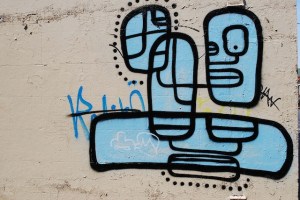
But even though I’m not posting as much as I should be here, I’m still looking at art, still living by certain images. In the last few months I’ve seen a lot of works around Melbourne by the same artist, and I have taken photographs of some of them. I keep coming across more: I spotted some more last night, and am hoping to go and photograph them soon.
Here’s one I kept seeing, in the hot days of the summer, since it’s in a laneway off a street that I drive past most days:
And if I don’t drive down that one (Elgin Street), I’m driving down Grattan Street, where I kept seeing this:
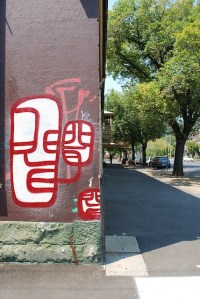
I also discovered one not far from the Law School at Melbourne University:

What really appeals to me about these images is not just their graphic, characterful humour and style, it’s the fact that the images work so well in the spaces they have been placed in. Whether it’s the boxy shape of the switching box on the corner opposite the Law School or the narrow space between a billboard and the corner of the wall on Grattan Street, the artist had made images which respond to the spaces they inhabit. The space enhances the image, and the image gives the space a buzz. Look closer, and from a different angle, at the one on the switching box near the Law School:
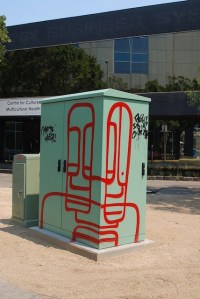
Here you can see how the artist is working with three-dimensional space, not just placing an image on a flat surface, but making the most of the possibilities offered by the box, extending the image around the corner and onto a second side, to make an image which works from different angles and which draws our attention not just to itself but to the space it occupies. Really satisfying to look at…
And if anyone knows who the artist is…..let me know!
On tagging, again: Cheyene Back’s appeal
Filed under: graffiti, law | Tags: Cheyene Back, graffiti, Tagging
Comments (2) It’s been a while since I have been able to write any entries – many apologies. I am trying to finish a book on cinema and have entered what is hopefully the last few months of that process. So I have my head down, working hard on that, and that means there’s a bit less time in the day at present.
But I did want to note what’s happened in Cheyene Back’s appeal against the sentence which was imposed upon her after she was caught tagging the outside wall of a cafe in Sydney, as previously written about in this blog. A magistrate in the Sydney Local Court had sentenced her – in a total rush of blood to the head – to a three month prison term. She appealed against this to the District Court and Judge Greg Hosking reduced her sentence to a twelve-month good behaviour bond with no conviction recorded. He commented that the previous sentence did not take into account the fact that terms of imprisoned are intended to be imposed only as a matter of last resort.
All good, yes? Well….. not quite. Judge Hosking said that it was unusual in the extreme to impose a prison sentence on a young woman with no prior record for the crime of putting graffiti on a wall – “as serious as that matter undoubtedly is”. The key issue for Judge Hosking, then, is the age and prior record of Back, rather than the issue of whether or not imprisonment is an appropriate sentence for writing a tag on a wall (and we are not talking about ‘bombing’ the city of Sydney with hundreds of tags, but rather a single tag written on a wall).
In case anyone might interpret his reduction of Back’s sentence as a wildly pro-graffiti move, Judge Hosking commented: “I’m not condoning what she did for a moment. People in Sydney are sick of graffiti, there’s no doubt about it”.
And Greg Smith, Opposition spokesperson for Justice, leapt into the media fray by adding his two cents’ worth: he thought it would be unfortunate if Judge Hosking’s reduction of the sentence meant that others were not deterred from ‘defacing property’. As The Age reported, when Mr Smith was asked if Back should be behind bars, he said: “Personally, I think she should. I think graffiti is a very serious offence. I understand that the culture hasn’t been to [imprison offenders] and we’ve got to change that culture, otherwise our city is just going to be … an eyesore.”
I know much ink has already been spilled (or many keyboards tapped on) in relation to this case, so I just want to say this. It’s amazing how graffiti can ‘press the buttons’ of – what would you call it? – ‘mainstream culture’ or ‘the dominant order’ or whatever. Clearly, the idea of a girl tagging a wall is irritating or infuriating to such a degree that both a relatively senior judge and a politician can feel able to comment that they would like to see her in prison rather than risk her (or others) tagging the walls of the city.
Two things: first of all, prisons are full. Why add to their overflowing population by sending Cheyene Back or any other graffiti writer there? Second, it is now well-documented that imprisonment can have hugely negative impacts on people’s lives – in fact, in the case of women, it would appear that imprisonment affects the mortality rate of women who have been to prison. So why do these powerful individuals – a judge, a politician – feel so comfortable saying that they would like to put this young woman in prison? What is it about tagging that drives out both reason and reasonableness?
 Images to Live By