Archive for the ‘art’ Category
Space Invaders at the National Gallery of Australia
Filed under: art, Art, Street Art | Tags: Ghostpatrol, Lister, National Gallery of Australia, Neils Oeltjen, Space Invaders, Street art, Vexta, Yok
 Leave a comment
 This is the first of two posts about the opening of the exhibition, Space Invaders, at the National Gallery of Australia in Canberra.

Exhibition entrance, with work by Ghostpatrol
I’ve just returned from two days there, enjoying the opening festivities.
On Friday night there was a preview of the show prior to its October 30th opening, with a party in the museum’s Gandel Hall and forecourt. I’m told that hundreds of people bought tickets to come to the party (hopefully they also went to see the exhibition). Works from the show were projected on to the museum walls; here’s a selection of some of my favourites:
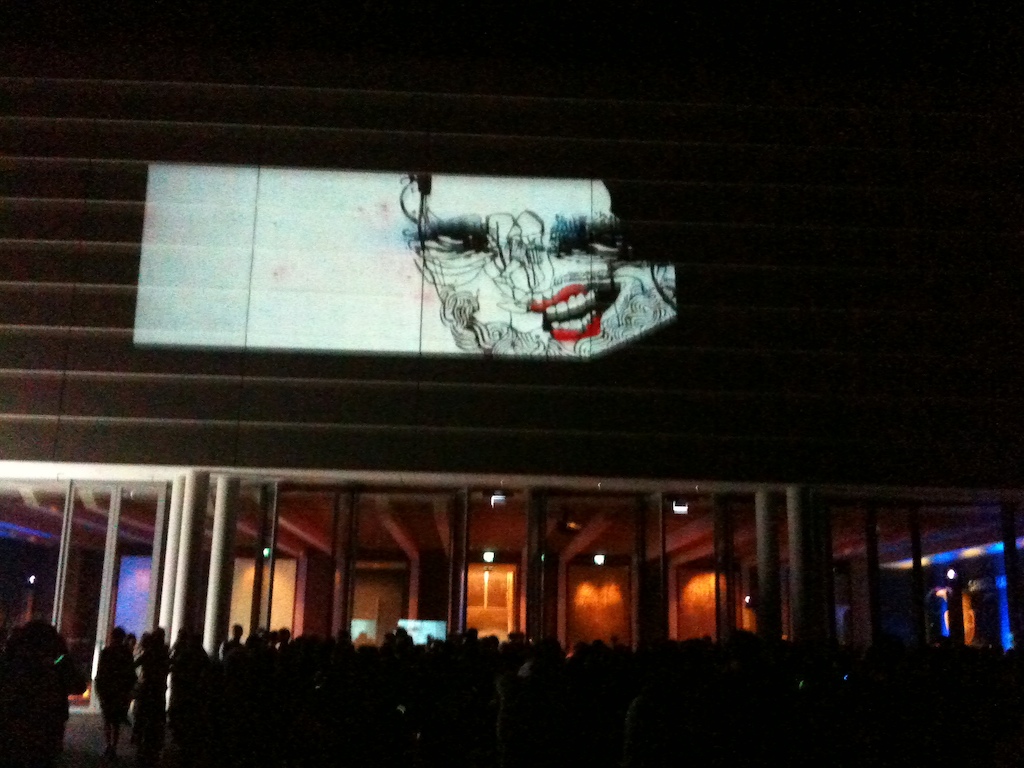
Anthony Lister
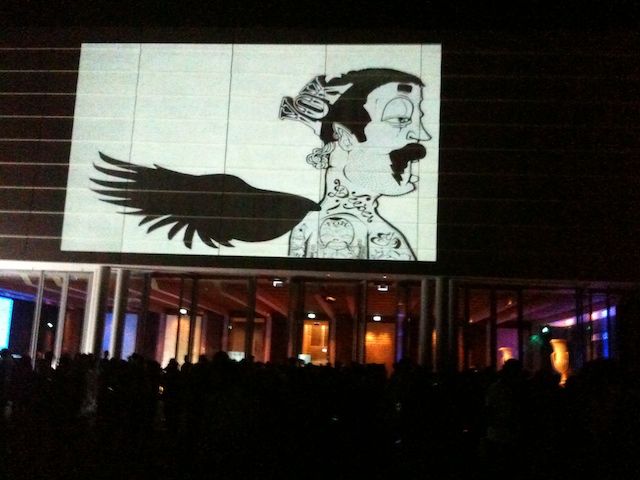
The Yok

Ghostpatrol
Meanwhile, upstairs in the Project Gallery, was the exhibition: a number of rooms containing a selection of the National Gallery of Australia’s large collection of street art (it has purchased over 350 works). The works are displayed with imagination and intelligence, organised according to themes such as ‘Neo-Pop’, ‘Connecting Crews’, ‘Politics and the Press’ and ‘The Return of the Hand’. There’s a display of zines (some of which you are able to read, as well as examine others in glass cases), and surfaces for stickering, with many of the visiting artists taking the opportunity to add their stickers to the display.

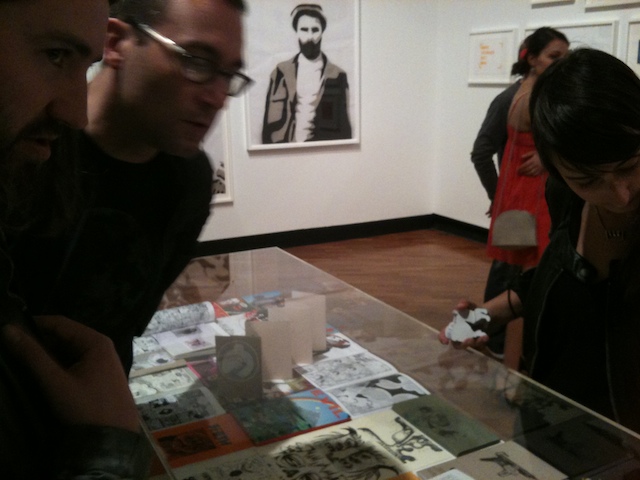
The works are displayed in a manner which evokes the street, clustering images together and dispersing others more randomly, with some exhibited high up on the wall and others placed at ground level. The evocation of the street isn’t tackily done, thankfully: it would have been easy for the museum to have strained after some embarassing sense of street credibility, but instead it has retained the look and feel of a gallery space at the same time as showing awareness of how the works would originally have been displayed on the streets.
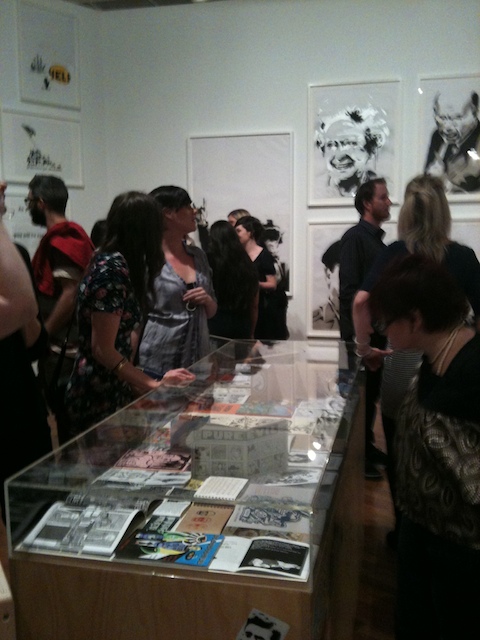
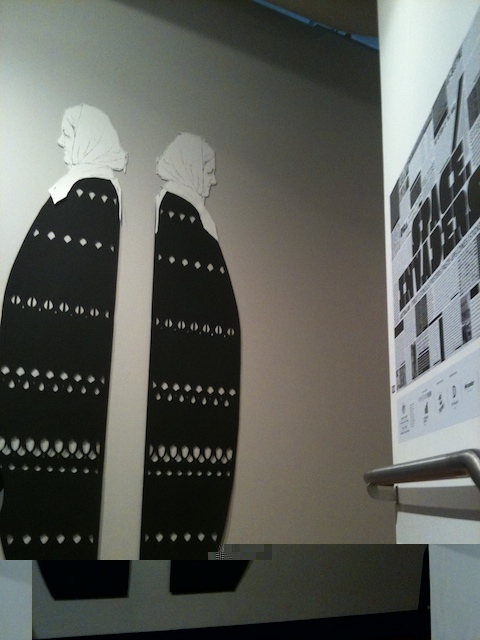
Other events included artist signings for the show catalogue, the Everfresh Blackbook, and Street/ Studio, plus an artists’ talk, with the curator of the exhibition Jaklyn Babington putting questions to Vexta and Neils Oeltjen about their work in the show and their careers on and off the street.

One of Vexta’s best-known works, Welcome to Australia, is featured in the exhibition:
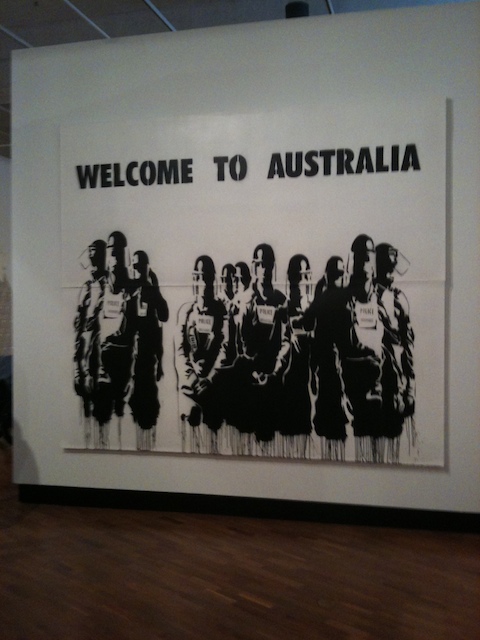
She and the curator talked about how this work was originally a site-specific piece produced for a show several years ago in a warehouse space in Melbourne. The work was destroyed after the show, and has been recreated on paper as a result of the NGA exhibition. This prompted an interesting discussion about how the exhibition functions as a sneak preview of a time capsule: many of the NGA works were made in the heyday of the stencil art boom in Melbourne in 2003-2004, and purchased soon after; since these works have long since been buffed, painted over, gone over, or faded permanently from the streets, the NGA collection represents a significant archive of works that otherwise would exist only in coffee table books and as digital photographs.
The conversation with Niels Oeltjen brought other issues to the fore as well, such as the politics of street art and its role in ‘city-building’. Neils’s work (like that of some others in the show, such as Miso, Meggs, Ghostpatrol and Lister) also points towards some of the more contemporary directions in street art, using drawing, painting, paper cut-outs, and collages to create work for the streets. Neils was invited to create a work specifically for the exhibition, a glorious confection of colour and shape:

Outside, in the museum forecourt, Everfresh spent the day painting a wall, while a happy crowd of friends, fellow artists and interested visitors sat around on the museum grass and watched:

Rone, Reka and Makatron at work on the wall
In order to acknowledge the importance of zine culture to street art, the museum had also given over its huge Gandel Hall to a zine fair for the whole of Saturday; plus, a short film made by artist Anthony Lister was also screening continuously at the entry to the gallery. The result was a nicely dispersed and variegated set of locations staged throughout the museum: the Project Gallery displaying the artworks, the Gandel Hall with its zine fair, the gift shop selling its catalogues, T shirts and books on street art, the Lister film on a continuous loop, and the outdoor live painting by Everfresh, meaning that visitors moved from inside to outside and back again, as if traversing from the outdoor spaces of the street into the more rarefied space of the gallery and back again…
To end this post, I’ll simply say that the show is well worth seeing. It’s on in Canberra until late February 2011, and will tour to other cities after that. And there’s a beautifully produced catalogue too (in the interests of complete disclosure, I should let you know that I wrote an essay for the catalogue – I was thrilled and honoured to be asked to do so). More about Space Invaders in a subsequent post…..
Space Invaders: The National Gallery of Australia’s exhibition of street art
Filed under: art, Art, Street Art, law | Tags: law, National Gallery of Australia, public space, Space Invaders, Street art
Comments (2) It’s never unproblematic when galleries and museums exhibit the work of street artists – some believe that street art is no longer ‘street art’ when it’s exhibited indoors in a gallery or museum space; others think that whatever constitutes the ‘street’ aspect of street art is more of a free-floating sensibility that pervades certain artworks whether they are installed inside or outside; still others believe that genuine ‘street art’ must be carried out illegally in public space and anything that doesn’t meet these criteria is rather a kind of site-specific artwork or is graphic design work or is even a form of advertising. These issues have been debated and argued over in many different fora (and the book that Miso, Ghostpatrol, Timba and I recently published, Street/Studio, is partly about the tensions – productive as well as constraining – that arise when artworks move between street and gallery).
Whatever your opinion of the street/studio relation and its implication for street art, there is, however, no denying the importance of a major cultural institution putting on a large-scale exhibition of street artwork – and such an exhibition is about to open at the National Gallery of Australia in Canberra. Its exhibition, Space Invaders, opens on 30 October (and runs until 27 February 2011, touring in 2011 to other cities). You can read here about the scope of the exhibition, which covers street art’s links to graffiti, its diversity of forms (including stickers, stencils, paste-ups, and so on), its connections to zine culture, the impact of pop culture upon the look of Australian street art, and its recent expansion into labour-intensive media involving drawn images.
I’m going to Canberra this weekend (along with a stellar bunch of some of Australia’s greatest street artists) for the opening festivities, and will be able to report next week on how the exhibition looks…. But it seems impossible to ignore the significance of this particular moment: Australia’s national gallery is putting on an exhibition dedicated to an art form which is often the product of activities deemed illegal by state governments and local councils in Australia, and many of the artists celebrated in the exhibition routinely risk fines or other punishments in order to make the artworks featured in the exhibition. Do we just chalk this up as being yet another instance when municipal and local governments are out of step with wider culture? Or is it time for local and state governments finally to admit that their persecution and prosecution of street artists and graffiti writers is just plain wrong?
‘Where is Mona? She’s long gone…’
Filed under: art, Art, Street Art, graffiti | Tags: buff, Fitzroy, graffiti removal, Melbourne, Mona, Street art, Toasters
Comments (2) So sings Nick Cave, in the opening line of the track ‘Fifteen Feet of Pure White Snow’ on No More Shall We Part.
And this line jumped into my head this morning when I walked down a street in Fitzroy to find the Graffiti Removal guys busily washing a wall that I had photographed and posted about only last night (see the previous entry).
One of my favourite recent works, which seems to be signed ‘Mona’, was being buffed.
So if you are walking through the streets of Fitzroy looking for the artworks of Mona, as far as this partoicular site is concerned, ‘she’s long gone’, and what’s left is this:

I guess this must be one of those issues of personal taste. All the other recently added works nearby seemed to be still there; it’s only the ones on this house that have been buffed. Did the residents ask the council to remove it? Or did the council decide that this house should be buffed and not the others? The latter seems unlikely so I’m assuming it’s been done at the residents’ request.
To my mind, this raises lots of interesting issues. In my view, the residents are completely entitled to remove the work if they wish. If an artist puts work up without permission, then there’s always the risk that the person living or working inside the property may not appreciate the art, and wishes to remove it. It’s like if you give someone what you think is a cool T shirt or interesting book for their birthday, but they then ask if they can exchange it for something else – maybe you wish they wouldn’t, but hey, people are entitled to some autonomy about what they read and wear. Same with street art, I guess. If you don’t like it, I guess you can remove it (although many wish that removal wouldn’t happen quite so often or quite so speedily).
But the problem is that what’s left here really don’t look great, and so this raises the question of the technologies of graffiti removal. It’s like painting out graffiti but leaving a mismatched square of paint that just looks odd, or blasting off bill posters and leaving tattered strands of paper hanging from the wall. All of these techniques seem to be acceptable to many people, so it makes me wonder how aesthetics are being operationalised, such that blurry lines of faded paint, tattered paper or sloppily rollered paint looks ‘OK’ to those making the decisions about removal (whether these are council workers or residents). Perhaps these individuals would say that the ultimate solution is for artists not to put up work in the first place, thus obviating the need for removal, in all its imperfections.
I don’t agree. I think that it would be far more useful to have a debate about the aesthetics of the street, in which the effects of removal can be compared to the process of leaving a piece to weather and fade, or in which people can learn to appreciate that some streets are going to be modified in various ways as part of the culture of an area or a city, and in which artists can learn what types of image will work best on different kinds of surface…. I’d like to take part in such a debate, and I think others would too.
ADDENDUM:
By coincidence, Art of the State has a post about some magical stuff being done in London by the Toasters, in which they adapt those painted-out shapes and make them into new pieces of art…
ADDENDUM 2: Take a look at the link in the comment by Seldom which follows this entry – there’s a really interesting essay by ESPO (Steve Powers) about the pointlessness of painting over graffiti.
New works in Fitzroy….
Filed under: art, Art, Street Art | Tags: Fitzroy, Ghostpatrol, Melbourne, Miso, Street art
Comments (4) After a lot of travelling this year, it’s good to be home, and to be here to stay for a while (except for a weekend in Canberra that’s coming up, about which more later).
And it’s wonderful to be back in Fitzroy, where a lot of activity has been taking place on the streets.
Here are some of the things I’ve seen since returning:
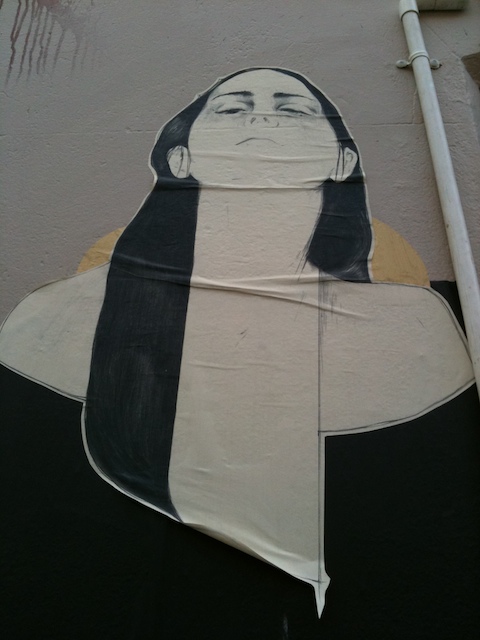
Close up of a new work by Miso

Sticker by Miso

Ghostpatrol
There’s an interesting installation piece on Smith Street, involving boxes attached to poles, with text on mirrored surfaces:
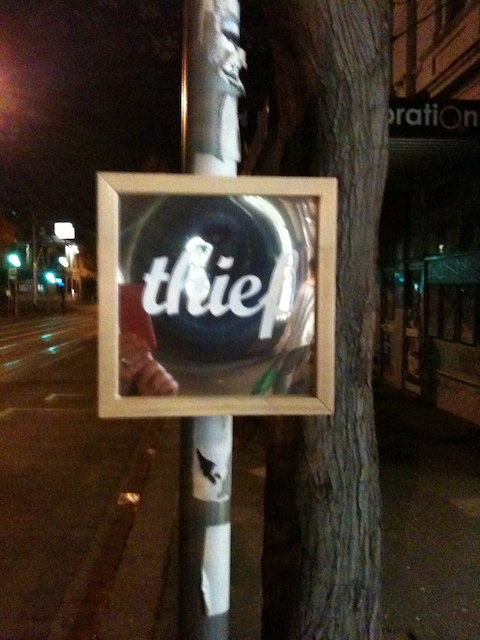
As you can see, this one reads ‘thief’; there are others which read ‘liar’ and ‘loser’. Nice stuff. Since first posting about this, Vetti (of Live in Northcote) contacted me to let me know this installation is by Nick Ilton, and Nick himself has sent me a link to a little video which provides a nice summary of the guerilla sculptures he has been placing around Melbourne in recent weeks. Check it out here.
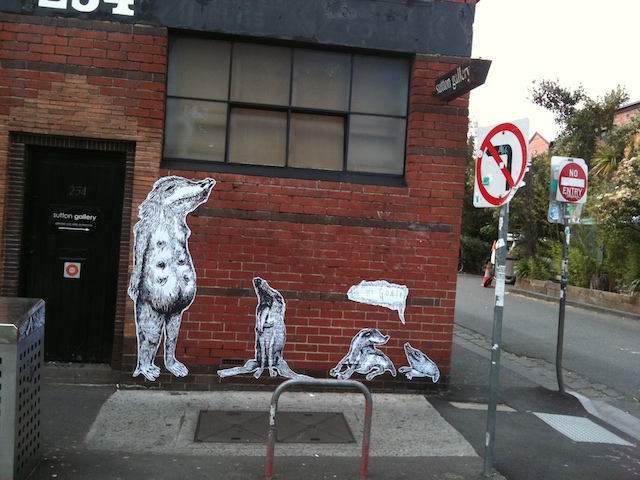
I’ve seen a lot of fresh paste-ups, such as these, outside the Sutton Gallery on Brunswick Street:
You can find these near Alimentari, where there’s been a lot of activity:

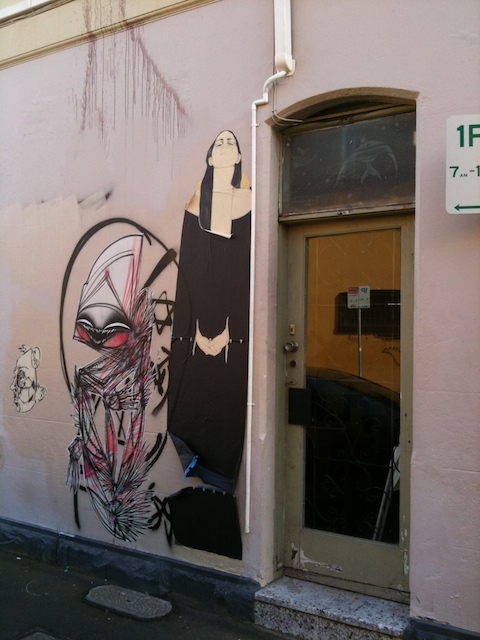
And this is pretty striking:

It’s nice to be home.
Bella Italia
Filed under: art, Art, Street Art | Tags: Italy, Padova, stencils, Street art, Venice
Comments (5) Not many posts recently, because I’ve been travelling through Europe. Sometimes there hasn’t been internet access; sometimes it’s just been too much of a holiday to do any blogging….
But here I am in Todi, an amazing hill village in Umbria, and there is wifi in the hotel room, so I thought I would dedicate a post to some of the fantastic street art I have seen so far on my trip.
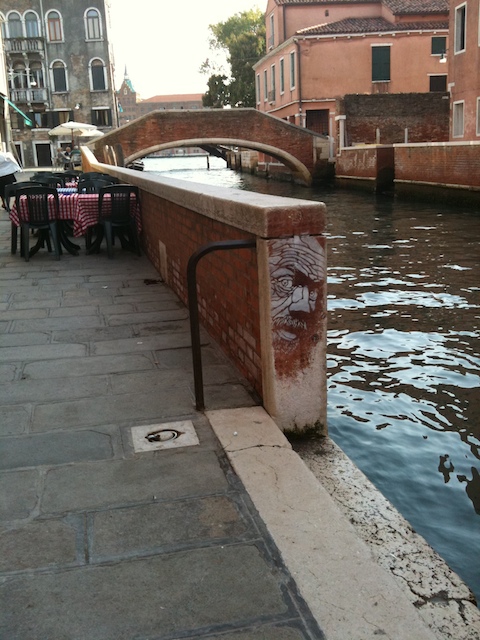
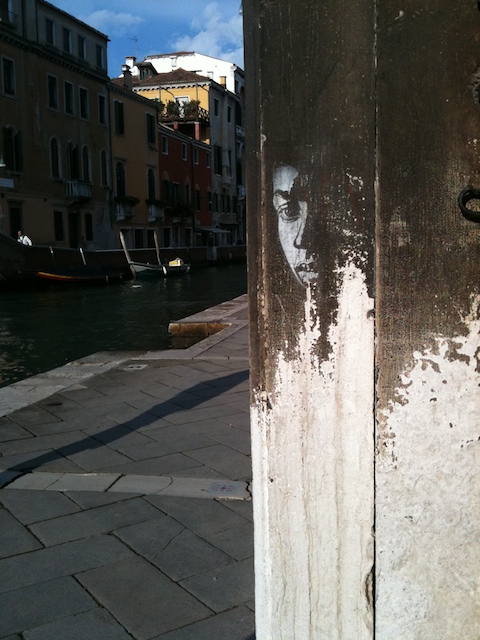
I spent a couple of days in Venice, which is really one of the most fantastic cities in the world. And it was great to see work by C215, beautifully placed as always, against the fading Venetian stucco:
It’s also good to see that some street artists in Venice use boats to move around while getting up – I love the placement of this Swoon piece too, as though the figures are waiting to catch a vaporetto:
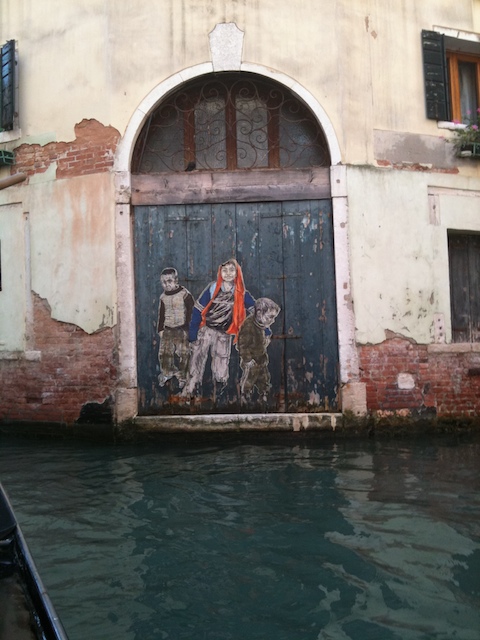
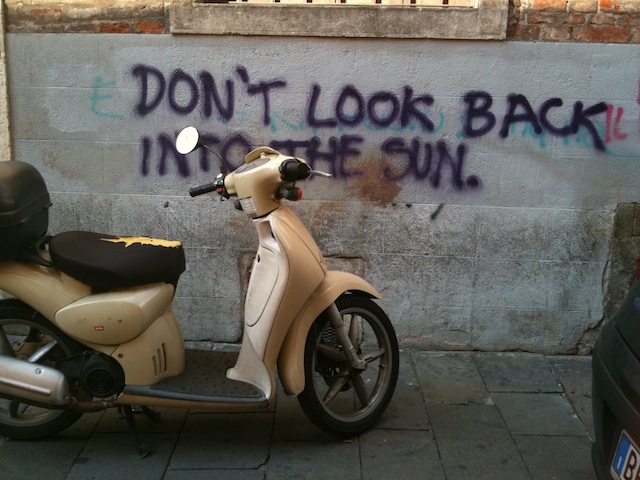
I also spent some time in Padova, which is a university town not far from Venice. There’s a huge amount of art on the walls there. I love it that people are still writing their thoughts on walls (something you don’t see so often in Australian cities like Melbourne these days): political comments, declarations of love, cryptic sayings, and a few words in Latin, too:

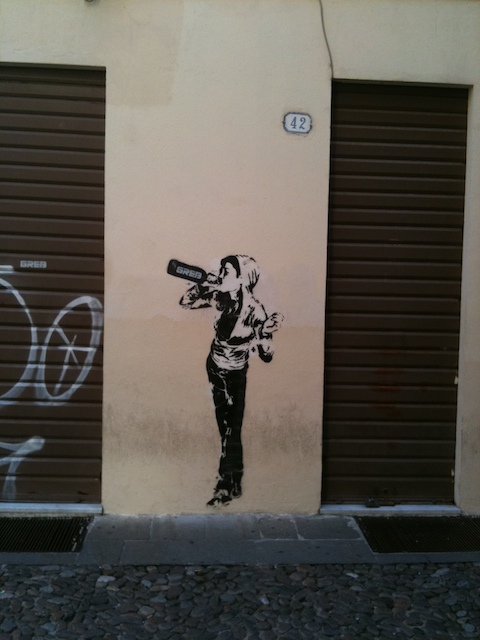
I also saw a lot of good stencil work, like this:
And many pieces which made use of the Padova’s gorgeous arcades to frame elegantly drawn figures like these:


I don’t know who the artist is – if anyone does, please let me know, I thought these works were excellent.
I’ll be in Rome soon. I’m looking forward to seeing the walls there…..
Berlin: name-writing
Filed under: art, Art, Street Art, graffiti | Tags: Berlin, Brad Downey, Charlie Isoe, Kripoe, PITR, Prost, stencils, Tagging, tags, xoooox
Comments (1) Berlin surfaces are written on to a degree I haven’t seen in many places… Tags, whether words or icons, are everywhere. The city’s lack of cash (Berlin is hugely in debt) means that graffiti, postering, stencils and so on are rarely removed, but simply layered over each other or gradually fading away. And so the walls (and many other surfaces too) are filled with images and words, many of them the names of the author or artist.
Lots of these are tags: tagging in Berlin has both an idiosyncratic history and quite distinctive contemporary forms. When reunification occurred after the taking down of the Berlin Wall in 1989, many in the former East wanted to participate in graffiti writing, and began to develop styles and tags. For many, however, it wasn’t an invented tag name that they initially practised: one artist showed me scans of pages from his black book from the early 90s, as an artist growing up in the newly unified, former East Germany, he wrote brand names, instead of tag names, before he developed his own tag (the notebook was filled with ‘Diesel’, ‘Reebok’, ‘Nike’ and so on). But then Berlin style developed very quickly (many artists looked to cities such as Prague for inspiration, after initially being influenced by Brooklyn, New York and so on) and huge block letter throw-ups developed in 90s, many of these still being done or fading but visible still, on train lines especially.
Right now, I’m told there’s a fashion for the so-called ‘ugly’ style of tagging, writing as if in a ‘toy’ style. Interestingly, many tags are very simple, but their significance lies in the prolific range of places that they have been written (this would apply to many, many artists, including Brad Downey, Charlie Isoe, PiTR, 6 and others); other tags are amazing because they have been placed on rooftops or high on walls. Some have developed beautiful forms and shapes (such as the stencilled tag of xoooox); others have used icons s a means to get up all over the city (especially someone like Kripoe).
There’s tons more that could be said about Berlin’s culture of obsessive name-writing, but for now, here is a selection of my favourites…
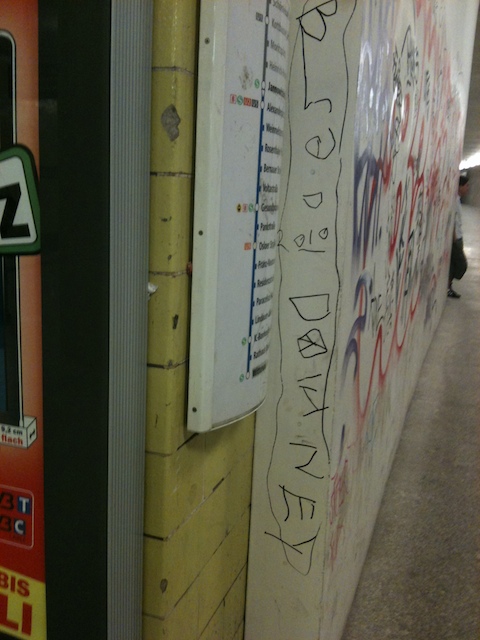
The insanely prolific tags of Brad Downey:



The equally prolific French artist, PiTR, whose tag features here in the toilet of a cafe on Kastanienallee:

Some nice placement here, low down to the ground (as were all the tags by Isoe that I saw):

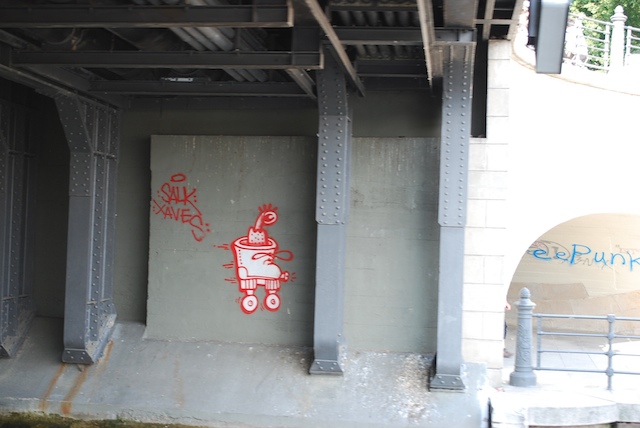
Kripoe’s iconic fists, followed by his equally iconic rollerskate:

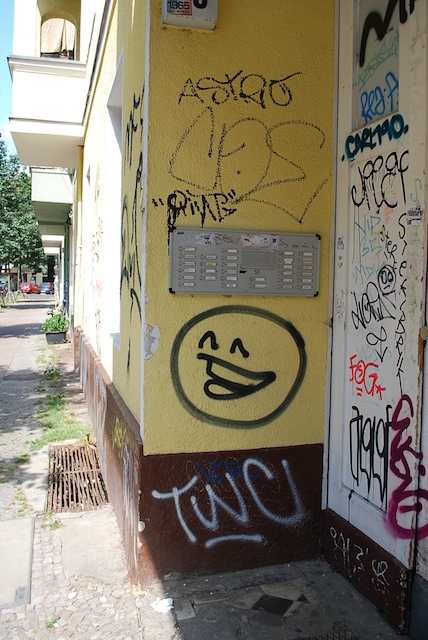
And the little face drawn by Prost (which means ‘cheers!’) all over Berlin (usually laughing, although sometimes angry. This shot shows the archetypical smiling Prost icon:
Here’s an elegant stencil showing xoooox’s tag:

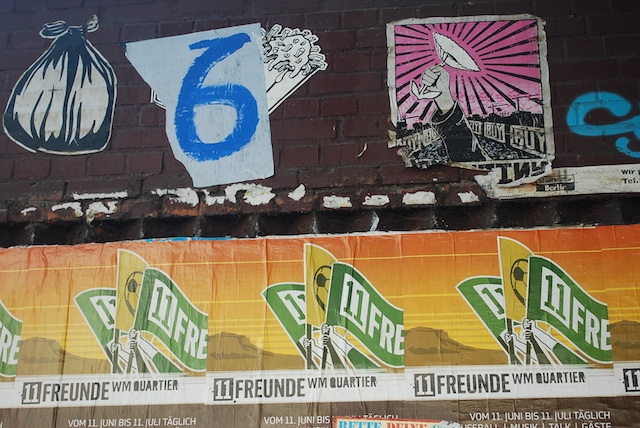
The utter simplicity of a tag that’s reduced to one digit: 6’s tag, here done on paper and pasted high up on a wall:
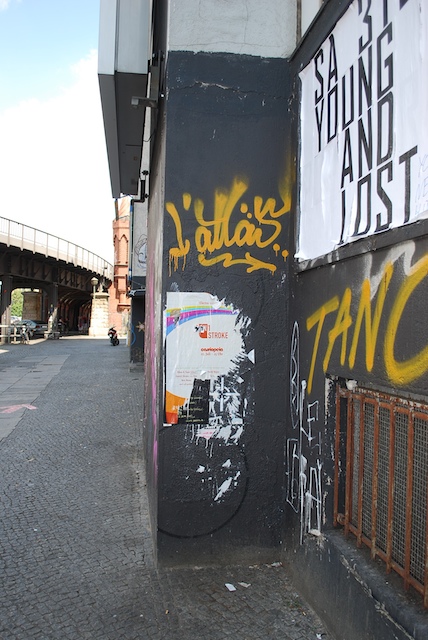
And along with the memories of Paris provided by seeing PiTR’s tag all over Berlin, here’s the tag of one of my favourite French artists, L’Atlas:
Berlin: city of memories, city of history, city of names.
Inside City Outside (walking in colour)
Filed under: art, Art, Street Art | Tags: Berlin, colour, Innen Stadt Aussen, Martin Gropius Bau, Olafur Eliasson, Turbine Hall, Urban space, Weather Project
Leave a comment Today I went to see the first solo exhibition in Berlin, Innen Stadt Aussen (Inside City Outside), by the Danish-Icelandic artist Olafur Eliasson (who has been a resident of Berlin for many years).
I can’t recommend this exhibition highly enough – if you are anywhere near Berlin, you should definitely go to see it.
It’s at the Martin Gropius Bau, which is a powerhouse of a museum, showing major blockbuster exhibitions: at the moment, the crowd-puller is a huge Frida Kahlo exhibition. When we arrived, people were queuing to buy tickets, then queuing again to enter one level of the musuem, then queuing again to get into the exhibition. We were always intending to go to the Eliasson exhibition, but the sight of so many people simply existing in a kind of suspended animation, made me doubly glad that we had decided just to go to the one show.
And the show… it’s really quite hard to describe, because it had such an impact on me. It’s the sort of experience that I think I will remember for many, many years to come.
I say this partly because I can still vividly recall my first encounter with Eliasson’s work – back in 2003, in London. Eliasson was one of the artists who was invited to produce a work for the Turbine Hall of the Tate Modern in London, the massive entry hall of the former power station. Eliasson’s work – The Weather Project – created a giant sun at one end of the hall, with the effect that the entire space was bathed in an orange glow: the chimerical orb, no matter what time of day it was viewed, seemed to be in the middle of setting or rising, pouring warmth into the cold grey of a London winter:

You can see in these pictures how rugged up against the cold we all are…
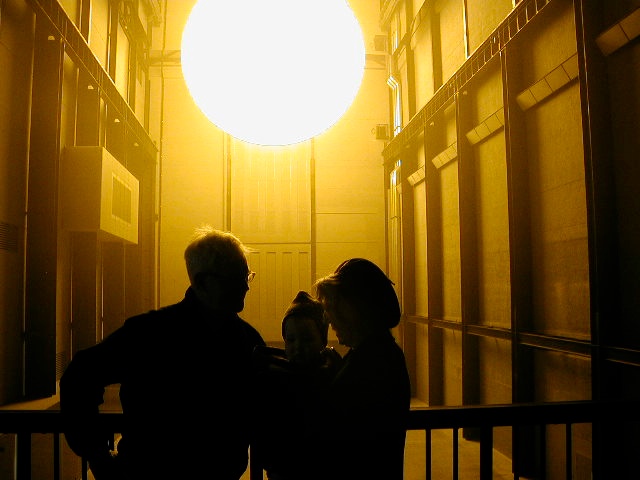
And yet, people, while viewing this artwork, acted as though they were at the beach, lying on the ground, in sunbathing mode, prone before the image of a golden sun:


The Weather Project was an unforgettable experience, one that I always felt lucky to have seen. And now, this solo show lines up beside The Weather Project in offering one of the most outrageously immersive artworks I have ever encountered…
The show is designed to explore notions of internal and external space as it relates to the urban setting. It starts in sedate but pleasurable fashion, laying paving stones from one room to another in the museum, and offering the visitor the unexpected delights of walking on an artwork:

Eliasson has a fetish for light and mirrors (The Weather Project, like most magic tricks, was all done with mirrors and really big lights), and some of the subsequent rooms show him playing with these devices, in a way that allows the spectator to have a lot of fun as well. In one room there are some undulating mirrors that distort sections of bodies across an entire wall in patterns that resemble the tiles and paving stones that are routinely used in urban space:

In others, bodies are projected against white screens in shades of pink and blue, or violet and green. Here’s me, taking a photograph of myself in the artwork…
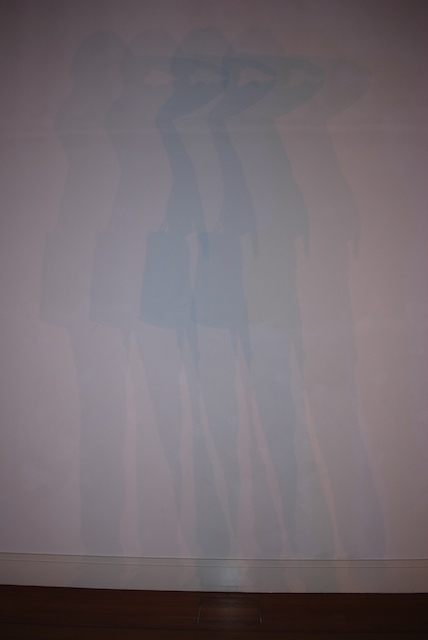
…and he builds sculptures of silver metal which contain cleverly placed lights and mirrors so that when one peeps into the internal cavities it appears that there is no floor, with the sculpture falling away to nothing before one’s feet.
There’s also a fascinating piece of moving-image art, a short film made around various locations (such as Moritzplatz and Kortbusser Tor) in Berlin, using a mirror to generate a sense of liquidity and shiver in the density of urban locations.
But in addition to these, there are two absolutely show-stopping artworks. In one, you enter a space that is constructed entirely of angled glass. It is a narrow space, an inverted triangle, but the mirrors make it appear to open to infinity on all sides, so that one fears to approach its edges, which initially seem to fall away, but then tilt to reveal another floor on which one is reflected, standing firmly and looking back into the main space. Sadly, this room was populated with museum staff whose main aim seemed to be to stop people taking pictures, and so I can’t show you what this amazing room looked like in any way.
It seemed like this might have been the highlight of the exhibition, until we entered another room, which was taped off, and which had a warning notice on the door stating that only children over six years old could enter….
This space inside this room was as hot as a sauna, and initially appeared to be filled with steam. (Although i know I should be fearless in my experience of art, I’m ashamed to report that my first thought was ‘oh no, my hair will go frizzy…’.) But the steam was actually smoke (and so, my hair survived, un-frizzed). The room was filled with smoke, which was coloured by long narrow lights in the ceiling, segmented by barriers, which shone down into the space. The lights in the ceiling were ordered according to the spectrum, so that the smoke in the room was in effect dyed according to the colour of the lights above. The dense smoke in the room meant that you could see only as far ahead as an arm’s length, meaning that all depth of field was lost, and you moved through the spectrum of colour, from one to the next, with no horizon, and no sense of boundary, horizon or limit.
It was utterly disorienting and completely transporting. You were literally walking in colour. At one point, in the red-to-violet section of the spectrum, the colour was so intense that my eyes could hardly make sense of what they were seeing.
And so we stumbled around, joyfully, for quite some time, until we admitted it was time to leave (well, it was as hot as a sauna – maybe it is designed to be hot so that people don’t stay in there for hours). And we emerged from the room and into the body of the museum (where people were still queuing hopelessly for the Kahlo exhibition), blissed out on colour.
I’ll always be grateful to Eliasson for this experience. A thoughtful, thought-provoking exhibition, capped with a mind-blowing artwork which takes on some of the limits of the relationship between artwork and spectator and dissolves them into coloured smoke.
Refiguring the Walls of Paris
Filed under: art, Art, Street Art, graffiti | Tags: C215, defacement, FKDL, Indigo, Jana und JS, Jef Aerosol, Jerome Mesnager, Miss.Tic, Nemo, Paris, PITR, stencil art, Street art
Comments (4) Street art and graffiti, when spoken about by those who don’t enjoy the experience of discovering unauthorised art in city spaces, are sometimes said to deface the walls of the streets in which they are found. Calling it ‘defacement’ is a way of saying ‘damage to property’, of course, but interestingly, when street art’s detractors want to focus on the question of purely physical damage to property, they usually use the term ‘vandalism’. So the term ‘defacement’ seems to speak to something else, as though the walls of the city have an outward face, which has been altered, spoiled, or even destroyed by the artwork – literally de-faced. (There’ an excellent book on the concept of defacement by Michael Taussig, if you are interested in thinking more along these lines…)
Thinking of city walls in this way sounds odd, until we start thinking of how we are quite accustomed to speaking of the facade of a building, for example; both ‘facade’ and ‘face’ share the same root, from facia (face) in Latin.
On my way home from Paris to Melbourne, I was thinking about the term ‘defacement’ and how it gets used as a negative descriptor of street art and graffiti (well, it’s a long, long flight, you have many hours in which to ponder these things). If walls have faces that can be ‘damaged’, then that sets the street artwork up as operating as a form of disfigurement.
[If you don’t look at street art as a form of disfigurement, then of course the addition of artworks to the city walls by its artists can be construed in many, positive lights (as written about in previous posts on this blog): as a gift, as a contribution to the community, as a means of beautification of drab spaces, as a form of communication between the artist and other members of the community, and as a means of celebrating the city itself.]
It seemed particularly fitting to me to think through the idea of street art and graffiti as a form of defacement and disfigurement after having spent two weeks in Paris this May. I spent hours walking through the streets and saw some amazing and inspiring work. One of the things that was striking about it is the preponderance of figurative work: there are hundreds of portraits by dozens of artists adorning the walls of Paris, and here is a selection of some of the ones I enjoyed most.
Here’s a section of a large work by the Vancouver-based artist Indigo:
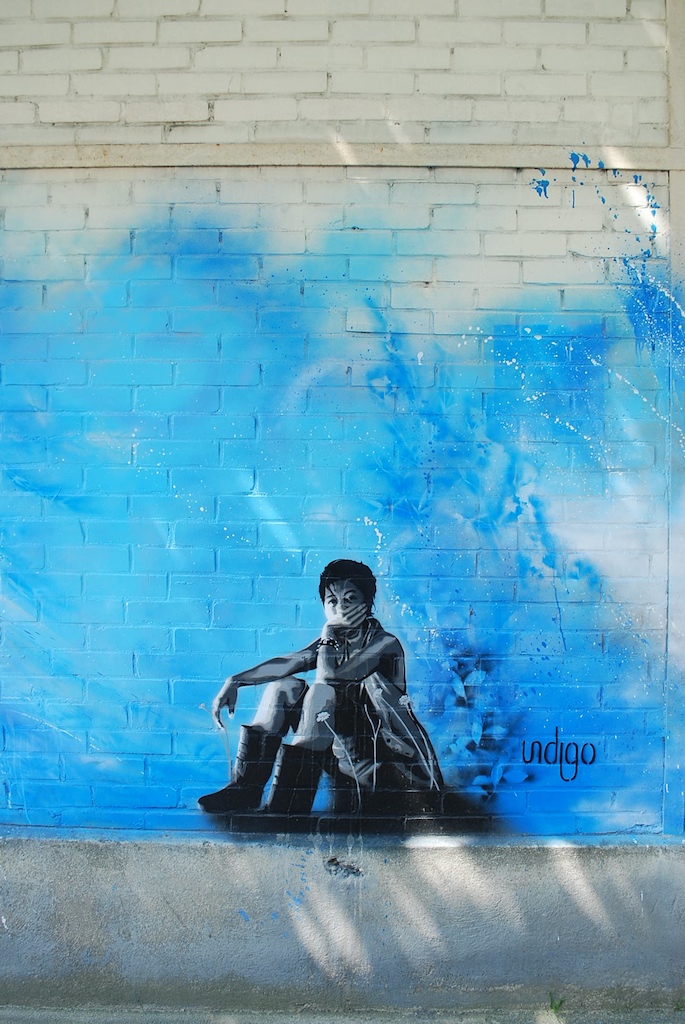
One of the curving black figures created by FKDL:

A beautifully placed image by C215:

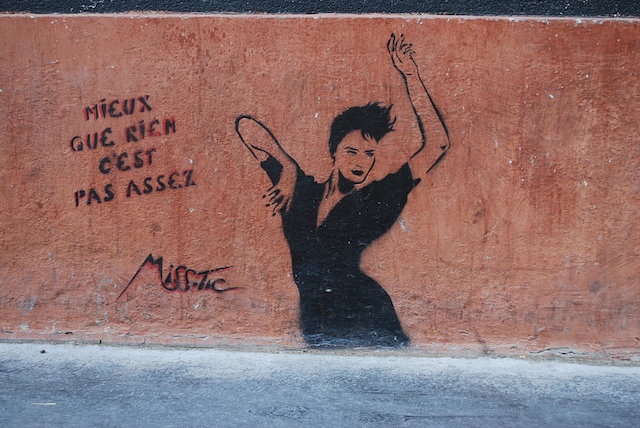
The incomparable Miss.Tic, making stencils since the mid-1980s:
Two works, dancing together. The corps blanc, or white figure, is by Jerome Mesnager, the female figure is by Jef Aerosol, both also veterans of the French scene:

And here is one of Nemo’s typically segmented scenes, in which a dark silhouetted figure tumbles through various scenes against a backdrop of sandstone:

As a graduate student, much of my time was spent reading the work of the French philosopher and historian Michel Foucault (and since becoming an academic, a lot of my time is spent teaching his work too), so it was a great pleasure to come across his face on a number of walls, placed there by the stencil artist PITR:

And I was fortunate enough to catch some freshly painted stencil works by Jana und JS, stunning in their photorealistic detail:
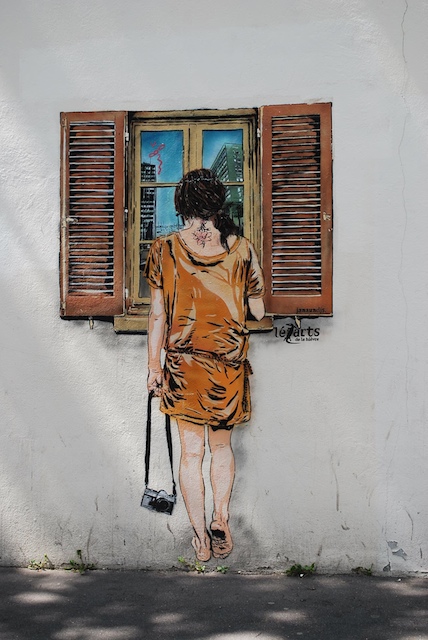
Finally, a slightly different kind of portrait, that of the grinning yellow cat made famous by Monsieur Chat. These cats apparently bound across many of Paris’s rooftops, but I caught sight of only one. You can just see its Cheshire-cat happiness high above the street, beaming down at the passers-by:

It’s easy to find this kind of street art appealing: well-executed images in bright colours, skillfully applied in well thought-out spaces. What’s not to like? Who could call these images a disfigurement of the walls? But I think that what I saw in Paris was more than just a negation of the criticism of street art’s detractors. And so I’ll say this: instead of simply being not-disfigurements, these works actively re-figure the streets of Paris, opening for the passer-by moments of narrative and instances of beauty where previously none had existed.
Street/Studio: the Launch!
Filed under: art, Art, Street Art | Tags: artists, Melbourne, Street art, Street/Studio
Leave a comment Last Friday was the launch at Federation Square of Street/Studio: the Place of Street Art in Melbourne (Thames & Hudson), the book that Miso, Ghostpatrol, TImba and myself have been working away on since last August.
The launch was amazing! We were completely overwhelmed at the numbers who turned up to buy a book, get it signed, have a beer or a glass of wine, and celebrate the publication with us.
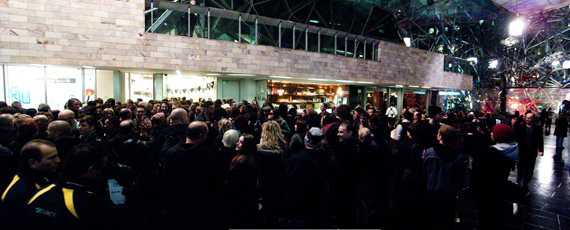

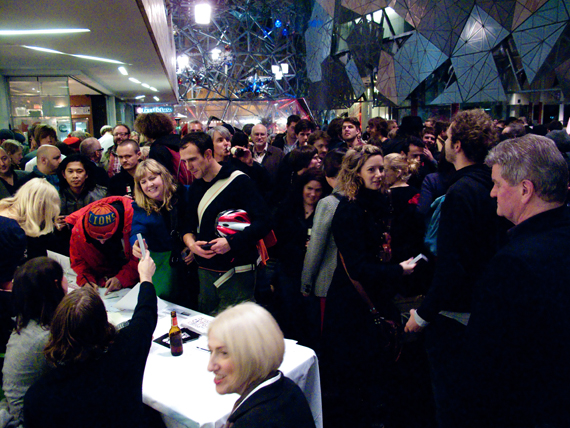
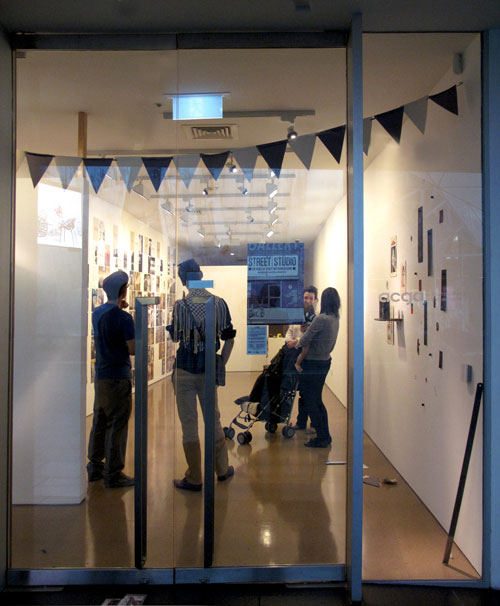
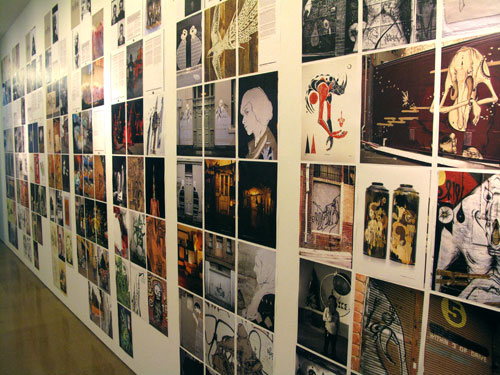
No Vacancy Gallery put on a really nice exhibition based around the book, which ran until Sunday:

Some of the artists featured in the book are overseas right now and couldn’t be there, but Niels Oeltjen, Twoone, and members of Everfresh came along to sign copies of the books.

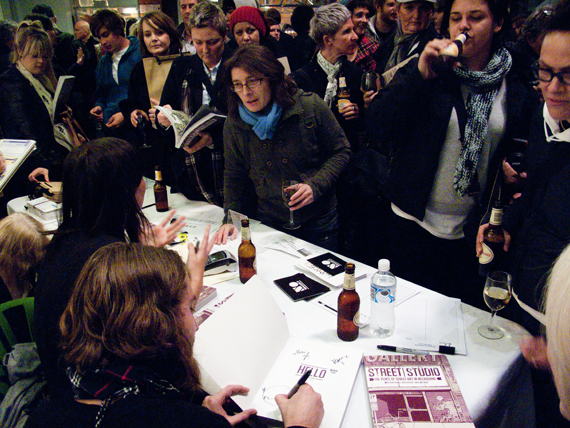
Thanks to Thames & Hudson for organising such a great night, and thanks to everyone who came along; apologies to those who weren’t able to get in because of the crowd.
And a huge thanks to Alex from NIce Produce for the amazing photos.
More Street/Studio events to come in the next couple of weeks….
Street/Studio launch: sneak peeks
Filed under: art, Art, Street Art | Tags: Melbourne street art, No Vacancy Gallery, Street/Studio
Leave a comment The launch of our book, Street/Studio; The Place of Street Art in Melbourne, takes place tomorrow night at No Vacancy gallery, in the Atrium of Federation Square.
Here are some sneak peeks at how the launch is shaping up…. Come by tomorrow night to see some great artworks and have a look at the book!
 Images to Live By