Archive for the ‘Art, Street Art’ Category
The walls of Fitzroy: a love letter
Filed under: art, Art, Street Art | Tags: Al Stark, Everfresh, Fitzroy, paste-ups, political graffiti, stencils, Street art
 Comments (3)
 When I first moved from England to Melbourne, in 1995, I lived in Carlton North but I spent a lot of time in Fitzroy, and I was struck by what I could see on the walls there. Not stencils (they would come later), not tags or pieces (they were on the trains, and the walls adjoining the train lines), but a kind of conversation taking place on the walls. Sometimes the conversation was between the authors of the comments, but oftentimes the addressee was me – or at least any individual who was walking, or taking the train, or driving, or sitting on the tram – any individual who happened to be looking. I saw graffiti that said: ‘subjugate thyself to the screen’; ‘this is the wrong site for the museum’; and ‘corporate whore’.
I became fascinated by the ways that these comments addressed the passer-by. Some seemed to simply express a view (for example, ‘this is the wrong site for the museum’); others seemed to be seeking an object of denunciation (for instance, ‘corporate whore’). And one day I passed by a wall, on which weeks before I had seen a piece of writing that said ‘Real Men Don’t Rape’. It had been edited, either by the original author or by another writer, and it now read ‘Dead Men Don’t Rape’. Something in that moment, which caused me to pause and think about the difference in the politics of each of the two statements, made me realise that the activity of writing on walls generated an encounter with the spectator (me, or anyone else), which can be educational, emotive, perhaps even transformative.
Over the years, the walls of Fitzroy hosted a huge range and number of statements, the majority being intensely political: ‘Refugees ain’t got fleas’; ‘Save Goolengook’ (an old-growth forest in Gippsland that was being intensely logged for woodchipping), and the myriad comments made by members of grrr, an all-women collective whose aim was to comment on and critique the narrow range of acceptable body types and identities depicted in television: ‘more fat women on tv’, ‘more dykes on tv’ and so on. (I was living in Northcote by this time, and I was delighted that one of grr’s comments, ‘more hairy women on tv’, was painted on the pavement in my street.)
After the explosion of stencilling in Melbourne from 200o onwards, the walls of Fitzroy became more known for its stencils than its political slogans – although many stencil artists used their medium for political ends, exploiting the stencil’s ability to catch the eye of a passerby, and using its combination of word and icon to provoke critical thought, as you can see in these examples:


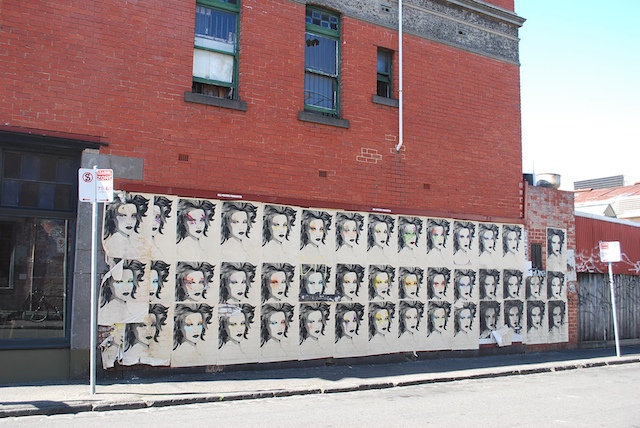
And nowadays? Well, Fitzroy is still synonymous with the communicative and creative use of wallspace but now it’s the diversity of styles and media that is most remarkable. There are entire painted walls, such as the ‘Welcome to sunny Fitzroy’ wall by Everfresh (the subject of an earlier post on this blog). There are amazing paste-ups like these:
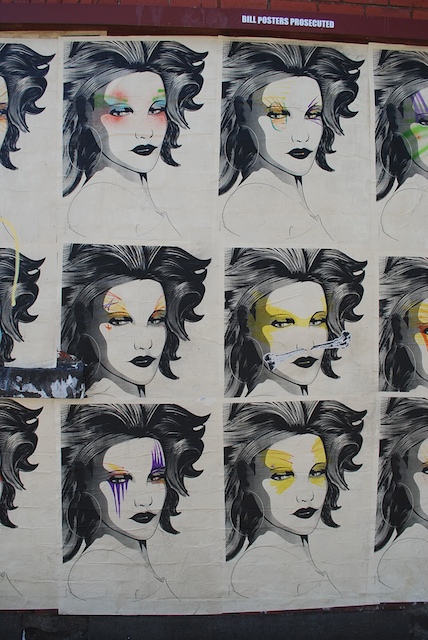
It’s worth taking a closer look at the details here. Rone has made each image slightly different, and has placed them under a ‘BILL POSTERS PROSECUTED’ sign:
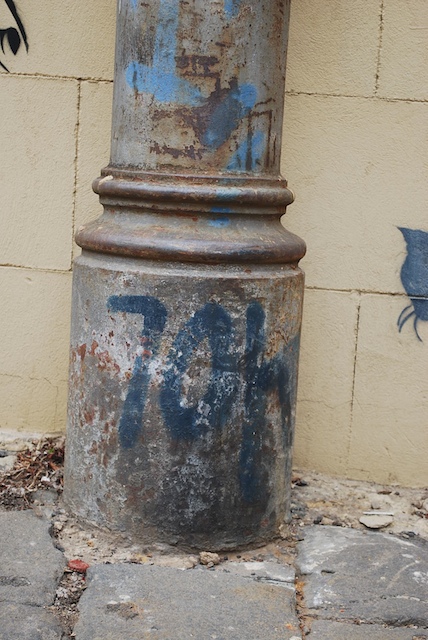
There are plenty of tags, of course, and some of Fitzroy’s laneways have some very old tags, such as this 70k one:
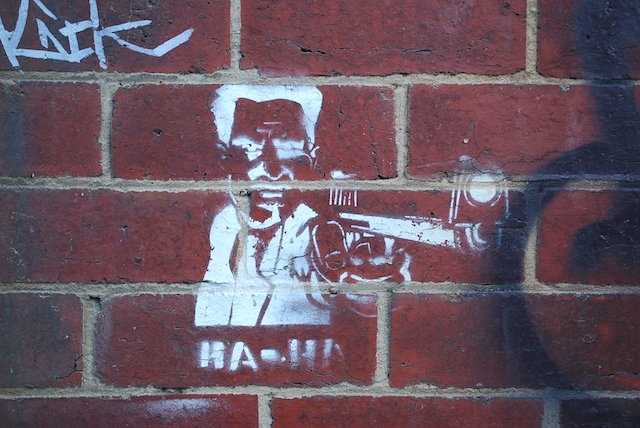
And stencils: there are certainly still stencils around, and, once again, some have been there a long time:
The history of the appropriation of the walls in this area by artists has been on my mind a lot recently, because I’m now living in Fitzroy, so these walls provide the backdrop to my everyday life, and when I walk past them I get a strong sense of the layers of street art, visible and invisible (through the effects of time, weather, buffing, and other artists), that have become part of the very geography of this suburb.
And it was while I was walking home the other day that I came across this piece: a stunning work by Al Stark, wrapped around the corner of a house, intricately painted, simultaneously evocative and elusive:
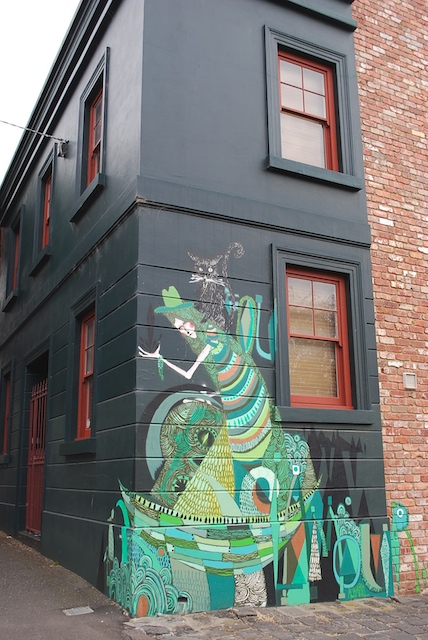
It’s almost fifteen years since I came to Melbourne, and I wanted to write a love letter to the walls of Fitzroy (and the artists who have transformed them), providing me (and many others) with so much pleasure. Long may it continue.
Jenny Holzer and the Art of Words on Walls
Filed under: art, Art, Street Art | Tags: art and politics, Jenny Holzer, Redaction Paintings, Street art, torture, Truisms
Comments (2) Last week I was among the lucky ones who heard the American artist Jenny Holzer speak at RMIT’s Capitol Theatre. Holzer presented a slide show of her work, which spans thirty years, from its earliest Truisms series, through the Inflammatory Essays and the Laments to the more recent Redaction Paintings. She spoke modestly and with humour, often seeming to downplay the impact and intelligence of her formidable artworks. Since last Friday evening, I’ve found myself thinking frequently about her work and how enormously insightful it is; I was assisted in this enterprise by visiting the Australian Centre for Contemporary Art (ACCA) last night, to see her current exhibition, and to listen to a conversation about her work between Louise Adler and Juliana Engberg, ACCA’s art director.
Holzer has become such a colossal figure in contemporary art that it’s easy to forget how she first came to public attention: as a street artist, wheat-pasting posters on the streets of New York in the very early 1980s. These posters contained lists of the ‘truisms’ she became famous for: short statements that sounded sometimes banal, sometimes profound, sometimes sensible and oftentimes directly contradictory. The posters stated, always in upper case, always justified to the left hand side, always in a vertical list: ‘ABUSE OF POWER COMES AS NO SURPRISE’, ‘TORTURE IS BARBARIC’, ‘RAISE BOYS AND GIRLS THE SAME WAY’, ‘MONEY CREATES TASTE’, ‘AN ELITE IS INEVITABLE’, ‘PROTECT ME FROM WHAT I WANT’ and many, many more. The Truisms were also printed onto T-shirts (and I was the proud owner of one): Holzer said in her lecture on Friday night that she wanted to make ‘cheap art’; art that would be ‘useful’ and that could circulate among people.
She spoke about how she made the Truisms series anonymous, because she wanted people to pay attention to the subject-matter, and she related the reactions that her work attracted: sometimes people edited the statements (circling ones that they approved of, crossing out others that they disliked). As she put it: ‘that’s the thing about working in public: people are immediate and truthful’.
Holzer is rarely included in discussions about street art (one of the few books that I know of which does discuss the importance of Holzer’s work for street art, is Cedar Lewisohn’s excellent book, Street Art). But there should be more consideration given to her work as a form of street art; if you do, a number of interesting consonances can be seen.
First, in many of her works, Holzer provides an account of consumer culture and its impact on contemporary society. In this respect, she has much in common with culture-jammers and adbusters who alter billboards or produce counter-images, inviting people to think differently from the ways advertising discourse would prefer. Second, Holzer’s fascination with public space aligns her with street artists, who share with her the desire to make an image that can be seen outside a gallery (even if Holzer now tends to make her works in public space on a rather larger scale than the Truisms series, projecting words onto the outside of buildings as massive and as monumental as the Louvre and the Guggenheim Museum).
Third, she also shares with some street artists an abiding interest in textuality and the possibilities of the word. One of the things that Holzer ‘s work does superbly is the investigation of the iconic properties of the letter form, and the ways in which words (whether static or in motion, racing crazily across her LED signs or progressing with inexorable slowness across the façade of a building or a body of water) can constitute images in themselves. And when I listened to Engberg talk about the combination of stoicism and poetry in the texts that Holzer uses (sometimes her own, more recently often the work of others), I was reminded of the way that Laser 3.14 writes aphorisms on the walls of Amsterdam (see my earlier entry on his work). And, of course, the possibilities of the letter form are taken to their calligraphic limit by graffiti writers’ wild style innovations (although Holzer would no doubt rightly point out that graffiti writers are not so interested in an accessible experience for the public in general and are engaging in a rather more private conversation).
Another consonance that struck me relates to Holzer’s recent fascination with light and projection. Holzer has used lasers to write the text of works such as Lustmord, and has created many installations that project words onto buildings, creating an utterly ephemeral image, just as artists such as the Graffiti Research Lab have experimented with lasers and LED devices to ‘write’ on walls.
But finally, and more generally, somehow, the quiet, determined politics of Holzer’s art seem to me to share something with street art, at least in its continual refusal to be erased from the streets by municipal zero tolerance. At ACCA last night, Juliana Engberg said that Holzer comments on, but doesn’t critique, various phenomena – I would disagree with this, in that Holzer’s selection of texts clearly leans towards the indictment of certain issues rather than detachment from them. There’s also a fascinating interview on the site ArtInfo (which you can read here) between Holzer and Benjamin Buchloh in which Holzer states quite explicitly her opposition to the war in Iraq, for example. So although her word lacks the didacticism of, say, Barbara Kruger, it actively seeks to communicate a political view.
Take Holzer’s recent Redaction Paintings series. In these works, declassified government memos regarding the torture of detainees have been screen-printed by Holzer onto large canvasses painted in various sombre and unassuming shades of brown. Last night, Engberg lamented the fact that some critics had opted to focus solely on the words contained in the memos, thus downplaying their nature as paintings. It’s a good point: what Holzer is doing requires the spectator to look at those words endorsing the torture of others in the same way that one might look at a landscape or a portrait; in the relationship of contemplation that is thus engendered, the spectator takes in those words of war in a wholly different way. Those words laid bare across the canvas are hung in the gallery next to paintings which contain screen prints of palm prints, prints taken by American soldiers after the death of a detainee, with the black lines of censorship drawn brutally through the whorls and inlets of the dead man’s identity.
Works such as these clearly have a lot in common with Lustmord, the installation Holzer made in connection with the rape and murder of women and girls in the former Yugoslavia (an installation I wrote about in my book, Judging the Image), but also have a long lineage, right back to the Truisms of 1981, in which Holzer wrote ‘TORTURE IS BARBARIC’. In the Redaction Paintings, it is as if Holzer is still saying those three words. Three decades on from the pasted-up Truisms, with great patience, Holzer is still telling us that torture is barbaric. When will we heed her words?
The City and the City
Filed under: art, Art, Street Art | Tags: China Mieville, city, Gorker Gallery, Miso, Street art, Tchusse
Leave a comment Imagine that the city you live in actually intersects with another city… Every street, every building exists in your city, but also in another city, which occupies the same space as your own…
This is the premise of the wonderful novel by China Miéville, The City and the City, which I read during the summer vacation. It tells of a fictional city, Beszel, somewhere on the far edges of Eastern Europe, which intersects with another city, Ul Qoma, in the way I’ve described. People live in the same space, but they are citizens of one city and not the other. The inhabitants of Beszel speak a different language to that spoken in the other city; each citizen of Beszel has to learn to ‘un-see’ the presence of the citizens of the other place, and vice versa.
It’s a fascinating idea and makes for some amazing reading. But it has also made me think about street art and the city, and about some recent work by Miso, in her show in December (which I wrote about really briefly here just before the summer break). Although the show is no longer on, I think that there were some really interesting ideas going on in it, and wanted to write a little about it.
Miso’s show, Tchusse, was at Gorker Gallery in Fitzroy,. I went there on an extremely hot night in December, to see the show and to hear Miso speak about the work. The gallery was crowded, indicating how much interest there is in Melbourne in her work.
In some ways it’s hard to think of the show as having individual works within it (although it does), because it also worked very well as a large installation. Have a look at these pictures, from Miso’s website.The gallery was transformed into a street space, by virtue of the layers of drawings and objects hung on the walls and criss-crossing the corners of the space on string. There were many of Miso’s beautiful drawings, often showing women in the midst of various activities, and many object that she had made: for example, small models of buildings lit from within.
But there were also objects that had been brought into the gallery as part of the setting for the works, some of which had themselves been transformed by the artist. There were wooden doors, upon which pages from books, or posters and notices had been affixed. Items of clothing were suspended from string like laundry from washing-lines; tea-bags also hung drying in corners. There were pages taken from books, pinned upon the wall, next to framed photographs of some of Miso’s street-based art works (which brought other, real, locations into the simulated location within the gallery, but did so through the means of mediation themselves).
The result, when one walked into the gallery, was a sense of entering city space rather than gallery space, albeit a city whose dimensions had been compressed and constrained into multiple layers around and across the gallery.
And it was not simply any city that was being created here: it was in fact Kharkhov in the Ukraine, the city that Miso is originally from; a city which inspires much of her art and which her art in turn remembers and recreates.
On that hot, hot night in December when we all crowded into the gallery to hear Miso speak about the work, I was struck by the way she spoke about her aims – to bring Kharkhov into Melbourne, through her drawings of its inhabitants, through the wooden doors covered with notices of items for sale or pages torn from books, through the tiny scale models of buildings with bullet holes in them, through the clothing hanging from the string. It is not a literal Kharkhov that is being created, but rather a representation of the city, a city that is sensed and experienced through standing in the gallery.
And so Kharkhov becomes a part of Melbourne, rather than a city on the other side of the world. It seems to me that such an achievement testifies to what art is capable of – to make another city within the city that we all take for granted. Miso’s show is an example of what street art and graffiti can do to and for the cities we live in.
China Miéville’s book The City and the City describes what it’s like to live in a city which is inhabited also by ‘others’ (people who speak differently from us, people who think differently about the same streets and spaces). Miso’s work allowed us to see the city of Kharkhov by temporarily bringing it into the physical space of Melbourne. And street artists and graffiti writers do this for us over and over again, pointing out that for every person who inhabits Melbourne as a space determined by private property and ‘clean’ walls, there is another citizen of the city, one who sees walls as surfaces to be painted. Miéville’s book may be classified as an ‘ urban fantasy’ on amazon.com, but the split experience described in his novel is one which certainly applies both to the art created by Miso and to the day-to-day experiences of anyone living in Melbourne today.
Update on the Graffiti Prevention Act…
Filed under: Art, Street Art, graffiti, law | Tags: art and crime, criminalisation of young people, graffiti, Graffiti Prevention Act 2007, police powers, State Government of Victoria, Tagging, young people
Comments (5) Back in 2008, I posted an entry about the newly introduced Graffiti Prevention Act here in Victoria… The State Government created that Act as part of its ‘get-tough’ stance on graffiti: the Act expands the definition of graffiti (so that more activities are now classified as graffiti), gives the police greater powers in responding to individuals they suspected of writing graffiti (increased powers of search and seizure, for example), and gives powers to councils to enter properties in order to remove graffiti without requiring the property owner’s consent (previously that was impossible).
It also created a raft of new and harsher penalties for those convicted under its provisions, and was constructed so that individuals facing a charge under the Act would be likely to pay an on-the-spot fine rather than try to contest a charge through the system (and in ensuring that on-the-spot fines were the preferable option for individuals facing a charge you could almost say that the Act engages in a bit of revenue-raising, like parking fines, for the State).
Contesting charges was made harder by virtue of the Act reversing the burden of proof so that anyone suspected of being a graffiti writer has to convince the police officer that they are carrying, say, an aerosol can for legitimate purposes rather than for writing graffiti. (Previously, and in relation to most offences rather than ones involving the possession of drugs, police officers had to actually do some detective work and ensure that they have evidence proving that the person charged had committed the offence.)
Back in 2008, I commented that it was likely that the Act would increase the number of individuals being criminalised by the system, and, since it facilitated police reliance on stereotyping in relation to who might be a graffiti writer, would have a disproportionate effect on young people. At the time I was writing, police officers were being trained in the implementation of the Act, and there was no information about how they were going to put it into operation. But now, thanks to an article in The Age newspaper recently, we can finally get a sense of what the police are doing with their new powers.
And the news is not good: what they are doing is more or less as I predicted, at least according to the article, ‘Graffiti tags help police put names to offenders’, by Andra Jackson in The Age on 22 December. The article describes a police operation, apparently in one municipality of Melbourne (Kingston) rather than city-wide or statewide, in which police have ‘raided the homes of 53 teenage suspects’ over the last year. The Act gives police the power to apply to a magistrate for a search warrant ‘when they have reasonable grounds to suspect’ that the individual has been writing graffiti. In the resulting raids, police have taken possession of aerosol cans, sketchbooks in which tags are practiced, and any other item which has been tagged.
In the article, the author states that the police ‘acted on intelligence’ to carry out the raid. I presume this means they obtained sufficient information to go before a magistrate and get a search warrant. It’s not clear how much information a magistrate would require before granting a warrant but if one year results in 53 warrants being granted in this one municipaility, I’m thinking that the local magistrates aren’t being overly strict with their interpretation of the Act).
The article doesn’t go into details of what actually happened to these 53 teenagers, but simply says that ‘usually’ they are given a community-based order by the Childrens Court. (Subsequent offending under the same Act will result in being sent before the Magistrates Court where higher penalties will apply.) So it would appear that one of my speculations about this Act was pretty accurate: would these 53 individuals have been brought before a court prior to the inception of the Act? Maybe some, but I would doubt that all of them would have, and so the Graffiti Prevention Act is proving to be a clear instance of what in criminology is called ‘net-widening’, where people who would otherwise not have been at risk of acquiring a criminal record and facing punishment within the system are now included within its ambit.
In terms of my other prediction – that the Act would facilitate the steroetyped targeting of young people – well, that seems to be coming true as well. This particular police operation was directed at two groups of people: the first involves teenagers, as already mentioned (because no-one other than teenagers ever does graffiti, right??), and the other is retailers who sell spray paint to teenagers. This other part of the police operation even involved sending under-18 year olds posing as would-be graffers into shops to attempt to buy aerosol paint during one week in December. Any retailer who sold paint to the kids was arrested. According to the article, 24 shops were approached, and ‘half willingly sold the students paint cans and other tools’. Throughout the last year, 120 retailers were charged with 1310 offences of this type. The penalty is an on-the-spot fine of $234 (hello!), and any subsequent offence sees the retailer in the Magistrates Court facing a $2000 fine. But even though this second group involves retailers, what’s striking is that the concern is with retailers who sell paint ‘and other tools’ to under-18 year olds, meaning that this issue has acquired its currency only because it relates to graffiti by young people. And it’s in this way that the Act is proving to be a powerful and flexible tool in the criminalisation of young people and others associated with their (illicit) activities.
It’s interesting that there’s been so little information until now about how the Act has been used since its implementation. I would very much like to know what is being done by the police in other parts of Melbourne and Victoria. It’s possible that perhaps the Act isn’t being used to criminalise more and more young people – but, I have to say, I doubt it. The State Government created the Act for exactly these purposes (against the advice of many individuals and groups), and it looks, sadly, as though the Act is doing what it was made for.
‘Tchusse’: new show by Miso at Gorker Gallery
Filed under: art, Art, Street Art | Tags: Gorker Gallery, Melbourne, Miso, Street art
Comments (3) It seems like every recent post I have uploaded to this blog has begun with an apology about how busy/sick/distracted/hectic I have been…. Well, why break a pattern by doing something different! Apologies for taking such a long time to add a new post here. I had been holding off on doing so because I was due to travel overseas (to Berlin, Paris and London) and I wanted to create lots of posts about the street art I would be seeing there. Instead, my daughter got pneumonia, and I managed to catch it from her, so my trip was postponed, then postponed again, then I finally said, ‘I give up and admit it, I am too sick to travel this year’. So I have had to delay with visits to those amazing cities until next year.
And then just when I thought that I would resume blogging about the fabulous street art in my home town of Melbourne, my partner managed to get sick (yes, apparently I passed on the whole pneumonia thing to him) plus we decided on an impulse to move house, so we have been consumed by the obsessive, stressful and depressing process of selling and buying. And while that’s not over yet, some of it is (we sold our house last week), and it’s definitely good to be able to feel that there’s a little more time in the week as a result.
I wanted this first-post-in-ages to be about something very special, and I’m happy that it is indeed. Miso, one of my very favourite artists in the world is having a new solo show in Melbourne at Gorker Gallery in Fitzroy. It opened a little while ago so to some of you this will hardly come as news (did I mention that I have been crazy busy?) but it is on until 20 December and in fact on Wed 16th there will be an artist talk by Miso at the Gallery.
Some info about the show and what to expect, which I have taken from Miso’s website:
Miso – Tchusse

Miso – Tchusse
{Stanislava Pinchuk}
Opening Night: Thursday, 3rd December {6-9 pm}
Gorker Gallery – crnr Gore & Kerr Streets, Melbourne.
“‘Tchusse’ sees Miso re-create & condense her home city into a gallery.
Kharkov {Ukraine} becomes a floor to ceiling installation – portraits of
strangers in the street, of friends, folk stories and things otherwise
forgotten, turned into a city built from paper, material and decaying wood,
as Miso replicates buildings, street signs and notices, ladders, empty
bottles, criminal tattoos and clothesline and clothesline from memory.
In this way, Tchusse becomes an extension if Miso’s widely renowned
work as a street artist, as well as being her most ambitious installation &
gallery project yet.”
Miso will be doing an artists talk on the wine tasting evening – Wednesday,
16th of December, at 6 pm. ‘Tchusse’ will also be the launch of a
collaborative clothing project with Warren Harrison.
The exhibition will run until 20th December;
3-7 pm Wednesday-Friday // 11am – 7pm Saturday-Sunday.
If you click on the link for Gorker, you will see some shots from the opening night and get a sense of how amazing the show is. And if you know Miso’s work already, you will realise that this is definitely a show not to be missed.
It’s also a great way for Gorker to end the year. In 2009, they have put on some of the most interesting exhibitions in Melbourne, and I’m looking forward to see what they have lined up for 2010….

Three Variations on a Theme of Surveillance
So much street art and graffiti depends upon thwarting the technologies of surveillance. I was looking back through some photographs taken on a trip to London last July, and came across three images, each of which are to do with surveillance in different ways.
Here’s one, taken in Rivington Street:
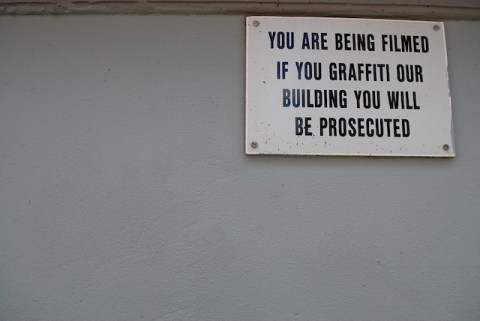
I like the double-layering that my photograph creates. The notice announces the fact of being filmed, at the same time as my camera films the notice.
This type of notice and device is typical of what can be seen all over London (and in many other cities around the world). London has filled itself with surveillance mechanisms, the most obvious of which is of course the closed circuit TV camera. They can be seen in so many streets, angling downwards from their elevated positions, like ugly metallic carbuncles on the walls of buildings. And the idea is certainly that in the streets where a camera can be seen, you can be seen on camera (although this Big Brother-esque cliché is often not true in practice: a few years ago I visited the control room for Melbourne City Council’s many CCTV cameras, and staff there admitted that there were so many screens and so few staff that it was impossible for them to properly see much of what was filmed).
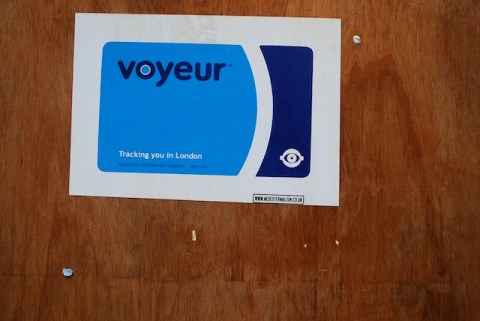
The camera on the wall is just one type of surveillance device; there are others. One is the Oyster travel card that allows users to move between modes of public transport. As they travel, it deducts the cost of their journey from a prepaid account in their name. Super convenient, of course,, but when I was visiting there were a number of interesting stories in the media about how the Oyster system was being used to provide information about people’s day-to-day movements. Cases were cited of individuals who believe their spouse or partner is cheating on them looking at their Oyster statements to check where and when they travelled, in the hopes of revealing illicit trysts. Others believe that such computerized systems can be used for data profiling, either for more extensive marketing and advertising or for the straightforward surveillance of citizens that all governments engage in.
And one street artist in London was promulgating a critique of the surveillance systems surrounding citizens: Xylo’s stickers denouncing the Oyster system and mobile phone records were everywhere in 2008. Here’s one, in which he has transformed the very recognizable Oyster logo into the word ‘Voyeur’:
The final image doesn’t survey, and doesn’t denounce: instead, it transforms. The phrase ‘Bill stickers will be prosecuted’ is well known; it announces that bill posting or sticking is a crime and acts as a warning to anyone engaging in the activity. (It has also led to a commonly-seen variety of corny graffiti, in which individuals might write, as a riposte, ‘Poor old Bill Stickers’, or something similar.) In Brick Lane, I found this object affixed to a wall:
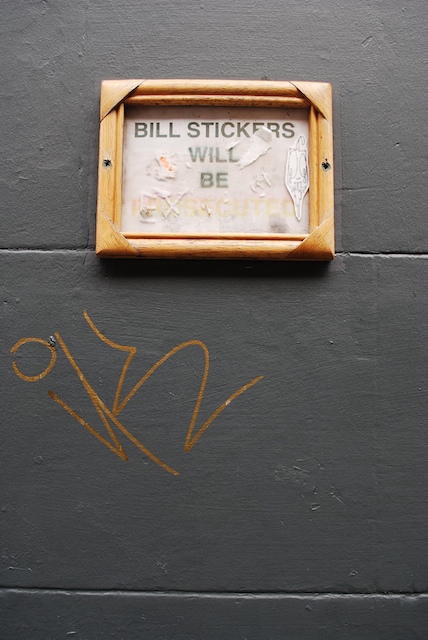
The artist has taken a printed version of the warning, and has edited it (illegibly now), and reconstituted it as part of an artwork itself. Thus the will to prosecute (to ‘put someone in the frame’, as the police might say) has been transformed into an image, itself framed and hung upon a wall, in public space, for all of us passers-by to see it, and to smile.
The Everfresh wall in Fitzroy
Filed under: art, Art, Street Art | Tags: crew, Everfresh, Fitzroy, Melbourne, Street art
Comments (4) Recently when I was reading the excellent blog by Very Nearly Almost, I came across a recent post which was celebrating some of Melbourne’s street art (which you can read here) and noticed that the Everfresh wall in Fitzroy was featured.
The post reminded me that I photographed this wall a few weeks ago, with the intention of dedicating a whole post to the amazing work of the Everfresh crew in creating this wall. So here is that post…
Everfresh will be well known to many readers of this blog, since their contribution to street art in Melbourne has been enormous. Their work, both commissioned and uncommissioned, can be seen on walls in many areas of the city (they are well represented in Hosier Lane, for example), but they are most closely associated with Fitzroy and Collingwood, and it’s in the streets of those suburbs that their works can be seen to best effect.
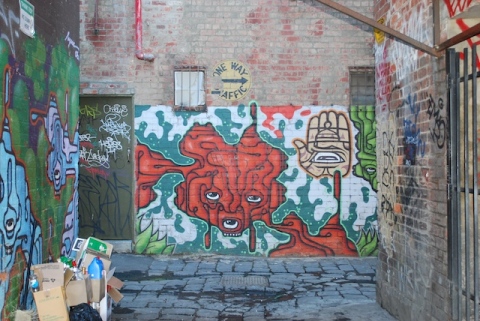
Everfresh are a crew of several artists (including Sync, Rone, Makatron, Reka, Meggs, and Phibs), who work as a group, solo, and in all possible combinations allowed by the group. They have evolved a very distinctive style, which, once you are familiar with it, is instantly recognisable. here’s one example, seen in a laneway in Fitzroy:
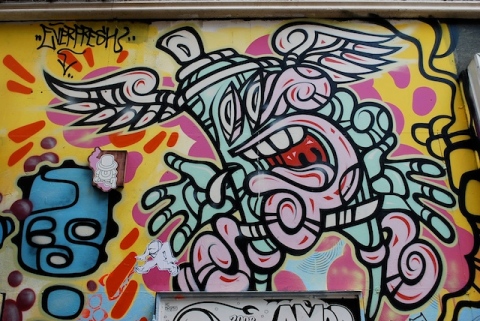
Last year, when I was in Amsterdam, I had the pleasure of looking up at a wall outside the Cafe Belgique in Gravenstraat and seeing an image that I immediately associated with Melbourne, and ‘home’:
Quite a while ago, I had heard that there was a large wall in Fitzroy that Everfresh were going to paint, outside the Black Cat nightclub. I know this wall well, in that I drove past it every day for two years, on my way to work. It was like any other wall in this semi-residential, semi-industrial area: tall, brick, occasionally tagged, occasionally billpostered. But now – now it looks quite different… I guess the painting happened during the several weeks that I was ill with the dreaded whooping cough earlier this year. At any rate, I didn’t see any of the work being carried out, but one day when I drove by – there it was: quite wonderful. ‘Welcome to sunny Fitzroy’:
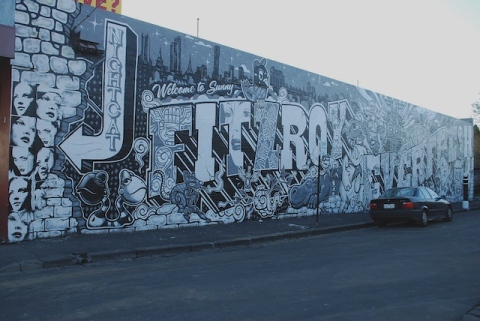
The car parked next to it gives you a sense of the wall’s scale and size. The artwork that completely covers it is an intricately designed homage to Melbourne in general and Fitzroy in particular. The fact that it is painted in black-and-white (and shades of grey) gives it a startling prominence amid the naturalistic colours of the street around it. It looks like a frame from an old film, somehow transported into the everyday ‘real’ world, located as it is opposite a petrol station and a row of terraced houses. It also manages to showcase the distinctive styles of the artists who worked on it (for example, by incorporating some of their signature images within the letters that comprise the words) within the overall sense of a single coherent visual style. It’s such a huge work that it’s hard to photographically do justice to all the complexities within it, but here are some examples.
A section by Rone:

And one by Meggs:
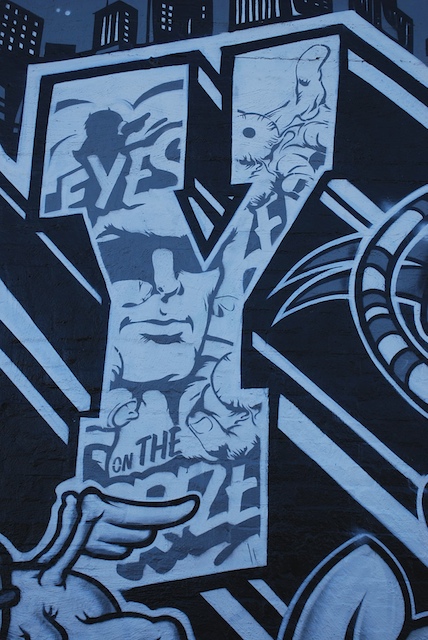
And here are a few more, just for good measure, because the work is so great:


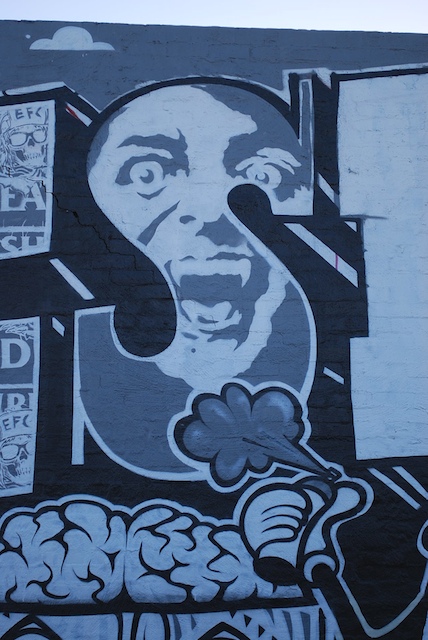
In this last image, you can really see the brickwork under the paint, a reminder that underneath there is a rather drab wall, now transformed into something which embodies the very idea and spirit of Fitzroy. Which is what Everfresh is all about, really.
You have been invaded….
Filed under: art, Art, Street Art | Tags: anti-graffiti, Invader, Lazarides, mosaic, Space Invader, Street art
Comments (1) To coincide with the about-to-open show at Lazarides’ Rathbone Place gallery in London, I thought it was a good time to post this little homage to the wonderful Invader.
For those of you who don’t know Invader’s work, Invader is a French artist who makes and remakes small mosaics of the ‘Space Invader’, star of countless video games in the 1970s.
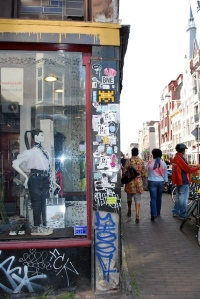
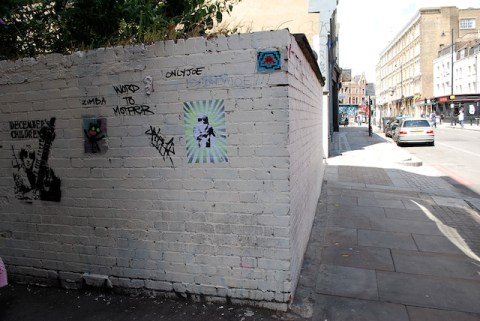
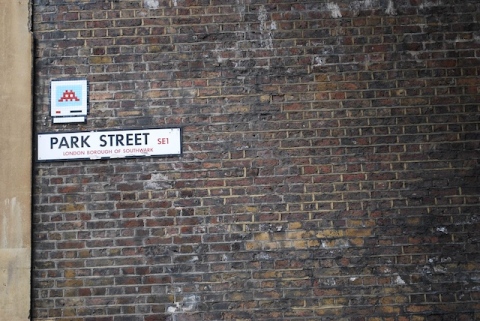
I always think of Invader’s works as occupying space in the street very quietly: due to their smallness, they tend to be unassuming and easy to miss, often placed high up on a street corner, or in some hard-to-reach location. (I’ve written recently about the appeal of the small – have a look here).
Once you do notice them, they have great appeal: as mosaics, they have an artisanal quality that provides a nice contrast with the low-culture evoked by the video game referent.
On his website, Invader repeats the trope of ‘invasion’ in another way, so that cities become sites to be invaded by the artist and his mosaic tiles. It’s obviously a militaristic metaphor, and one which is often used by the opponents of graffiti, who see illicit imagery as something which ‘invades’ a previously ‘clean’ wall. It’s one of the great things about Invader’s artwork that it can pinpoint the hysteria that underlies anti-graffiti rhetoric, for here, indeed, are the fearful ‘invaders’, and it has to be asked, who could fail to love these little mosaics?
In addition to his dedicated work in invading (to date) 40 cities around the world, in recent years, Invader has also had a number of gallery shows. I’m unsure how successful his work is in the gallery setting, but it certainly draws a lot of strength from fine art movements such as Pop Art. For me, Invader is at his best in the street, and so, while I recommend that anyone who is in London over the next month takes a look at his gallery show, I wanted to pay tribute to the enduring charm of the Space Invaders that can be found all around us – in the streets. I believe that Invader has been busy adding some new works to the streets of London in the last little while, so keep your eyes open for those. But for now, here are some of my favourites.
In Amsterdam:
In Shoreditch, London:
Not far from the Tate Modern, in London:
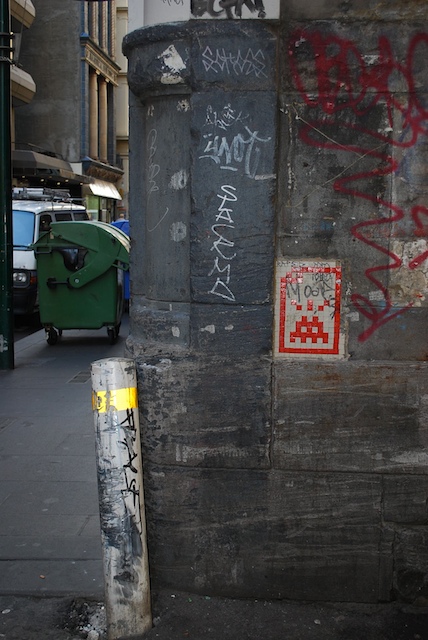
In Rothsay Place, in Melbourne’s CBD:
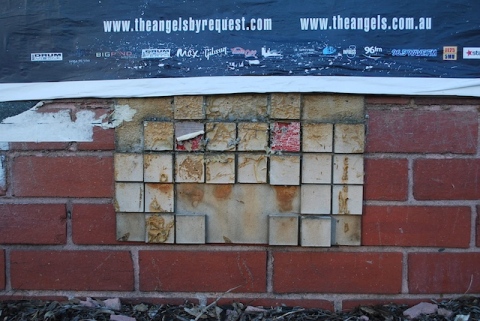
Just off Alexandra Parade, in Melbourne, a very faded example:
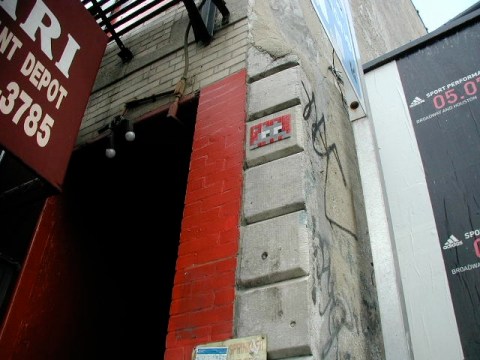
In SoHo, New York City:
Enjoy the show, if you get to see it at Lazarides. But, even better, enjoy the streets if you are lucky enough to have been invaded!
Talking about street art….
Filed under: art, Art, Street Art | Tags: JR, Melbourne, public space, Street art
Leave a comment I’m giving a lunchtime talk in my department next week, called ‘Street Art and the Contestation of Public Space’.
Here’s what it will be about:
“Cities are sites of intense cultural and aesthetic production, engaged in the continual development and refinement of their self-image. This occurs by means of a range of aesthetic practices, such as architectural innovation, statuary, control of signage and advertising, and public art, underpinned by a network of planning regulations, local and municipal laws, and public order law.
For its citizens, a city’s processes of cultural production are sometimes unremarkable or even imperceptible; at other times, however, these processes become contested, subject to planning disputes, legal intervention, and shifts in public opinion. This talk focuses upon the contestation arises in connection with street art and graffiti writing.
The talk will focus upon two examples.
The first is the approach to street art taken by the City of Melbourne. Since 2003, local councils within Victoria have been required by the Department of Justice to develop plans for the regulation of graffiti within their municipalities. The City of Melbourne initially developed a strategic approach to graffiti based on the concept of zones of ‘tolerance’ for graffiti and street art, but then elected instead to pursue a policy of zero tolerance combined with a discretionary permit system.
The second example focuses upon the French street artist JR, who uses street art as a means of engagement with the politics of ethnicity, race and religion and as a platform to draw attention to the impact of war or emergency in ‘post-conflict’ cities and countries.”
If you are in Melbourne and are interested in coming along, here’s a link to the departmental homepage, where you can find details of the talk listed under ‘Events and Seminars’. Clicking on that link will open a downloadable pdf of a poster for the talk, which gives information about the venue and the time.
I’ve done a few talks on street art and graffiti over the last few years in Melbourne – Street Alliance, at Federation Square, or the Cultural Development Network’s forum on Permissible Art at the Famous When Dead Gallery. This one will be a more ‘academic’ one, given the setting, of course. Anyway, if you are interested, you are welcome to come along.
On being small
Filed under: art, Art, Street Art | Tags: art in a jar, Civil, small, stencil, Street art
Comments (1) Reading back through some of the previous posts on this blog, I realised there is a bit of a repeated theme, in that I’ve commented favourably on the large scale of many works (for example, the works in the Leake Street Tunnel in the Cans Festivals, JR’s paste-ups in London, or Bill Viola’s images, or the works on the façade of the Tate Modern).
Since I don’t want to give the impression that an artwork has to be huge in order to impress, I thought I would devote this post to images which demonstrate that an affective charge can arise from placement and composition as much as from scale.
One of these is something that I have been thinking of as ‘art in a jar’. Have a look:
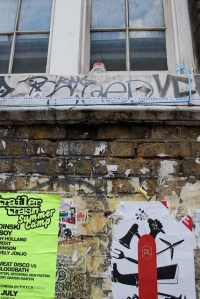
Perched on a window sill, high above ground level in Brick Lane in London, sits a little jar, with a lid on it. Inside the jar, there is a piece of paper, folded up, and on the piece of paper you can just about glimpse a drawing of a figure. I love the idea that someone not only did these little drawings but also placed them inside their own small containers and then placed the jar on a window sill, which functions as a kind of display shelf for the artwork. It’s the tiny size of the jar and its half-hidden drawing that gives the work its character, which would be lost if the jar were bigger.
I also like this stencil very much:
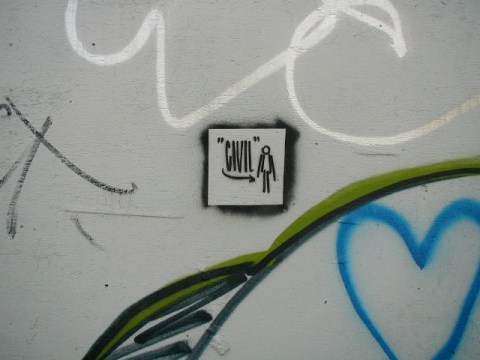
Taken in Richmond, Melbourne, back in 2003, it is signed by Civil and shows one of the little stick figures that have since become a signature motif, featuring in large numbers in much larger works. I like those larger images a great deal, but there’s something quite perfect about the simplicity of this: the figure, the name, and the frame.
And finally, here’s something I saw just last week. Actually, my daughter spotted it, as we were walking home from school. She suddenly stopped and pointed upwards, saying, ‘Look, mama, graffiti!’(She doesn’t make any distinction between street art and graffiti: controversial, I know, but since she is only seven, I figure she still has plenty of time to learn about the arguments as to whether graffiti is different from street art and vice versa.)
Here’s what she had spotted (and what I had missed):

And a closer view of it:

It’s a simple enough piece of work, nothing tremendously spectacular about it. But what I liked is the fact that it is placed so high on the wall (it’s a good fifteen feet up), and is thus easy to miss (as I did). It’s a great example of an artwork being there for the noticing (or not). Once noticed, its very presence brings pleasure: I now feel as though I’m party to a secret history for that little part of the street, since the presence of the artwork reveals that someone came here, probably with a ladder, and attached this image to the wall, placing it in such a way that it could be overlooked, just as it looks down at us from on high. Now I’ve seen it, it draws my gaze upwards, reminds me to be alert in the streets of the city, attentive to whatever small gifts might have been placed in public space for us to enjoy.
 Images to Live By