Bill Viola: ‘Ocean without a shore’.
Filed under: art | Tags: art, Bill Viola, death, moving image, water
 Comments (2)
 These last few weeks in Victoria have been all about heat, fire and drought, and so there’s a certain aptness in writing about an artist whose works often make use of water. Bill Viola is an American artist whose work, Ocean without a shore, has recently been purchased by the National Gallery of Victoria. It has been installed for a number of weeks, and I finally managed to get to see it. As with the other times I have seen Viola’s work, I was completely awestruck by it.
The work was originally made for the Venice Biennale, where it was installed in a small chapel. Each of its three screens took the place of altar pieces within the chapel, and the setting must have generated an amazing atmosphere in which to view this work. Here’s a short film about the installation of the work in Venice:
The NGV installation retains a sense of the work’s engagement with the sacred and the uncanny by placing it within a very small, darkened room. The spectator sits on a low bench just inside the room, a low bench reminiscent of a church pew. Each screen is placed on one of the three walls, in a manner very similar to the Venice installation. Unlike a standard chapel altar piece, however, the images within the screens are moving.
Each screen shows the same scenario, performed by a different person. A blurry figure stands at a distance from ‘us’, or, from the ‘front’ of the image, if the screen constitutes some imaginary ‘front’. These images strongly evoke depth of field – the figures start in the distance, walk forwards, halt, look around, turn, then walk away. When they have each returned to their starting point, each one is succeeded by a new figure (although this moment of succession is never possible to see on screen – I found myself always either distracted by the other screens or simply unable to make out the exact moment of transition due to the fuzziness of the figure once it has receded into the depth of the screen).
The figures do not move in synch with each other; they come and go in series, sometimes in the same order (left panel, then centre panel, then right panel), sometimes not (left panel, then right panel, oh, then left panel again, then centre panel, then right panel… and so on). The speed of the figures is slow: they are in fact shown in slow-motion, which makes their movements seem both ponderous and tentative, and which adds to the ominous tone of the piece.
And what else is happening as each figure makes this slow walk forward and back? There is, as with all Viola’s work, a great deal more going on, consisting mainly in the thick texture of the artwork itself. As each figure draws near to ‘us’, they pass through a wall of water. Digital effects mean that we do not see the water, except as after-effects – droplets, spray, sprinkles – after each figure passes through it. But what we really are being invited to look at is the transformative capacity of the water: the individuals are of course drenched by the water, so that previously frizzy hair lies flat, or a light coloured shirt is soaked dark.
But more than this, passing through the water wall plunges the figures into rich, deep colour and sharp focus. No longer grey and blurry, they seem fully present as they stand and look around, sometimes seeming even to gaze directly at the viewer. They exhibit no pleasure or joy, however; their moments are still solemn and hesitant, and after a short time, each figure turns and walks back through the invisible water (which we still see only in its after-drops) and back into black and white indistinction.
While this takes place, we hear a dull continuous, almost industrial thrumming sound, which crescendos to a cascade of noise whenever a figure approaches and moves through the water wall. Here’s a short clip which gives a sense of what this looks and sounds like:
Viola is, as many of his other works will confirm, fascinated by the anunciatory and transfiguring power of water. A number of years ago, I had the experience of seeing one of his works, Five Angels for the Millenium, at the Tate Modern in London. Here’s a video clip which gives an idea of what this work is like – you have to persist till the end for the extraordinary pleasure of the last few seconds:
That work was installed in an enormous, extremely dark room; five gigantic screens were installed on the walls, each showing a single figure plunging into and out of water in extremely slow motion. For the viewer the experience was utterly disorienting: I found my gaze compelled by the screens, and the surrounding darkness meant that I often did not see other spectators on the periphery of my visual field, so that I would bump into people while moving around to view the screens. Thus, just as the figures in the work were plunged into dark water, so the spectator was temporarily immersed in darkness: ‘all at sea’, as if moving through an unlit ocean.
In the NGV piece, although water plays a large part (as you can tell, both from my description and from the title of the work), we are not being invited to feel any such consonance or connection with the figures depicted, or to measure our experience in comparison with theirs.
On the contrary, the invisible wall of water marks a threshold – between the worlds of the living and the dead. For Viola, the figures in each panel are ghosts. The work makes literal the archaic term for a ghost: shade. Faintly visible in blurry grey tones they come towards us – the living – and attempt to press themselves into our world, but are always, after each brief return, forced to withdraw, to fade once more into the shadows where they belong.
The triangulation of the three screens, with each successive apparition gazing at the spectator, provides a melancholic sense of a threshold that cannot be surpassed, of the limits of life for us all, and of the irrevocable rupture that death brings about. It’s an artwork of immense power, and, in the immediate aftermath of the devastation brought by bushfires in Victoria, it’s an artwork that seems made for this sad time.
Tagging, part 2: how a signature can lead to prison
Filed under: graffiti, law | Tags: graffiti, Graffiti Prevention Act 2007, laws against graffiti, penalties, prison, Tagging
Comments (5) The previous entry was about some apects of social attitudes to tagging; however, it didn’t mention one of the most important aspect of how people think about tagging – that it constitutes a crime.
Precisely which crime depends upon the jurisdiction you are in. In Victoria, it could fall under the Summary Offences Act, or if you are caught carrying something like a marker pen or a spray can, you might be prosecuted under the new Graffiti Prevention Act (see my previous post in September 2008, called ‘Clamping down’). Some jurisdictions have graffiti-specific legislation, like Victoria’s new laws, while others prosecute tagging and other graffiti activities under more generic headings.
But of course the thing is that calling tagging (or any other graffiti-related activity) a crime sets off a whole series of consequences. First of all, it categorises the activity as something that ‘society’ should be concerned about, should condemn, and should try to prevent. Next, and directly following on from that, it perm its the involvement of the police and other crimino-legal agencies and institutions, and authorises them to ‘respond’ to graffiti. Relatedly, it allows councils to create local laws which authorise the removal of graffiti (consider the fact that councils are compelled to have ‘graffiti management plans’, mainly because graffiti is considered criminal, but not ‘public urination reduction plans’, or ‘bag snatching abatement plans’). Subsequently, if an individual is discovered engaging in a graffiti-related activity, such as tagging, by these crimino-legal agencies (most likely the police), then the categorisation of tagging as ‘criminal’ means that they can be arrested, charged, and prosecuted. Once that’s done, then further consequences follow: an on-the-spot fine, perhaps, or an appearance at the Childrens or Magistrates Court.
Many people assume that when individuals get prosecuted under laws prohibiting graffiti-related activities the punishments available are not harsh. Some might assume the penalties are ‘lenient’. (After all, it’s only a property crime, right? It’s not as if we are talking about interpersonal violence.) Others might say that the available penalties are ‘not harsh enough’ (and would argue that the effects of property crimes accumulate such that their overall effects are considerable).
So perhaps it’s useful to be reminded that the punishments are not ‘lenient’ or ‘not harsh enough’. A couple of days ago, an 18-year old girl, Cheyene Back, in Sydney was sentenced to three months’ imprisonment for writing on a wall in a cafe. (Check out here what the Everfresh boys had to say about this. And click here to read a thoughtful opinion piece about the case by Kurt Iveson.)
According to one news report (thanks for sending the link, Noah!), she wrote her ‘nickname’ (which I presume means her tag) on what’s described as the ‘public wall’ of the Hyde Park Cafe. I’m not sure what ‘public wall’ means – is it the outer wall, or does it mean something else? ‘Public’ wall sounds like ‘legal’ wall, but given that the action led to her being ‘caught’ with ‘a black texta at the scene’, that surely can’t be right. (Perhaps someone from Sydney who knows the Hyde Park Cafe could enlighten me as to what the ‘public wall is…)
Whatever it is, Cheyene has been convicted of the offence of ‘intentionally destroying or damaging property’, and she will go to jail as a result. And all through the chain of consequences set up by the categorisation of the act of writing one’s name on property belonging to another as ‘criminal’.
On tagging
Filed under: Art, Street Art, graffiti | Tags: Arthur Stace, calligraphy, graffiti, Tagging, Xero
Comments (1) I’ve been on holiday for a few weeks, and on my first night back in Melbourne I watched the ABC’s broadcast of The Eternity Man, a filmed version (directed by Julien Temple) of an opera which has been performed in London and Sydney, among other places. The music is by Jonathan Mills, with a libretto by the late poet, Dorothy Porter (information about The Eternity Man here).
The Eternity Man tells the story of Arthur Stace, whose name will be familiar to many Australian readers of this blog as the man who chalked the word ‘Eternity’ in meticulous copperplate script on Sydney’s streets, walls and buildings for decades. The identity of the word’s author was for many years unknown, and the reality of Stace’s existence – a formerly homeless alcoholic who was almost certainly schizophrenic – came as a shock to many who had speculated as to what individual might have such perfectly flowing ‘penmanship’. Stace’s handiwork, although initially decried as ‘graffiti’, was eventually recast as an idiosyncratic aspect of Sydney’s identity, with this process of redefinition reaching its apotheosis, long after Stace’s death in 1967, in Sydney’s Millenium celebrations for the arrival of the year 2000, when the Harbour Bridge was lit up by thousands of fireworks spelling out the word ‘Eternity’ in Stace’s handwriting.
The Eternity Man continues this investment in the figure of Stace, representing him as a melancholic, enigmatic loner, hallucinating his memories and anxieties around Sydney, calming his fears and uncertainties through the repeated inscription of one single word.
While watching the film, it struck me that what Stace was doing was ‘bombing’ the city – the word ‘Eternity’ is like a tag, written over and over, and Stace’s nocturnal wanderings and indiscriminate interest in any urban surface was a version of going ‘all city’, covering urban space with the author’s tag. A few decades ago, when Stace was writing ‘Eternity’ all around Sydney, his actions were regarded as graffiti. But now, it would be hard to find any contemporary examples of his activities being described in this way. What prevents Stace being viewed as a ‘graffer’ and the word he wrote being thought of as his tag?
Well, of course, an obvious answer would be that Stace clearly didn’t belong to any kind of crew and was not interested in graffiti culture. Well, yeah, of course not. But that doesn’t really answer the question why it is that a clear separation is now being made between Stace’s writings and ‘graffiti’.
That Stace is to be regarded as a kind of artist (rather than as a ‘graffer’ or as a ‘vandal’) is signalled to the spectator through the film’s construction of a thoroughly aestheticised frame for Stace’s compulsion: when he is shown walking through the city at night, significant events from twentieth century history are projected onto walls around him, in a manner that evokes the artwork of Shimon Attie (if you’re not familiar with Attie’s wonderful artwork, there’s a nice summary with some examples here). The opera thus constructs him as eccentric and possibly mentally ill, but certainly not as a criminal.
And watching The Eternity Man got me thinking about others who write words on the city walls but who are not portrayed in mainstream culture as enigmatic but admirable figures. The copperplate script used by Stace is in many ways as exacting and as particular a way of writing as the calligraphy used by taggers, who often spend a great deal of time refining and perfecting their signatures. Despite the complexity of their lettering and despite the time put into the development of a tag, tagging is certainly the aspect of graffiti which tends to be the most reviled. It is often called ‘scrawl’ or ‘scribble’; it is condemned for being illegible. Taggers are similarly criticised: some news articles compare taggers to dogs urinating on lampposts, and taggers often get called ‘vandals’.
So it’s interesting to imagine taking the admiration directed at Arthur Stace and his copperplate script and turning it towards the effort it takes to develop and execute a good tag. A few years ago, Melbourne artist Xero wrote a piece called ‘In Defence of Tagging’ which put forward a detailed argument as to why ‘putting up a tag is not mindless. It represents imagination, dedication to an artform, and the willingness to take a risk in a public place to achieve an aesthetic outcome (even if it is one that we don’t happen to like)’.
In Xero’s view, all tags, even if some don’t look aesthetically appealing, are worthy of our thoughtful consideration, because their very existence says something about the author’s commitment to making an image (out of letters), in public space, often at some risk to themselves (of injury or arrest). I think there’s a lot of validity to that argument, but I also want to mention here some particularly interesting tags.
For example, Doug Pray’s documentary Infamy showcases Earsnot tagging around New York City, in broad daylight, unfazed by passing pedestrians.
Then there are ‘celebrity’ tags, put up by famed writers such as Twist/ Barry McGee(whose tag is elegant and elaborate) and Neckface (whose tag’s status derives both from a certain mystique around its author and from the vast number of places it has been inscribed).
You can see Neckface’s tag towards the top of this image (taken at the tagged-all-over Luggage Store Gallery in San Francisco):

The work of Melbourne’s most prolific taggers, the 70K crew, can be seen in this image (taken by Ben Pederick):

A decade ago in Melbourne, anti-consumerism slogans were written around Melbourne, accompanied by the author’s tag in the chunky lettering of a thick black marker pen: ‘SHUT UP AND SHOP’.
There are of course stencils which act like tags, so that the spectator, on seeing a particular icon, might recognize the image as a kind of signature (Banksy’s rats have this function; so do the robots stenciled by Ha Ha in Melbourne).
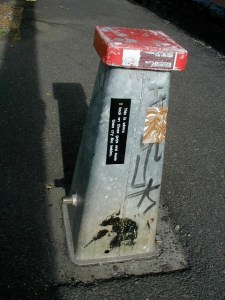
And some tags may be calligraphically audacious, unconventional, or simply pleasing for their symmetry and form. Here’s one of my favourites, taken in a street near where I work:

I don’t think anyone is going to be composing an opera about any of these artists any time soon (sadly), but perhaps looking at the incredible heterogeneity found within the apparently homogeneous category of the tag will contribute to a conversation about what tagging means – both to those who do it and to those who look at it.
2008 – the best and worst….
Newspapers are full of these ‘best of…’ and ‘worst of…’ lists right now, and reading some of them got me thinking about some of the great (and not so great) moments in art and cinema this year. What follows is a really incomplete – and really subjective – list of images that I’ve been happy to live by in 2008. In no particular order (and apologies for repeating some topics already written about, but they still deserve to be mentioned as some of the great moments of 2008):
• Jose Parla’s work. I saw his show at Elms Lesters Painting Rooms in London, and I think his images are gorgeous. You can read more about Jose’s work here.
• Miso and Ghostpatrol’s show, ‘Nesting and Dying’, at metro5 Gallery in Melbourne. Beautiful works, beautifully installed in the space.
• Seeing Brad Downey’s presentation of a series of short films about his ‘street sculptures’, at the Tate in London.
• The Kill Pixie show at Until Never Gallery in Melbourne.
• C215’s work, all over London in July. Some of it is still around, like this:

• The JR show at Lazarides. Haunting.
• Being shown some new works by Elbow Toe, freshly unpacked and ready to hang, at Stolen Space in London.
• Meeting the artist who paints these cats all over Amsterdam:

• Walking around San Francisco with Russell Howze.
• Regan Tamanui’s portrait of my daughter. Love it!
• Spotting new Invader works around Melbourne several times during this year. How many did he put up? Fantastic!
• Watching the Mikosa mural evolve.
• The Cans Festival in the Leake Street tunnel. Awesome. Both times.
• Meggs’s show at Dont Come gallery in Melbourne.
• Seeing Hunger, by Steve McQueen.
• Seeing the Peak Hours sticker being put up on the London Underground. I would still love to know whose work that is… Thanks to everyone who contacted me about the sticker.
• Seeing Gilbert (of Gilbert & George) walk past on Brick Lane.
• The Sidney Nolan show at the NGV. I’m not an Australian, so I don’t have the attachment to the Ned Kelly iconography that an Aussie does, but I still thought Nolan’s images were breath-taking.
• Meeting Laser 3.14.
• Logan Hicks’s show at Stolen Space in July. No space could have suited his works more.
Regrets….
Every year has to have some of these. Again in no particular order:
• Too many great shows missed, one way or another. MuTate Britain in London, the Poesia Urbana show at Famous When Dead Gallery, Acorn’s solo show in Melbourne, Locust Jones at Until Never. And many more. What can you do?
• Not photographing the ‘little diver’ stencil by Banksy in Cocker Alley before it had silver paint poured over it. I walked past it so many times, always thinking, ‘yeah, I’ll take a picture some other day’. Strange how something becomes part of the cityscape and then – gone.
• The Victorian State Government’s new anti-graffiti laws. Perhaps 2009 will bring some greater appreciation of street art in Victoria – but I will not be holding my breath.
• The Bill Henson debacle. So many people should be ashamed of their roles in this business. And its aftermath continues, with new, incredibly strict, rules governing the production of images of children.
• All those times I didn’t have my camera with me when I came upon some amazing image on the wall.
This is the last post for 2008. Back in a few weeks.
“I know I have lost”….
Filed under: Art, Street Art | Tags: image, interpreting the image, Loss
Leave a Comment Loss has been a bit of a theme in this blog off and on. The previous post was called ‘Losing Banksy’ (about the destruction of a Banksy stencil in Melbourne’s CBD), and back in October I wrote about how I felt upon discovering that one of my favourite C215 stencils had been buffed (‘Losing the image’).
And now, more loss…. But here’s why: last week I had been scrolling through photos that I’ve taken on various trips recently, and I came across this image:

The location is a side-street near the Tate Modern; I had been doing the ‘walking tour’ that the Tate organised as part of its Street Art exhibition. A number of works had been created and installed in locations close to the museum, and then maps indicating these locations were given to Tate visitors. I had been dutifully walking around the relevant streets, looking at the various images, and feeling that there was something a little sterile, a little forced, about the whole exercise, when I came across these words, meticulously painted onto a wall, not part of the walking tour, placed there by some unknown writer who knows how long ago.
In some respects, its meaning is so plain. ‘I know I have lost’: what ambiguity could possibly be said to exist in those words? And yet, it’s worth hesitating over… Lost what, exactly? The way? Self-respect? A ten-pound note? Love?
And why not just state “I have lost’? It’s the conjoining of ‘I know’ with ‘I have lost’ that makes it so powerful – it’s not simply that something has been lost. Loss is registered through our knowledge of the fact of loss.
Over the weekend, I had been going to write about how simple and how satisfying I think this is; however, the destruction of the Banksy stencil, and the media reaction to it, provided a more pressing issue. But then Monday brought news of another loss: my partner learned that his father had died suddenly. It’s hard to do justice to the magnitude of that kind of pain, but in some strange way the ambiguity of those simple words on a wall in Southwark have sedimented the grief and sadness experienced over the last few days. ‘I know I have lost’.
Losing Banksy…
Filed under: Art, Street Art | Tags: Banksy, Banksy effect, Melbourne, stencil art, Street art
Comments (7) There’s been a lot of discussion since the weekend about what’s happened to the famous Banksy stencil in Melbourne’s CBD. This stencil is famous for two reasons: first because not many of Banksy’s works, painted during a visit here in 2003, remain in Melbourne; and, secondly, because plexiglass plastic had been screwed over the top of it to protect and preserve it, thus singling it out from the mass of stencils and street artworks in Melbourne.
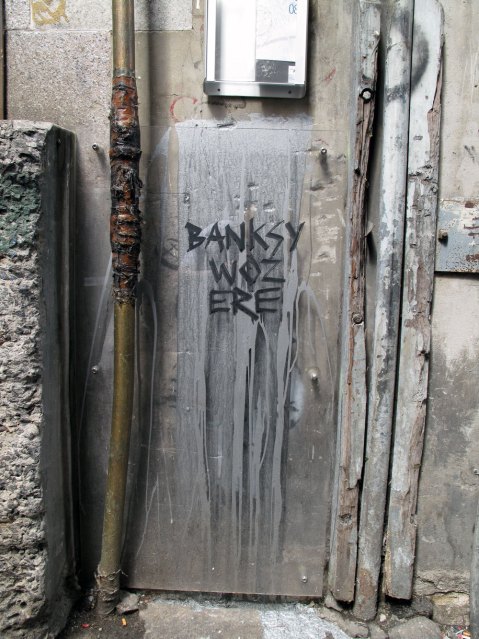
It seems that someone has poured silver paint down the back of the plexiglass, so that the image is now obscured. On top of the plexiglass, the words ‘Banksy woz ere’ have been written in black marker pen.
Here’s what it all looks like (photo sent to me by Miso, who found it on Nice Produce):
You can see a news report about this here.
I have some pretty mixed reactions to what’s happened. Yes, it’s definitely sad to see the end of a cute little stencil. And it’s a bit frustrating if the stencil has been destroyed in order to provide whoever did it with a quick thrill of excitement.
But…
There’s a lot more that needs to be said about what has happened. For example, why get worked up about this image in particular? Other images done by Banksy in Melbourne have also been lost over the years, such as this classic ‘Laugh now…’ ape, which I photographed in Richmond back in 2003:
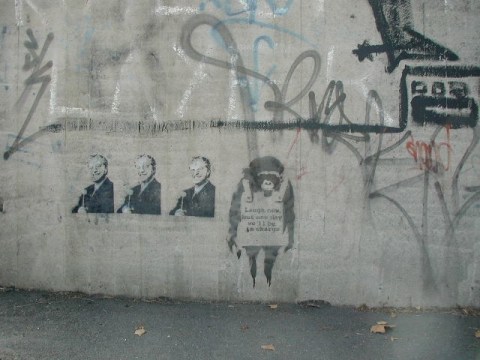
It is long gone, painted over by Yarra City Council. Its disappearance wasn’t remarked by the media. So why is the loss of the ‘little diver’ so noteworthy now? Ah, but wait…. In recent years, Banksy has been the object of much media interest as well as seeing his works suddenly increase in value (in fact, a version on canvas of the same image that I photographed in Richmond in 2003 sold at Bonhams ‘urban art’ auction in London, in February this year, for 80,000 pounds).
And many other stencils and street artworks have also disappeared, without finding themselves to be the subject of news reports or mass ‘mourning’. Why is their loss not so noteworthy? Works have been put up by local and visiting artists all over Melbourne, only for them to be painted over, or torn down, and thus vanish. Perhaps it’s only the disappearance of Banksy’s work that merits comment in the mainstream media?
I also suspect that the media is reporting on this because the work appears to have been destroyed by an individual who can be portrayed as a ‘vandal’. As I mentioned, Yarra City Council painted over Banksy’s apron-wearing ape, along with rats such as this one…

When a council, or a property owner, buffs street artworks or graffiti, the media doesn’t represent them as ‘vandalising’ the images – instead, no doubt the council would be seen as exercising its ‘graffiti management strategy’ and a property owner would be ‘cleaning’ the surface.
I’m sure a large part of the media’s interest in what has happened to Banksy’s stencil is because it allows them to have their cake and eat it too – they can express regret at the loss of the stencil while implicitly condemning whoever did it.
To me, the whole event brings up a number of issues that are worth thinking about. One relates to the protective plexiglass that was placed over the stencil. The news story that I read stated that it was the building owners who asked for the protective covering; in conversations with people around Melbourne in the past I’ve heard it said that Melbourne City Council decided to protect the stencil. I don’t know which is correct, and in some ways it doesn’t matter, because what interests me is less who put the plexiglass there and more the fact that suddenly there has developed the desire to preserve street artworks along with (apparently) the technology to do so.
I started thinking about this recent phenomenon back in July, when I visited Cargo in London. Cargo is a desperately hip bar in Shoreditch, famous for its courtyard area where the walls have been painted by a range of street artists. Some of its panels get painted over as different artists visit: for example, in July there was a fantastic panel painted by Logan Hicks; by October when I went back, it had gone and a new piece was up instead. Exceptions to this process of renewal are two panels by Banksy, which have been covered in plexiglass. You can see one of these here (and in the photo you can see some weird reflections caused by the plexiglass covering):

The Cargo courtyard demonstrates the emergence of a hierarchy in the way mainstream culture is responding to street art. It’s a hierarchy that is clearly related to ‘the Banksy effect’, in which Banksy’s works are treated differently than others (they sell for more money, they are the subject of more media interest, they are ‘protected’ where others are not).
Leaving the ‘Banksy effect’ aside (and I’m not trying to be critical of Banksy here, since this phenomenon has arisen mainly through the responses of others to his work rather than through direct actions of his own), is the desire to ‘preserve’ street art a good thing?
I have to say I’m suspicious of what the plexiglass represents. It seems like an attempt to pin down something that shouldn’t be ‘frozen’ in this way. And am I sad at the loss of the little diver stencil? I know I have expressed sadness at ‘losing’ an image in the past (see the entry ‘Losing the image’ in October this year), but in this instance I am much more ambivalent. I think what has been done to the image draws our attention to the plexiglass as much as it destroys the image behind it. As such, if it makes people think about what hypocrisy might be present when one work (or the works of just one artist) can be placed behind plexiglass, then perhaps that will assist the public debate that still needs to take place around street art. And as for whether this is an act of ‘vandalism’, well, in some ways it might be, but if we take a moment to look at what has actually been done, then it’s a little more complex than that.
How can we read the meaning of writing ‘Banksy woz ere’? Well, it is quite a funny, literal, demonstration of what has happened. A Banksy stencil was here, and now these words are here instead. Or, Banksy himself was here in person, and is now gone. And of course ‘Banksy woz ere’ evokes the famous ‘Kilroy was here’ graffiti of the 1970s onwards, in which an anonymous male character seemed to travel the world, leaving only his enigmatic images on walls. A bit like Banksy, really.
So if the stencil had to disappear (and most street artworks will disappear, some day, one way or another), then this might not be a bad way to go.
More JR
Filed under: Art, Street Art | Tags: JR, photography, Street art
Leave a Comment It will be clear from my earlier post (‘The power of vision’: JR and the women) that I am fascinated by the work of JR, the French street artist who works with portrait photography to make extremely interesting interventions around race, gender and violence.
I’ve been trying to find online clips from the film that I saw in London, which concerned the women of the favela Morra da Providencia in Rio de Janeiro. No luck so far, but what I have found is a brief excerpt from another part of the 28 Millimetres: Women project, described as a ‘trailer’ and called ‘Women Are Heroes’. JR travelled to a range of African countries which could variously be described as at best ‘post-conflict’ and at worst ‘at war’: Liberia, Sierra Leone, and Kenya among others. This little film shows many of the same cinematic devices used in the one I saw in London – the jittery camera work (used to a lesser degree here), the hypnotic, repetitive music, the telling of stories of violence and loss. It has its differences too: in this film, we hear JR himself narrating his intentions for the project, and it features a slightly more conventional, documentary-style telling of one woman’s story.
There are other films on YouTube showing different aspects of JR’s work (for example, in the housing projects on the outskirts of Paris), all of which are well worth watching too. But this one has an intensity that comes very close to the experience I had, sitting in the Lazarides gallery in London, with women’s faces pasted all over its ceiling, floor and walls, watching the women of Morro da Providencia on screen. If you do watch the little film I’ve included here, I should also give a bit of a warning: some of this film is very distressing.
Fade to grey
Filed under: Art, Street Art | Tags: Banksy, fading, JR, Miso, Street art
Comments (1) Recently I wrote about buffing, the different ways in which councils, governments and property owners seek to erase any graffiti or street art that has been added to a wall or surface.
For many works of street art, the buff represents their fate, sometimes far sooner than the artist would like. One day the image is there, next day it’s gone – painted over, scraped off.
But sometimes an image evades the buff and remains in place for a long, long time. Its longevity might derive from its being tucked away in a hard-to-notice spot, so that years go by and the work has actually only been seen by a few people. Or it might have been placed somewhere that’s hard to reach – hard for the artist who put it there, but also hard for any cleaning crew, which means that a work can stay up for years. And sometimes, even when a work is prominently visible, easy to access, and illegally located, it somehow escapes the buff, and just slowly and gradually disappears, fading back into the stone.
Within street art culture, there seems to be a lot of admiration, and often rightly so, for newly painted work: images that look glossy and shiny, which haven’t been weathered or degraded in any way (by the addition of tags or the application of posters on top, for example). And I’ve heard people say that work which is fading ‘looks old’, ‘tired’ and so on, and to a certain extent that’s true.
But some artists like to see the effects of these external forces and circumstances on their artworks. Miso, for example, is interested in the peeling and fraying that can arise when a pasted-up image experiences the effects of hot sun, rain, wind. And JR’s pasted-up photographic posters register the impact of the environment pretty fast – his work on the façade of the Tate Modern was repaired by the gallery after only a matter of weeks in place, thanks to a damp British summer. For these artists, though, the possibility of deterioration isn’t a problem, but is rather an integral part of their artistic practice – it’s something they actively invite.
Beyond this, though, I think it’s also worth looking at fading artworks, even when that gradual disappearance and deterioration isn’t part of the artist’s stated intentions. It takes quite a time for a painted work on stone to fade – usually months or even years, which means these greying images have a lifespan that’s quite remarkable given the frequency of buffing and going-over by other artists.
Here’s a fading Banksy. To see the remains of it, it’s best to click on the image to make it bigger. Look at the top step, where there are some words still faintly visible:

It reads ‘designated picnic area’ and is stencilled on the steps of an office building in a busy road in Shoreditch in London. It’s scarcely legible now, almost vanished back into the steps, its humour and incongruity about to depart the scene.
And take a look at this one:

It looks like a red smudge on the pavement, but it’s the remains of another Banksy. If you look more closely at the wall next to the smudge, you can see the traces of the two rats stencilled on the walls:
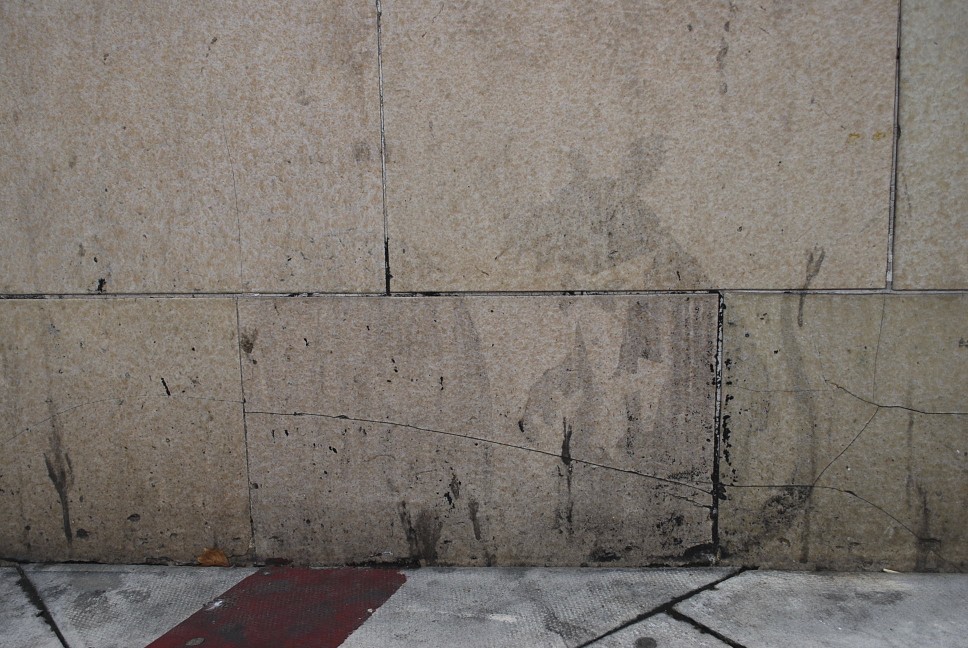
These rats were kitted out as waiters in a fancy restaurant, with the red smudge actually a red carpet. The rats have faded more than the red carpet, and you need to know what was there in order to make sense of what remains. I’m indebted in this respect to Martin Bull’s useful little book, Banksy Locations and Tours (details available from his website), which has a photograph of the work before it started to fade.
So how should we make sense of the fading artwork? Do we dismiss it as occupying some transitional zone between ‘freshness’ and oblivion? Do we paint over it so that new work can take its place? Does its faded nature mean that it is no longer worth noticing or thinking about?
In some ways, I think it’s the very ‘in between-ness’ of the fading image that makes it interesting. Not quite here and not quite gone, maybe having an almost historical value as a record of what was done in the past, but gradually relinquishing any claim on our attention amidst the visual hubbub of the contemporary city. So next time you walk through the streets, perhaps it’s worth paying homage to these fading images, these survivors who have, through chance or circumstance, escaped both the buff and the privileging of the new work of art.
Learning to dislike graffiti?
I have sometimes wondered where some people develop the unshakeable conviction that graffiti is ‘wrong’…
Well, today I discovered one possible place: they learn it in school. My daughter is in the first grade of primary school (which in Australia is called ‘Prep’), and she is learning to read. Every night she brings home a reader, and she reads it to me or to her dad. Today’s reader was called Tammy Toodlepepper Paints the Town (by Tracey Reeder, 2000).
The story in this book involves Tammy waking up and wondering what to do today. She decides to plant flowers, but in her garden she discovers ‘there was graffiti all over her gate’. So instead of gardening, Tammy paints over the graffiti. She paints purple and red flowers instead.
She is so inspired by the experience of painting out this graffiti that the next day she decides to do some more. She gets a little cart and puts her tins of paint in it, puts on overalls, and drags the cart all over town, painting out graffiti wherever she sees it – on walls, on the side of a building, and on a bridge. The illustrations show graffiti as a black squiggly line covering each surface, and, we are told, Tammy replaces the graffiti with what are clearly supposed to be lovely pictures – black and yellow bumblebees, green and brown trees, a truck and two buses. Each time she finds new graffiti, her reaction is the same: ‘oh dear, what a mess!’, she says. At the end of the day, she heads home, saying, ‘That’s it for today. No more mess to paint.’
I guess there are bits and pieces of ideology threaded through the majority of kids’ books: things to do with heteronormativity (the frog turned into a prince and married the princess), or with race (I can well recall growing up with Noddy books, and the later furore about the character of the Golliwog, who has since been excised from most modern Noddy stories). I hadn’t realised kids are also being taught that graffiti is always ‘a mess’ and must always be cleaned off or painted out. As with many bits and pieces of ideology, it’s depressing to see the poverty of imagination revealed in Tammy Toodlepepper Paints the Town.
‘The power of vision’: JR and the women
Filed under: Art, Street Art | Tags: art and violence, JR, Lazarides, photography, portraits, Street art
Leave a Comment JR is a French photographer who used to paste up in the street the poster-sized printouts he had made of his photographs. Since he did this without the permission of the property owner on whose building he would stick the artwork, his art was, of course, illegal. JR has become one of the most internationally celebrated ‘street’ artists (have a look at his website to get a sense of his fantastic work). He is one of the six artists who were selected to exhibit their work on the front of the Tate Modern in London earlier this year (see the blog entry in October, ‘Street art and the museum’).
He has built this huge international reputation around a simple but clever artistic device. He makes portrait photos: head-and-shoulders shots, waist-upwards shots, extreme close-ups of faces or of facial features such as eyes. These photographs are then blown up. It’s through this simple device that JR has become famous – the photograph replicated and expanded in size, pasted up around the streets. These portraits were also made within the parameters of a political point of view. JR’s artworks draw the spectator’s attention to issues of race, ethnicity and poverty, all of which are crucial issues in a city such as Paris where JR began pasting up his work.
Over the years, it seems that JR’s images have become larger. While the scale of his artwork on the Tate was obviously determined by the size of the building, there were additional JR images around London during the northern summer that confirmed his ability to position a very large work in a really fascinating way. Have a look at this image:

What you can see is an image that is several storeys tall, situated on a building in Old Street in Shoreditch. The massive buildings next to it become simply part of the artwork’s frame. There’s also something of the trompe l’oeuil about the image: it’s black and white, it’s clearly not real, its perspective is all wrong for it to work as a straightforward in situ illusion, but there is something about the image – deriving from its nature as a photograph – which means that the spectator looks into it as well as at it. It is as though two separate worlds have been made to rub up against each other.
While in London in October, I saw JR’s show called 28 Millimetres: Women (it’s just a small part of his massive 28 Millimetres project much of which focuses on post-conflict societies in Africa, more details on JR’s website, and on this aspect of the project see this link).
JR took photographs of some of the inhabitants of Morro da Providencia, a favela in Rio de Janeiro. As is his usual practice, he blew up the photographs and turned them into massive posters which he pasted onto the sides of walls and buildings in the favela. He also used some of these to make some more conventional ‘fine’ artworks, and others were blown up to the enormous sized images which covered some buildings in the street outside. In addition, he made a film in the favela, which features the artworks he made for the buildings but which is also very much an artwork in its own right.
The show took place in the two Lazarides galleries (one in Greek Street, and the other on Charing Cross Road, both in Soho), and on Manette Street, a small street which runs between the two galleries (here’s a link to the Lazarides website and its information about the show). The Greek Street gallery contained the works which most conformed to the genre of the ‘fine’ artwork – that is, individual works, hung on the gallery walls.
These works were mainly photographs, sometimes small, sometimes blown up to considerable size (though nothing that could rival the building-sized images outside). Some work were pasted onto wooden panels, or sheets of rough wood, so that the face or figure in the image enters into a kind of relationship with the texture of the wooden surface, which in some works is fairly smooth but in others is very rough-hewn. The paper covering the wood is often scratched, as if it has been scored with a knife or sharp nails, and thus although the wooden backing and framing of the images seems to give them a sense of place, even though they have been detached from their original home, the images also seem to register an injury…
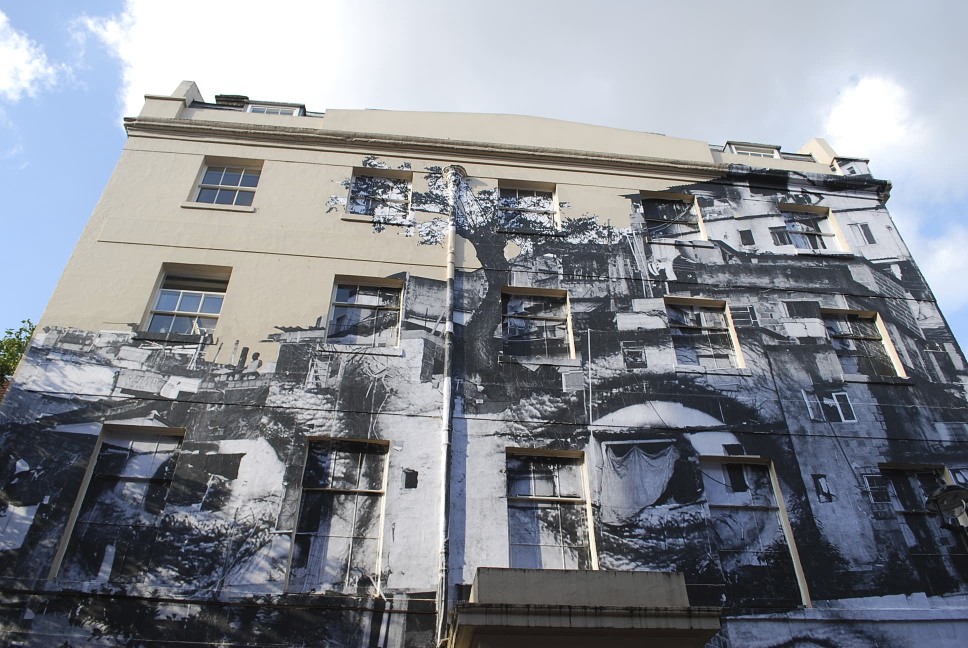
In Manette Street, some of JR’s massive artworks had been pasted onto the buildings:


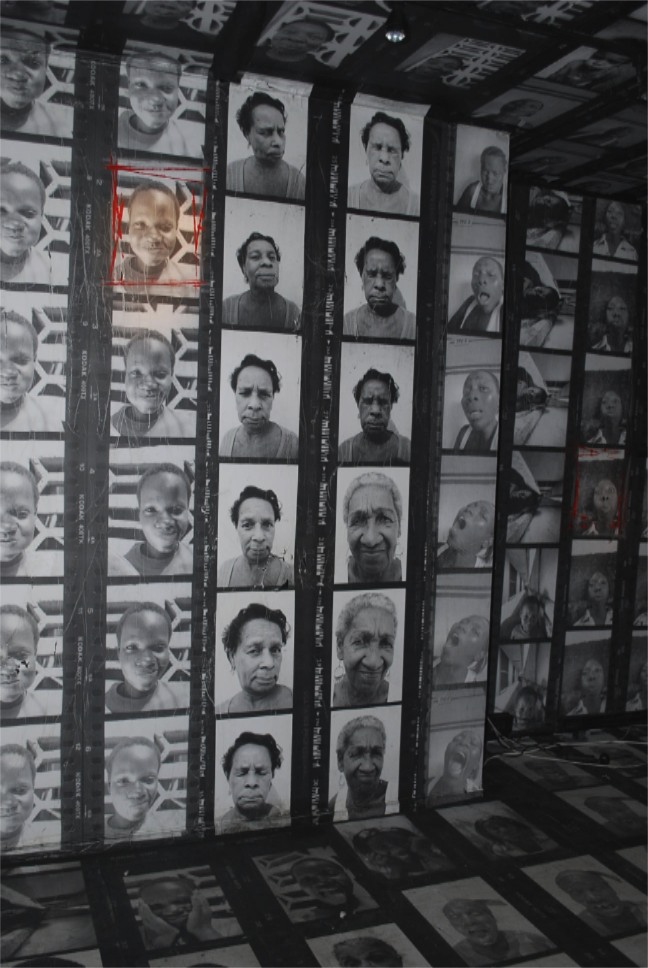
In the Charing Cross Road gallery, the walls and ceiling of the exhibition space were covered with printed ‘contact sheets’ of JR’s portrait subjects, replicated over and over in a manner that mimicked the continuous run of celluloid film, as you can see in this photograph:
And on a screen at the rear of the Charing Cross Road gallery, showing on a continuous loop was a short film – for me, the most extraordinary work within this incredible, multi-layered show.
As I’ve mentioned, the film focuses on Morro da Providencia, a favela built on a steep hillside in Rio de Janeiro. As with the multiple levels in the exhibition as a whole, the film combines several elements: music (which is electronic, both urgent and plaintive), some archival news sources, the inclusion of voices speaking over the images (since they speak in Portuguese, the film is sub-titled in English), and a range of cinematographic techniques, including hand-held camera and time-lapse film. (I can’t say exactly how long it lasts – I watched this film several times over, on different days, and, although I tried to time its duration, each time I watched it I became so caught up in its narrative and its affect that I forgot to check my watch at its conclusion.)
The opening shows a news anchor relating a story about the shooting of some of the favela’s inhabitants, after the military opened fire on a public square. And this straightaway establishes the context for the film: the impact of militarised violence and torture inflicted upon a community. After this, the film shows, through time-lapse film, the installation of JR’s images throughout the favela, as they are pasted up on walls and outside houses. For this sequence, the camera is positioned quite a distance away and well below the favela, so that its entire upward sprawl can be seen, with the eyes, mouths, foreheads and faces of JR’s subjects now covering many of the vertical surfaces (there’s a still showing this on the Lazarides website).
But the film’s purpose is not (or not only) to record the installation of these works. JR’s objective is always portraiture, but here he produces a portrait which is multi-faceted enough to do justice both to the many individuals who face the video camera for JR and to the identity and space of the favela itself as a community dealing with the aftermath of police violence.
After the opening, the film is mainly composed of a series of sequences in which the camera races down alley ways and eventually halts in front of an individual – sometimes a woman, often a child, occasionally a man – or in which the camera follows someone through the interconnected rooms of their home, often ending up with that individual (child, woman or man) standing on the flat roof of their home with the favela rising and falling around them.
But although I say the camera ‘halts, or someone ‘ends up’, these words aren’t an accurate description of what the camera is doing, because they imply that some kind of even momentary stasis is reached. Instead, the camera is in constant motion, its film speeded up so that it fairly tears through the streets and alleys. Even when it is apparently at rest and in contemplation of an individual face, it is still recording at an accelerated speed, so that every single blink, glance or expression registers as a twitchy jitter in the subject’s face. In this way, what could have been a languid, leisurely excursus through the favela is rendered urgent, compelling (and fitting the film’s attempt to show how trauma registers within the everyday life of the community and its inhabitants).
And while the camera is building these jittery portraits of place and face, various voices speak (with sub-titled translations). At one point, a woman relates the experience of having to go to the garbage tip to search for pieces of her son’s body, after he had been taken away by soldiers and then killed. Her voice says: ‘it hurts your soul’. Another says: ‘I only give this interview because you are not from here and will take it far away, otherwise I wouldn’t, for I am afraid of the violence’. One boy narrates his witnessing the shooting of three children when the police started firing upon a demonstration in the public square. And another woman speaks of how Providencia had been neglected by artists, and how important JR’s intervention is for the community. She calls it ‘the power of vision’.
Many of the faces which constitute as the film’s jittery portraits are solemn, sombre or impassive. Occasionally a smiling face is shown – a young woman breastfeeding her baby, a little girl laughing. Many of the voices speak of how much they love Providencia, of how grateful they feel to have lived there. Such love, such gratitude, in the context of lives lived amid violence and loss, is amazing. The film completely succeeds in conveying the tension between a sense of the beautiful (the favela as a space of community and happiness) and the experience of violence (the faces whose camera-accelerated jitters seem to bespeak the pain they have undoubtedly suffered, and the favela as a site of loss).
And as such it is a text profoundly about trauma, about the inability to resolve such a contradiction. It is about witnessing violence, and about making art visible. It is about seeing the effects of violence, and about creating an artwork whose faces and eyes look outwards from the hillside towards the city whose police force has inflicted such harm. Through art, the houses are literally made to look, as walls and windows become eyes, faces, bodies. The film ends as night falls over Rio de Janeiro, and these faces, bodies and eyes fade into black, with the camera juddering the distant lights of Rio into a neon blur. Freeze frame, and then black. The film ends, but there is no ‘end’ to what we have seen.
 Images to Live By