Losing the image
Filed under: Art, Street Art | Tags: affect, C215, graffiti removal, London
 Leave a Comment
 I’m in London right now, and yesterday I went to Shoreditch, to meet with a gallerist. The area is filled with street art, so, after the meeting I went walking, to see what was on the walls. I had spent a day doing this when I was visiting in July, and had come across some fantastic images.
I thought I would revisit one of these, a work by the French artist C215. It’s the image I used to accompany the very first post on this blog (see ‘inaugurations’). It was a diptych, portraits of two children, each one filling a small tiled panel low down on the outside of a pub. I had come across it by accident, in the way that sometimes happens, and which makes the artwork really feel like a gift. The pub was on Leonard Street, and a tiny side street connected Leonard Street to Willow Street. Walking down this side street, I had suddenly seen this image, quietly and perfectly placed close to the ground.
Yesterday, I walked purposefully to find it, almost as if I wanted to say hello to an old friend. But it was gone.
The tiled panels had been buffed – whether by the council or by the pub’s owners, I don’t know.
It’s hard to describe the feeling of loss I experienced in seeing it had gone. It was much more than a momentary flicker of disappointment, much more than any sense of annoyance at my objective being thwarted by circumstances. I actually felt quite disoriented by its absence – I found myself looking around, as though to check whether the image might have migrated somewhere else nearby. I felt really, deeply, saddened by its disappearance, and it’s a feeling that resurfaces now, when I think about those blank panels.
I’m not sure why. Images on the street come and go, right? It’s meant to be ephemeral. I know all that. But clearly I had become attached to that image – maybe because I admire C215’s work generally, maybe because that particular image seemed so perfectly placed. Maybe it’s because I’ve watched a really excellent video on YouTube (by romanywg) which shows C215 putting his work up in London, probably at the time he did this image:
Maybe it’s because when I came across it back in July it had that fantastic sense of being a gift from the artist to the passerby, to the spectator – to the city.
At any rate, it’s gone, and I feel its loss. I photographed its absence, and here is what that looks like:
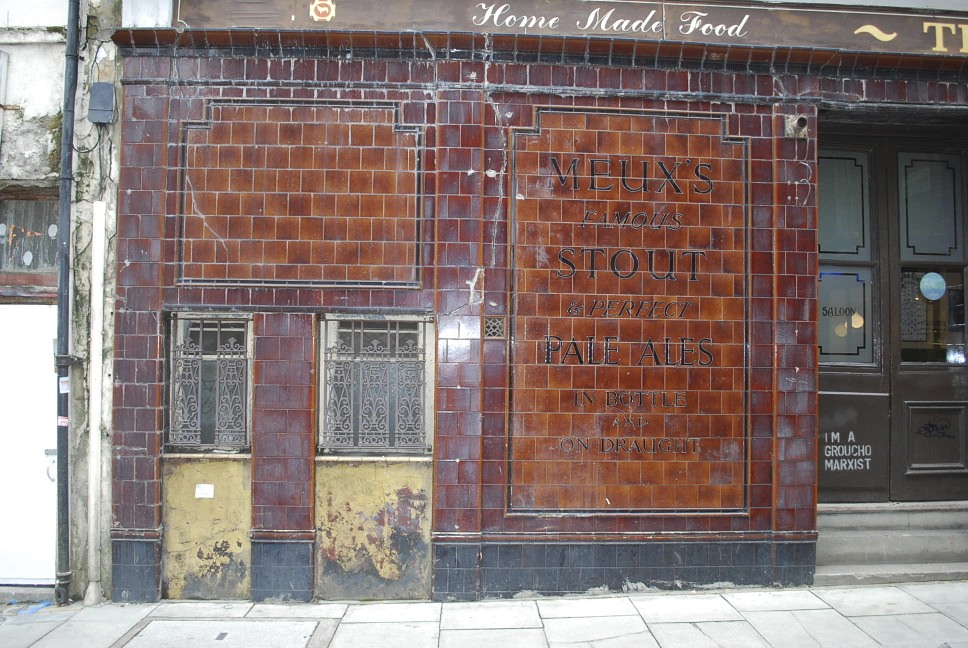
Images appear and images disappear. Their disappearance says something about time, and its passing. The way we respond to the loss of an image on a wall says something about how we see street art itself – do we celebrate the empty space, as the opponents of graffiti and street art do? Do we plan the next image for that empty space, as an artist might do? Do we mourn the loss of an image?
On tourism, street art, and Melbourne
Filed under: Art, Street Art | Tags: Melbourne, Street art, tourism
Leave a Comment Well, this topic certainly deserves a long post, which sadly I don’t have time to write at present. More later, I think. But I did want to note the latest instalment in the continuing saga of the State Government’s conflicted attitude to street art and graffiti in Melbourne.
On Monday, I noticed a story in The Age (our local broadsheet newspaper, for any non-local readers) which reported on how a recreation of Melbourne is the centrepiece of a food and wine festival at Disney World in Florida. Laneways painted with street art and graffiti are the location for small cafes serving different kinds of food – so far, so Melbourne, right? Well, today (Tuesday) a friend (thanks, Esther!) sent me a message with a link to a story in the Herald Sun, which is all hot under the collar about this, on behalf of Tim Holding, the Victorian Minister for Tourism and Major Events, who has apparently criticised his department for allowing Melbourne to be associated with graffiti: ‘graffiti is not the way we want Melbourne to be promoted to a global audience’, he says.
Tourism Victoria is, sadly, admitting that it has made ‘a mistake’ in allowing the graffiti panels to be included. I say ‘sadly’ because, for one thing, I would have preferred Tourism Victoria at least to have been consistent in its expressed views, given that it features street art in much of its promotional material. And for another thing, I would like the State Government to actually consider what it objects to about the association between Melbourne and street art. It seems so short-sighted and blinkered: street art in London has brought large amounts of money into previously cash-strapped areas like the East End and Shoreditch over the last 8-10 years. If the State Government here could at least participate in a discussion about the cultural value of street art and graffiti, it might not need to engage in such self-righteous huffing and puffing about a food and wine festival. Makes me wonder if Minister Holding has ever wandered around the laneways of Melbourne – spending time on such a pursuit might show him that, for many, food, wine and street art combine very nicely in this city of ours.
If you would like to read the Herald Sun story, it’s here.
There’s a forum for posting comments, too.
Heading to London
I’m off to London this Thursday for a couple of weeks – to photograph some more street art, to check out the Cans Festival mark 2, and to meet some artists and gallery folks.
I’ll try to post while I’m away, but I also wanted to ask if anyone would like to suggest artists I should be trying to meet, or great stuff I should go and photograph, or any exhibitions I should catch while I’m there (there’s a new D*face show opening this Thursday, for example)…. please let me know!
Clamping down: the Graffiti Prevention Act 2007
Filed under: Art, Street Art, law | Tags: Graffiti Prevention Act 2007; art and crime, Melbourne, Victoria
Comments (8) You could be forgiven for thinking that the Australian state of Victoria just can’t make up its mind as to what it thinks about graffiti and street art. On the one hand, it uses images of graffiti and street art to promote tourism, showing images of Melbourne’s laneways (well, Hosier Lane, usually) on television and in its information guides (have a look here). On the other hand – well, it has recently passed a new statute called the Graffiti Prevention Act 2007, which creates a bundle of new criminal offences and gives the police new powers of search, which hardly seems to fit with its marketing of Melbourne as the city of cool street art.
So, what are the new offences? Well, there’s one of ‘marking graffiti’ – creating graffiti that is visible from a public place and done without the property owner’s consent. Another one is ‘possessing a graffiti implement on transport company property or an adjacent public place, or a place where you are trespassing’. What’s meant by ‘graffiti implement’? It’s pretty broad – it means any tool or object or implement or substance that you can use to mark graffiti. So… what does ‘mark graffiti’ mean? Spray, write, draw, mark, scratch or ‘deface’ property by any means so that the result cannot be cleaned off with a dry cloth.
So one thing that’s clear from this is how legal language likes to bind one definition up in another, so that interpretation of what this statute will actually mean is the product of a chain of associations, definitions and meanings (making it hard, sometimes, for non-lawyers to realise that they might be actually breaking the law in what they are doing).
But what else is clear is that this Act has really broad scope. The title of the Act and its fixation on public transport property make it sound as though it might be restricted to tagging and so on. It isn’t. It includes stencils. It includes paste-ups. It includes all kinds of street art as well as conventional graffiti. It applies to everyone who puts up on a wall on or near public transport property, if the image they make can’t be rubbed off with a dry cloth (and since walls aren’t really anything like whiteboards, I’m a bit at a loss to think of what you can put on and rub off a wall with a dry cloth and leave no mark).
These new offences come with new penalties, as you might expect. Marking graffiti – up to 2 years’ imprisonment, and a fine of up to $26,428. Possessing a graffiti implement on or near public transport property, or while trespassing – a fine of up to $2,753, or an on-the-spot fine of $550. Pretty serious penalties, and remember that the police may well be looking to charge people with a number of counts, which would increase the total fines. (It’s through non-payment of fines that many people end up in prison, so imprisonment is a real possibility under this Act.)
And in order to assist the police, the Act creates some new powers of search for them. A police officer can search any person, vehicle or thing if they have ‘reasonable grounds’ for suspecting that person is in possession of a graffiti implement on or near public transport property or while trespassing. What does ‘reasonable grounds’ mean? It means that if you are at or near a place that has recently had graffiti put up on it, the police officer is entitled to take that into account in deciding if it’s reasonable to search you. If they search you and find an ‘implement’ (like a spray can), they must ask you why you have one.
So, suppose you are stopped and searched by the police? You’re at a train station, or on a tram, or waiting at a tram stop, or walking down a laneway near a train station. The police find a spray can in your bag and ask you why you have one. It’s up to you to convince the police that you have the spray can for a ‘legitimate’ purpose – like a school art project, or that you are on your way to your studio where you are working on your next big gallery show.
The thing is, this means that the ‘burden of proof’ has been reversed. What SHOULD happen is for the police to prove there’s reasonable grounds to suspect that you don’t have a spray can for a legitimate purpose – this is part of the work of policing and it’s what the police have to do for most offences. The burden of proof has previously been reversed in relation to drug offences – does that mean that a spray can is being equated with heroin in terms of the amount of social harm caused?
So what will be the consequences of this new legislation? Well, one of its stated aims was to make it easier for the police to arrest graffiti writers and artists, and it seems very likely that we’ll see an increase in arrests once the police get into the swing of using it (at the moment they are still being trained in its implementation). Another consequence is the erosion of legal principles: the burden of proof is supposed to be one of the cornerstones of criminal justice, a basic safeguard against the abuse of power by the state and its agents. If the State Government can create an Act which reverses the burden of proof in the context of graffiti, simply in order supposedly to address ‘community concerns’ about graffiti and to facilitate the arrest of graffiti writers by the police, then that seems to indicate that legal rights are not taken as seriously in this State as they should be.
What the Act won’t do is deter people from tagging, of course, no matter what the Department of Justice and the public transport companies are hoping. What the Act will do is create the risk that many more people – and especially many more young people – will be brought into the criminal justice system, acquiring fines and a criminal record as a result.
And on top of this, the Act is about criminalising artists. It’s all very well for the Department of Justice to make claims about graffiti being a social problem (which they do on their website, here), one major consequence of the Act will be that artists are subjected to the criminal law for putting up work on the streets. The result could well be be a kind of ‘chilling effect’ on many of the great artists who live in Melbourne or who visit the city, so that it could seem too risky to do work on the street.
It makes me sad and frustrated that a city so well known around the world for its urban art should be the site where laws like this get implemented.
And if you are one of the folks who get arrested and charged under this new legislation, you can get legal advice from organisations such as your nearest community legal centre or from Youthlaw.
An image to drive by…
I have no photograph with which to illustrate this post. Last Friday afternoon, I was in the car with my partner. I’m sitting in the passenger seat. We drive down Hoddle Street and take the entrance to the Eastern Freeway off Hoddle Street. Just as we whizz at some speed around the corner to join the freeway, I glimpse what I’m sure is an Invader artwork, positioned on the wall next to the freeway entrance. My memory says purplish-blue as the main colour, perhaps with a few key tiles in red?
Invader is a French artist who makes mosaic tiles and attaches them to walls. Usually, they take the shapes of ‘space invaders’ from that proptypical video game back in the 1970s, although some of his more recent works have involved Rubik’s cube designs. The mosaic tiles are attached to street walls, and often sit quietly unnoticed by passers-by. I don’t know when this tile was put up, but unless it’s very recent I’m pretty sure that I have driven past it a number of times without realising it was there.
If I ever get up the nerve to walk round the corner of the freeway entrance and take its photograph I will certainly post it. Or perhaps, in summer, I could get up at first light – when that road might be free of cars – and photograph it then.
But I also like the idea that it is hard to photograph, so that it exists in my memory rather than as a thumbnail on my computer. In my memory, it has the shimmer of sudden colour against concrete, as the car sweeps past – an image appearing out of the stone.
Shaking Hands with a Legend….
Filed under: Art, Street Art | Tags: Amsterdam, Doze Green, Fefe, K-Space
Leave a Comment It’s not often you get to shake hands with a legend. That’s the thing about legends: by definition, they tend not to hang out with us mortals. So imagine the thrill of being introduced to an honest-to-god legend of graffiti: Doze Green.
Doze, as many of you will know, is one of the original members of the Rock Steady Crew. He started putting up on the walls and trains of New York City in 1974; in the mid-80s his work was being exhibited in galleries such as Fun and Tony Shafrazi. And he is still working: check out his website HERE to see some of his recent activities.
Doze was in Amsterdam in June, collaborating with Fefe Talavera for an exhibition at K-Space Gallery. Fefe is a 26 year old Sao Paulo artist, who also has credits to her name of opening for Missy Elliott on tour. Her artworks often feature monsters and fabulous, vaguely terrifying creatures, like THESE. For the K-Space show, each artist produced some solo works, and collaborated on a huge piece, which blended Fefe’s monsters with Doze’s characters using a palette of rich, lush colour:
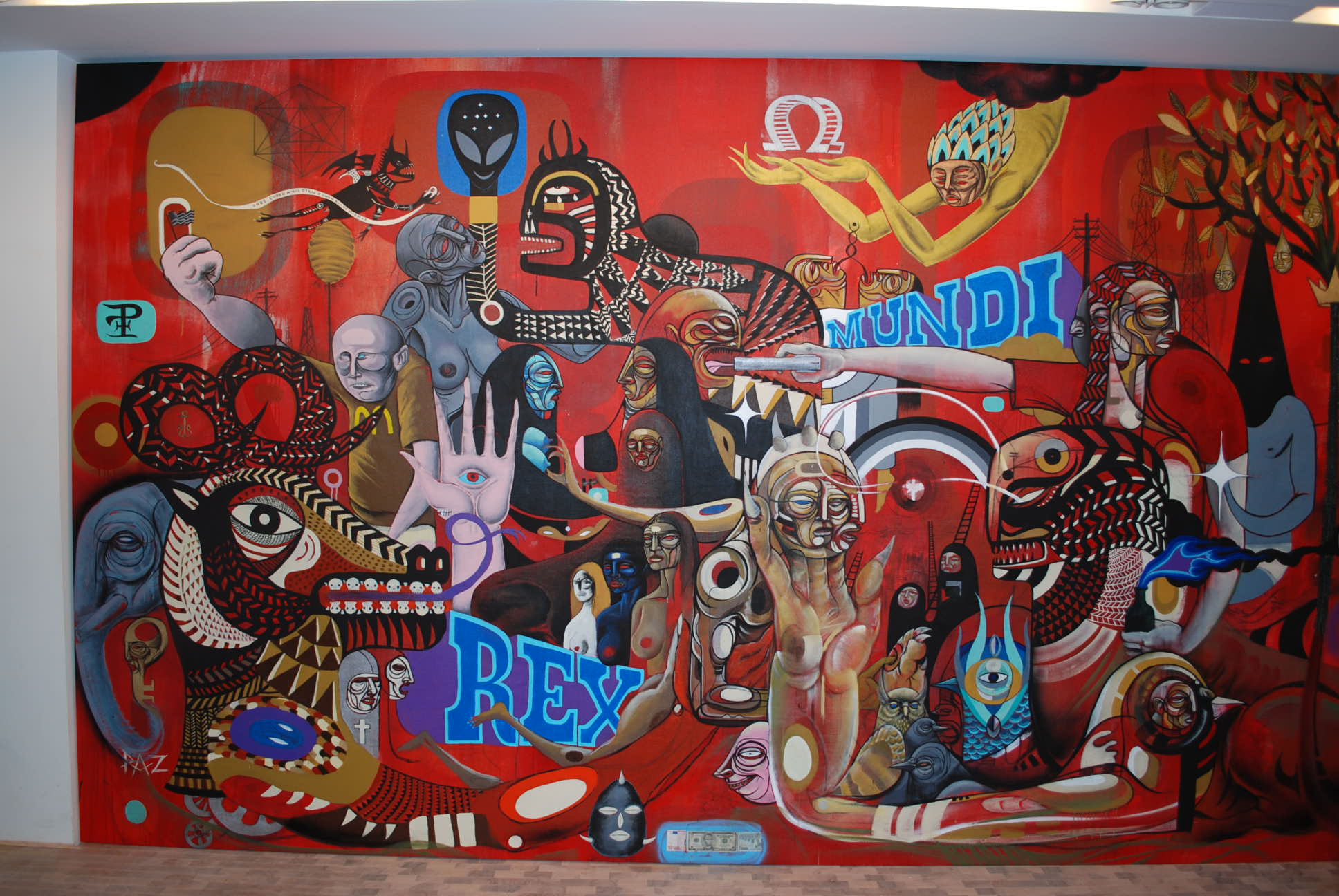
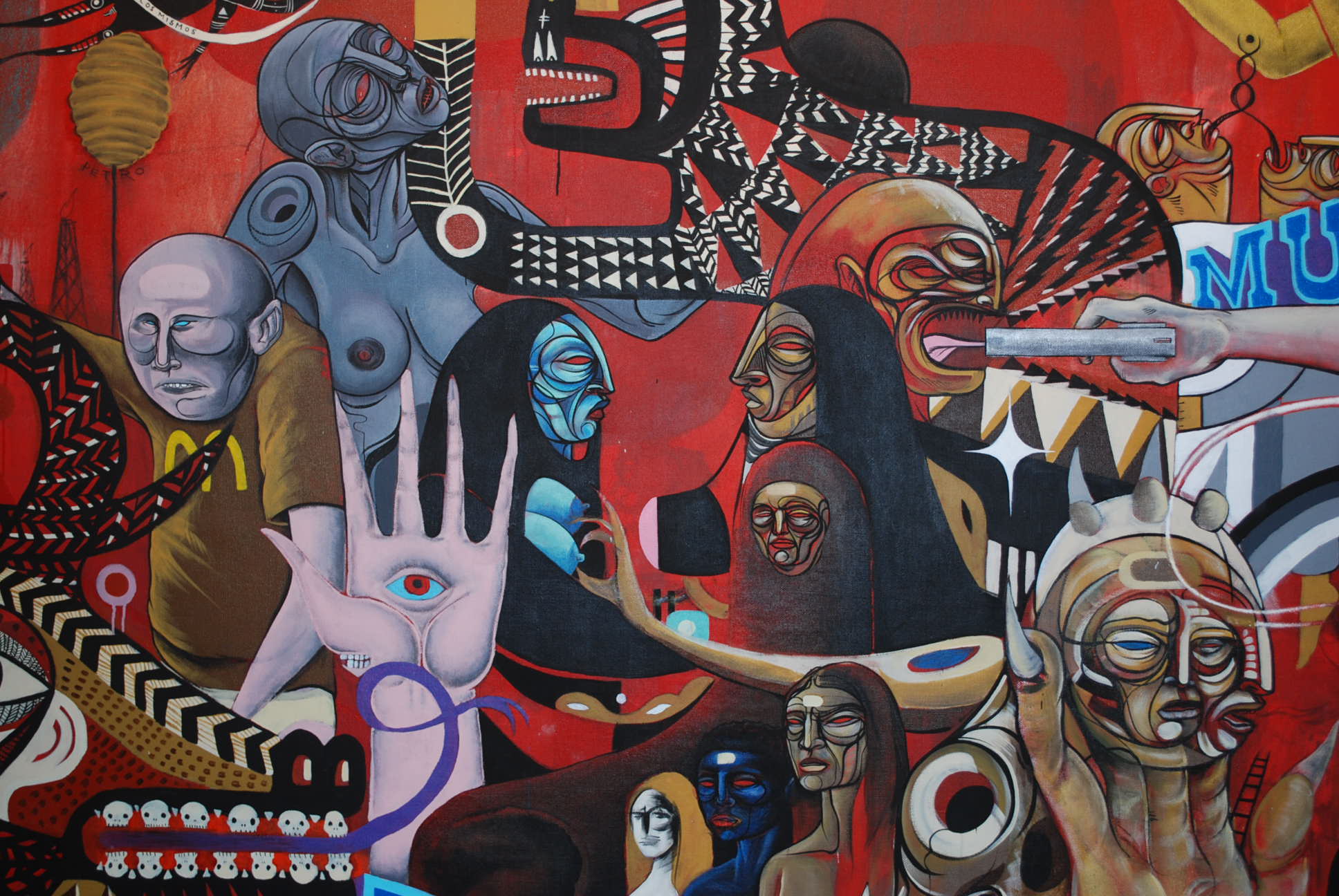
Check out some of the detail in this work:
The K-Space site contains many great shots of the artists working on this piece together. The exhibition opened with a big party, with both Fefe and Doze present. I had been standing around quietly taking photos, when one girl asked who I was and why I was taking pictures (she thought I must be a journalist). I explained about my research, and she asked if I would like to meet Doze and Fefe. Like to!!??!
And so I was introduced to them – one of street art’s new stars, and one of hip hop’s pioneering legends. And here they are together:

Also present at the party was Orlando Reyes, someone else with an illustrious hip hop career, and now running the 58 Gallery in New Jersey. While we were chatting, standing in the small area outside the gallery, Orlando’s attention suddenly was distracted by something happening inside the gallery. ‘Excuse me’, he said, ‘I have to go tag’.
And he rushed inside to join Doze, who was tagging the sound equipment set up for the opening. Here they are, hard at work:

As you can see, a fun time was had by all… And if you are in Amsterdam, apparently Doze and Fefe did some works under some of the canal bridges too. What better reason to rent a pedal boat and head up and down the canals than to search for the work of a legend?
Good timing…
It’s always so great when, just sometimes, you are in the right place at the right time. I experienced a little bit of that when I was in Amsterdam in June this year, which is when several artists got together to paint a huge piece known as the Mikosa Mural.
Amsterdam is a small city with a long tradition of graffiti and street art, thanks to the radical politics of squatters and others throughout the last few decades. But in recent years the city has become more conservative. Although the red light district and the coffee shops are flourishing (and as such Amsterdam seems to be a liberal, progressive, hip city) political shifts have taken place which mean that there are tensions within the city about ethnic differences, about ‘anti-social behaviour’, and so on. In such a climate, getting sponsorship for a gigantic graffiti mural to showcase the work of several artists is quite a feat.
The ‘Mikosa Mural’ was created through the efforts of the Mikosa Foundation, founded in Amsterdam in 2005 by Marco Galmacci, Rocco Pezzella, Claudius Gebele and Henk Kramer. Check it out HERE. Mikosa supports the work of artists ranging from graffiti writers through street artists, internet designers, and video artists.It organises exhibitions, has a clothing range, and produces a ‘magazine’, which as a term just doesn’t do justice to their extremely cool and classy publication.
But the Mikosa Mural was something different – a much bigger project than before, involving a lot of sponsorship – that is, basically schmoozing not only to get the funds to pay for a ton of paint and scaffolding, but also to get permission to undertake the project in the first place.
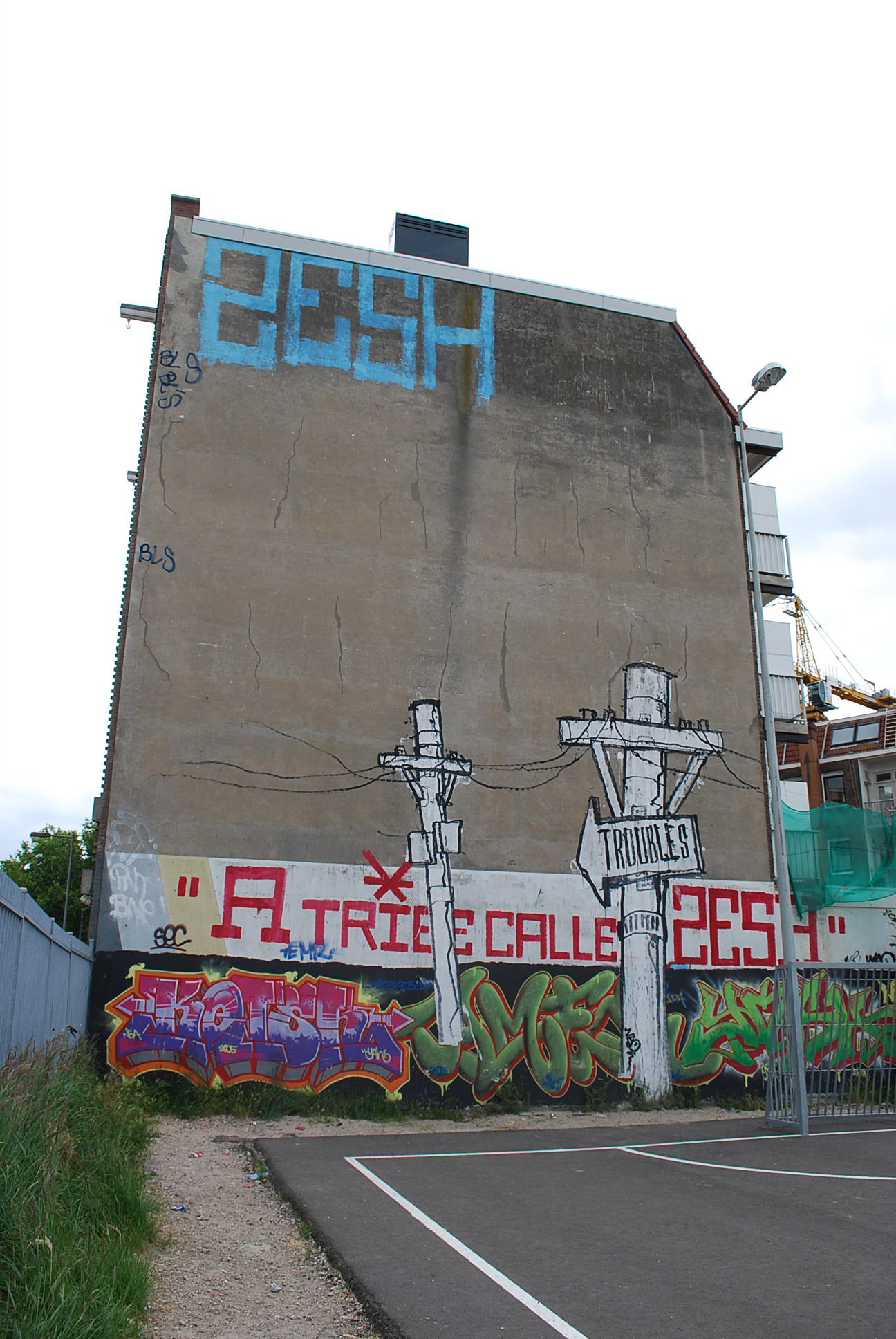
The site that was selected was at Baarsjesweg 200, in an area called Des Baarsjes, which lies outside the main canal belt where most tourists spend their time. The mural was to be on a wall at the end of a block of apartments and on the adjoining, lower, wall, and it overlooked a small (concrete) soccer pitch. Here’s the wall before the project began. As you can see, it had already received the attention of some local artists:
Painting the wall would take ten days. Its height meant that six levels of scaffolding were required (one of the things that Mikosa had to organise was insurance for the artists working on the scaffolding). The artists taking part were Zedz, Lordh, The Boghe, Morcky, Wayne Horse, and The London Police. Some had been featured in a 2006 exhibition at GEM, the Museum of Contemporary Art in The Hague, which was the first street art show in a contemporary art museum in Holland. All of them are amazing, and very different, artists.
Each worked on different sections of the wall, but the aim of the collaboration was to create a unified piece that would not look ‘bitty’ to the spectator. Here are some of the different sections worked on. The bull with gaping mid-section shown here is by Wayne Horse:

Easily identifiable behind the scaffolding is the work of The London Police, of course:
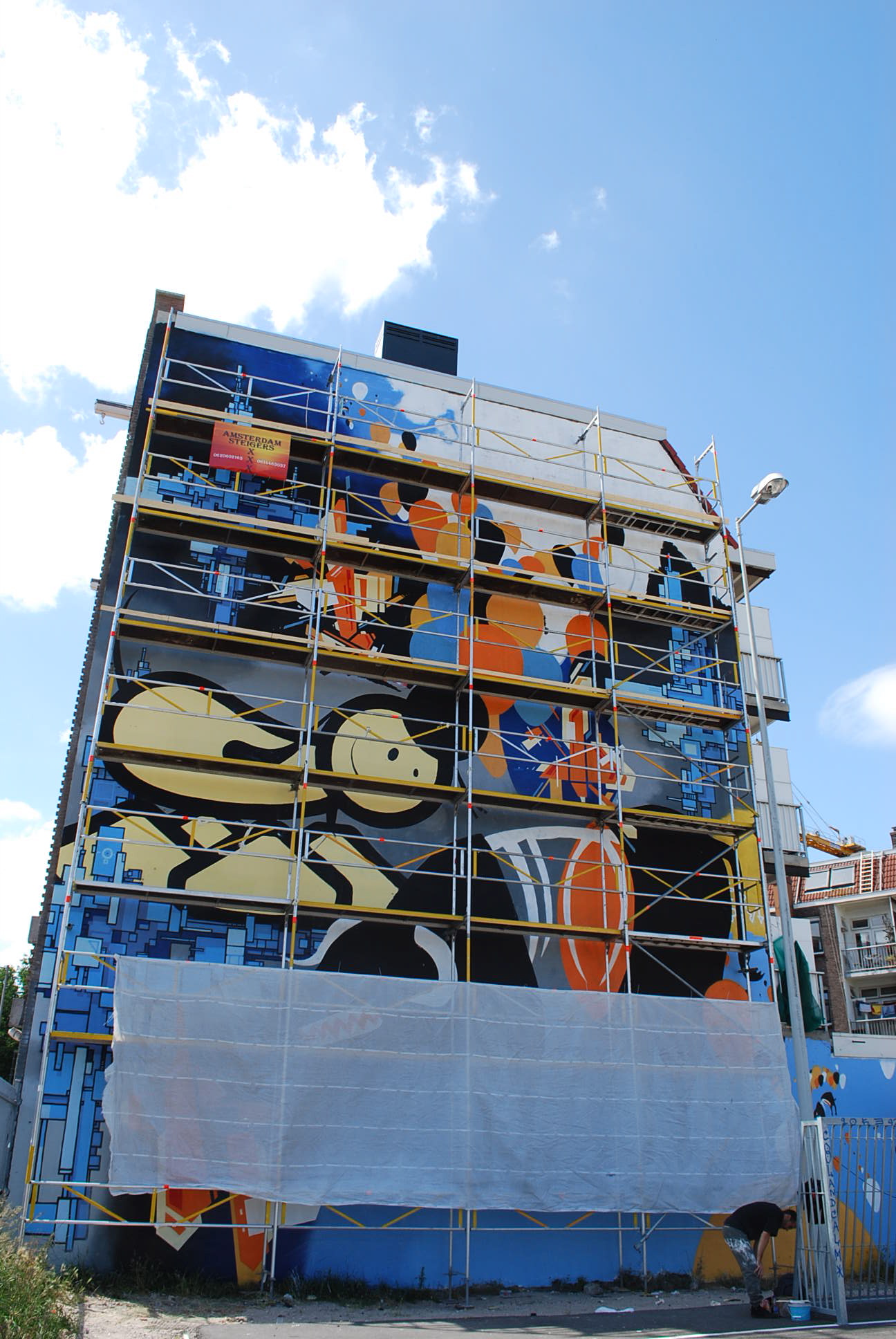
In the next image, the amazing hand puncturing the balloons is by Morcky, and to the sides you can see some of Zedz’s intricate geometric work:

For more of Zedz’s work, check out the adjacent wall:

For me, the timing was so good because I got to observe the mural as it took shape. I turned up at the site several times during the ten days, and watched the artists paint, and paint. And on one day, I turned up to discover them repairing the images, which had been heavily tagged during the night (the scaffolding of course made it easy for anyone passing to climb up and tag over the work).
While something like this on the one hand is part and parcel of graffiti, on the other hand there were a couple of things that made it seem so frustrating. First, the mural was clearly the work of artists at the top of their game, and tagging over it just seemed so… so… disrespectful. And second, the guys who had bombed the mural had stopped by the site during the day before to chat to the artists and in fact came back the day after the tagging to say: ‘nothing personal, it’s just graffiti’…. But it seemed to feel pretty personal to the artists who were now forced to repaint their work.
Anyway, the tags got painted over and the work repaired. If you want to see ten days’ work compressed into a three minute video, watch this:
And here’s what the mural looked like when it was finished. Fantastic!

The Cans Festival (Mark 1)
Filed under: Art, Street Art | Tags: Banksy, Cans Festival, London, Street art
Leave a Comment In late May this year, artists from a range of different countries (Australia, the US, Holland, France, Portugal and more) were flown to London to take part in creating the Cans Festival, a massive exhibition of stencil art.
The location was a disused tunnel in Leake Street, near Waterloo Station. This tunnel had had its fair share of graffiti applied to it in the past, but the Cans Festival turned it into a unprecedented display of street art.
The location was kept secret while the artists went to work over a period of several days, but once it became known where the Festival was to take place, hundreds of people queued for up to three hours at a time to see the artworks. The tunnel was filled with people, some adding their own stencils or tags to the walls, other photographing what they saw. For a sense of the massive public enthusiasm for the event, do a search on Flickr for ‘Cans Festival’ or watch any of the many videos made at the Festival:
When I visited London in July, things had quietened down at the site. There were still people visiting (around 20 people when I was there), but it was possible to take photographs without other people in the shot, and to stand back and look at the sheer scale of the place and the display (the tunnel is a couple of hundred metres long, and its curved walls around 10 metres high).
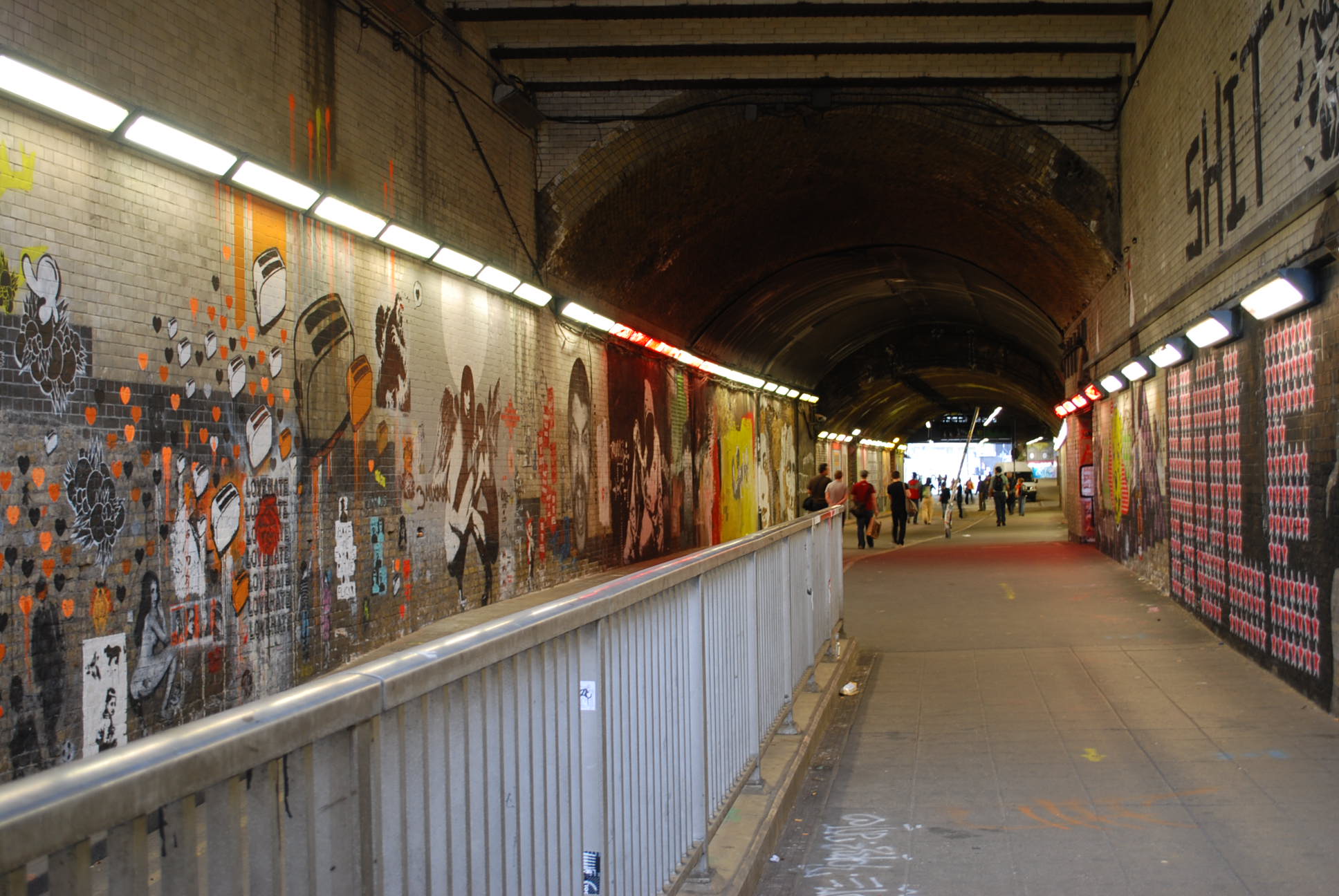
The ‘official’ artworks – by artists such as Vexta, Tom Civil and DLux (all from Australia), Vhils (Portugal), C215, Blek Le Rat and Jef Aerosol (France), Lex-Sten (Italy), Kaagman (Holland), Logan Hicks and Faile (the US), Pure Evil, Eine and Banksy (the UK) – were now surrounded by unofficial additions. Sometimes people had stencilled an image, sometimes they had tagged over other people’s work. The tunnel was crammed with images: railings and posts had been sprayed, as had the ground: someone had sprayed a stencil version of a scalectrix racing track, complete with cars, through the tunnel.
Some of the images were simply amazing. I’ve written already about the works by Logan Hicks (see the entry ‘In anticipation…’). Other memorable ones included this work by Vhils, a young Portuguese artist:
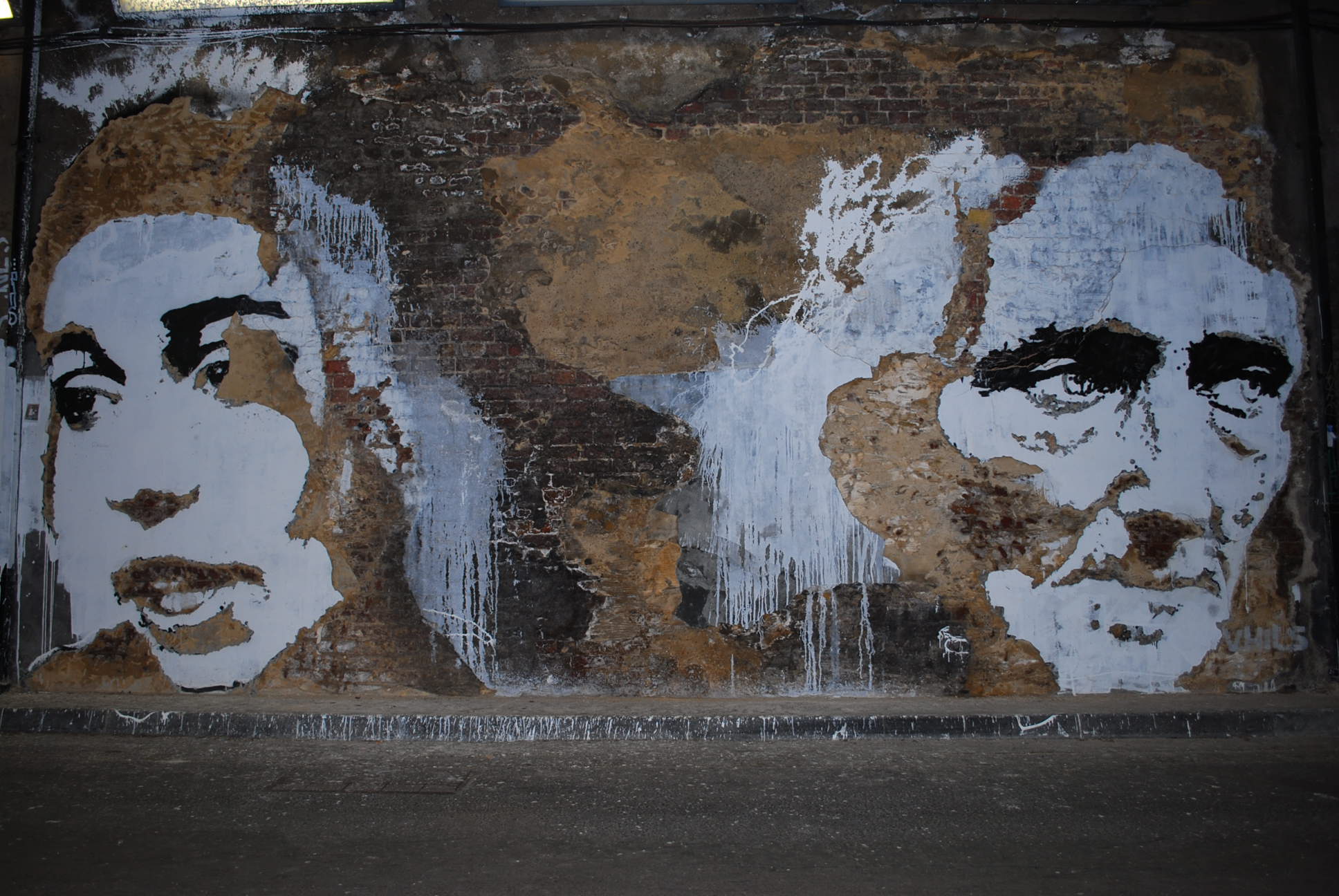
For a sense of its scale, try to imagine that I (who stand 1.78m tall) would reach eye level on these faces. And there were dozens of these amazing images: a fantastic work by Eine, a huge and delicate paste-up by Faile, several of C215’s faces, some glittering figures by Pure Evil.
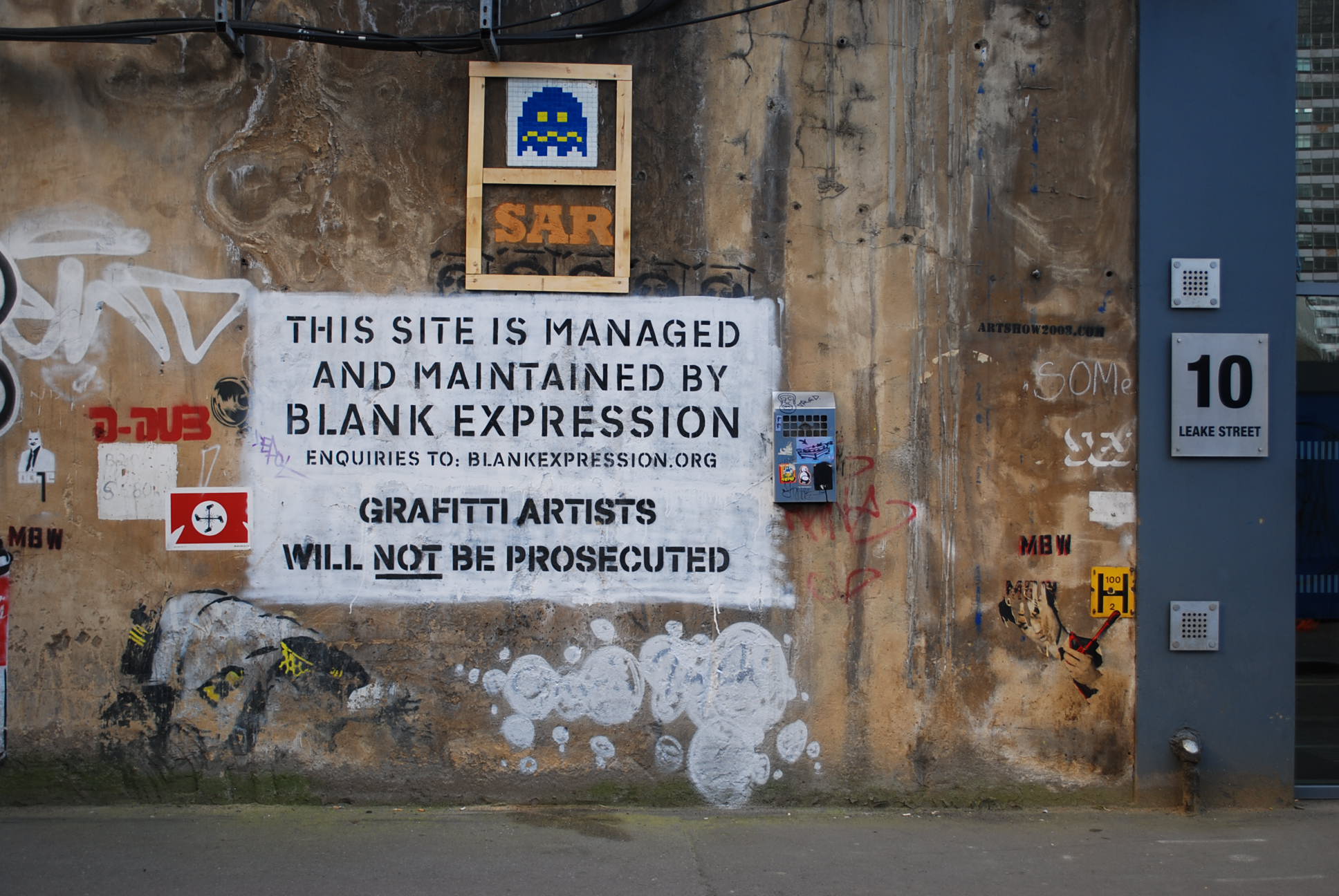
And of course several works by Banksy, an artist derided by some but considered by many to be single=handedly responsible for popularising street art around the world. The tunnel had previously contained some old works by Banksy: in this photograph you can see a faded ‘snorting copper’ kneeling at ground level and surrounded by more recent additions for the Festival:
Of the several Banksys in the Festival, my favourite was a massive image of a hoodie-wearing, knife-holding, bleeding boy. The scale of this work is huge, and yet it is extremely detailed, showing Banksy’s skill as an artist (often forgotten in the brou-ha-ha that always follows his various stunts).

In the neatest of copperplate script to the left of this boy’s sneaker, it reads, ‘I am starving’. Many dismiss Banksy’s penchant for a catchphrase as glib, but I found that this work had a certain resonance, in a city where the homeless and hungry are present on many street corners. Too hard to do justice to Banksy’s work in this post: watch this space for further discussion of his work.
To see all these works in one place – and in the street, not in a gallery – I walked up and down, photographing, photographing, unable to stop smiling. My daughter, who is 6, said: ‘mama, I’ve never seen so much graffiti in one place’, and it was very true.
But I don’t want to overlook the unofficial additions to the Festival, made by the hundreds of people who came and stencilled or tagged their own words and images at the site. Here’s one, out of thousands:
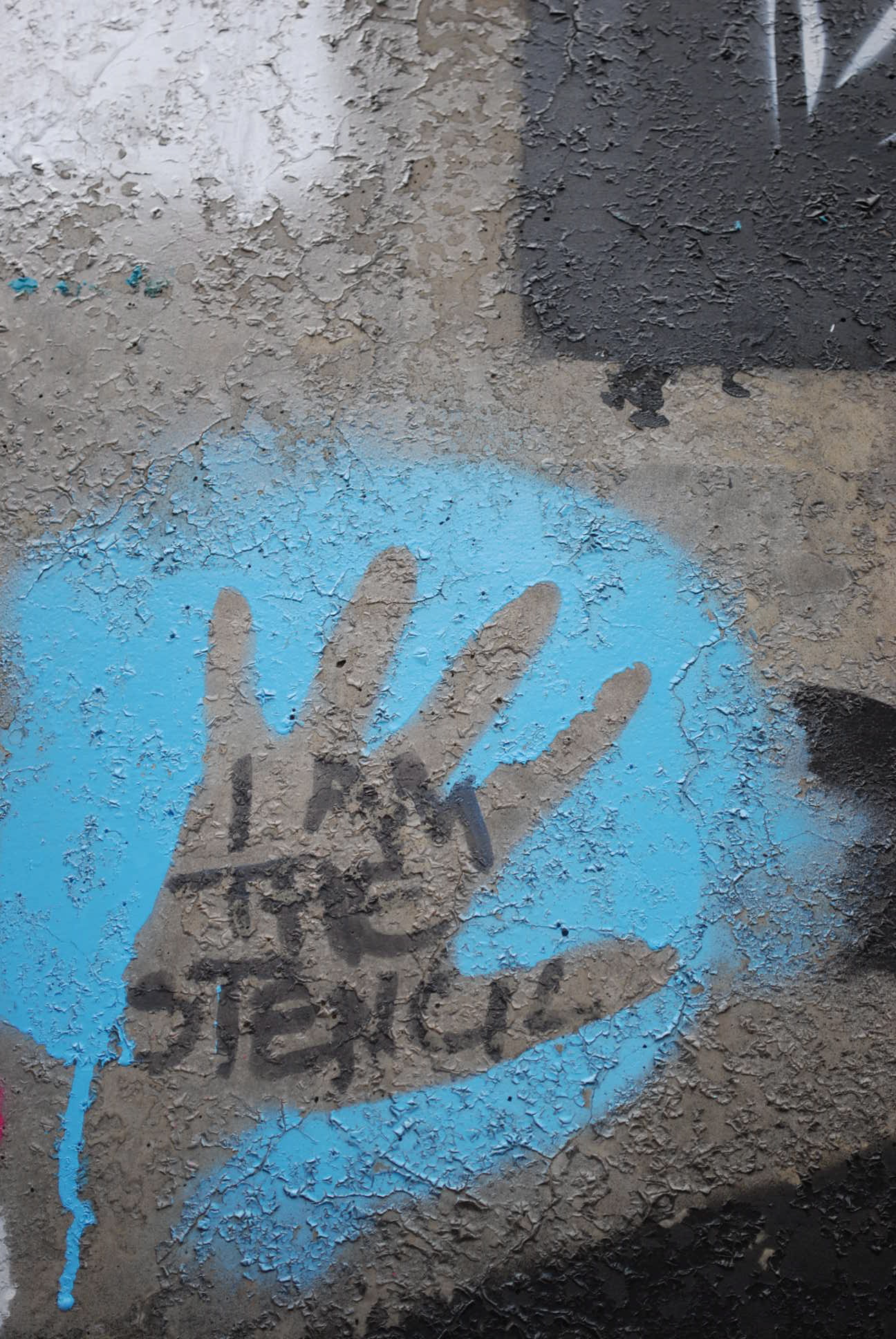
I love this. I like to imagine that the artist perhaps didn’t have any stencils with them when visiting and simply borrowed a spraycan from someone, in order to spray around their hand.
And who, you may ask, made all of this possible? Banksy. Not just through his popularising of street art, but far more directly in that he paid the airfares of the visiting artists and covered the costs of the event, which many estimate to be a cool half a million pounds.
Perhaps reading about the Cans Festival might make you want to go and see it for yourself? Well, yes, you should go and see it, but in fact all of the works I’m writing about no longer exist. That’s right: last weekend a whole new crew of artists were brought in and the tunnel has been entirely repainted. Take a look at the official website here for details of the artists involved. Cans Festival Mark 2 !
How long will the work be there? I don’t know, but I really hope it will still be there when I visit London again in October. But if it’s not – well, contrary to those who seek to preserve street artworks by putting plexiglass over them (as has been done with Banksys in London and in Melbourne), ephemerality is part of the nature of street art.
“I will not draw as I am told…”
Filed under: Art, Street Art | Tags: Amsterdam, laws against graffiti
Comments (6) I’m typing this in bed, where I’m supposed to be resting up, after being sick with a thoroughly unpleasant combo of sore throat and flu symptoms plus upset stomach. Lovely! I’ve spent a few days feeling too unwell to do anything, and today is supposed to be a day of doing nothing except more lying in bed resting up. But…
…that can get boring, so I’ve been reading other people’s blogs, and eventually the desire to write even a short post got too much for me. And in this little moment of not-doing-what-I-should, I wanted to write about an unknown artist in Amsterdam, whose work I saw all around the city in June. He or she writes: ‘I will not draw as I am told’.
Sometimes these words are written, in looping cursive script, as when I first came across them on a wooden hoarding on Bloemgracht, near where I was staying:
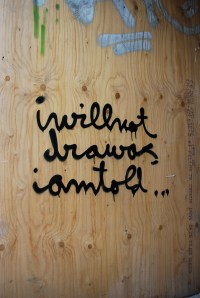
A few days later, I saw another inscription, outside a branch of the ubiquitous Albert Heijn Supermarkets. This time the letters dripped paint, the words running into each other.

Were they painted in greater haste, perhaps? Or was the writer deliberately seeking a particular effect? (There’s a genre of graffiti known as ‘drippies’, made when the writer fills a squeezy plastic ketchup bottle, or some similar container, with paint, and writes drippily on the ground or on a wall…)
Some time later, after my partner and daughter had arrived from Melbourne, we spent a day at Artis, Amsterdam’s wonderful zoo. As we made our way towards Artis’s cafe, hot and longing for an ice-cream, imagine my surprise and delight, when I spotted the same words, written upon a metal container box. The paint was peeling, and the remains of someone else’s paste-up obscured some of the lettering, marking the words as done some considerable time ago.
A few days after that encounter, I was sitting outside the Cafe Belgique in Gravenstraat, carrying out an interview with an Amsterdam artist. The walls outside this tiny bar tend to get covered with paste-ups, stickers, pieces: the bar’s owners are fond of street art and make the walls available to local and visiting artists who in turn use the bar as a kind of unofficial club, meeting there in the evenings for a drink. As I asked my questions and listened to the artist’s answers, my gaze drifted across the alleyway and settled upon a sticker on the wall opposite: “I will not draw as I am told’, it read.
Whoever the author may be, these words seem to encapsulate something about graffiti and street art. Anyone who ‘puts up’ on the street without the property owner’s permission is, by definition, committing a criminal offence, and in doing so, they are refusing to draw as they are told (which would be on canvas, in a studio, for a gallery, with permission, and so on). I’m not trying to claim that graffiti and street art has intrinsic value because of this, but the persistent refusal by its authors and artists to do as they are told seems worthy of remark. In a time when Victoria has just passed some fiercely repressive laws with the potential to criminalise many artists (the Graffiti Prevention Act 2007, about which, there will undoubtedly be more to say in this blog), I find myself to be quietly admiring of the determination to make art on and for the street.
Street memories…
I spent a few weeks in Amsterdam recently. I was there to meet artists and take photographs of art on the city streets (Amsterdam is one of the cities I’m studying as part of my research on street art). One day, I was walking along a street when I suddenly came across this:
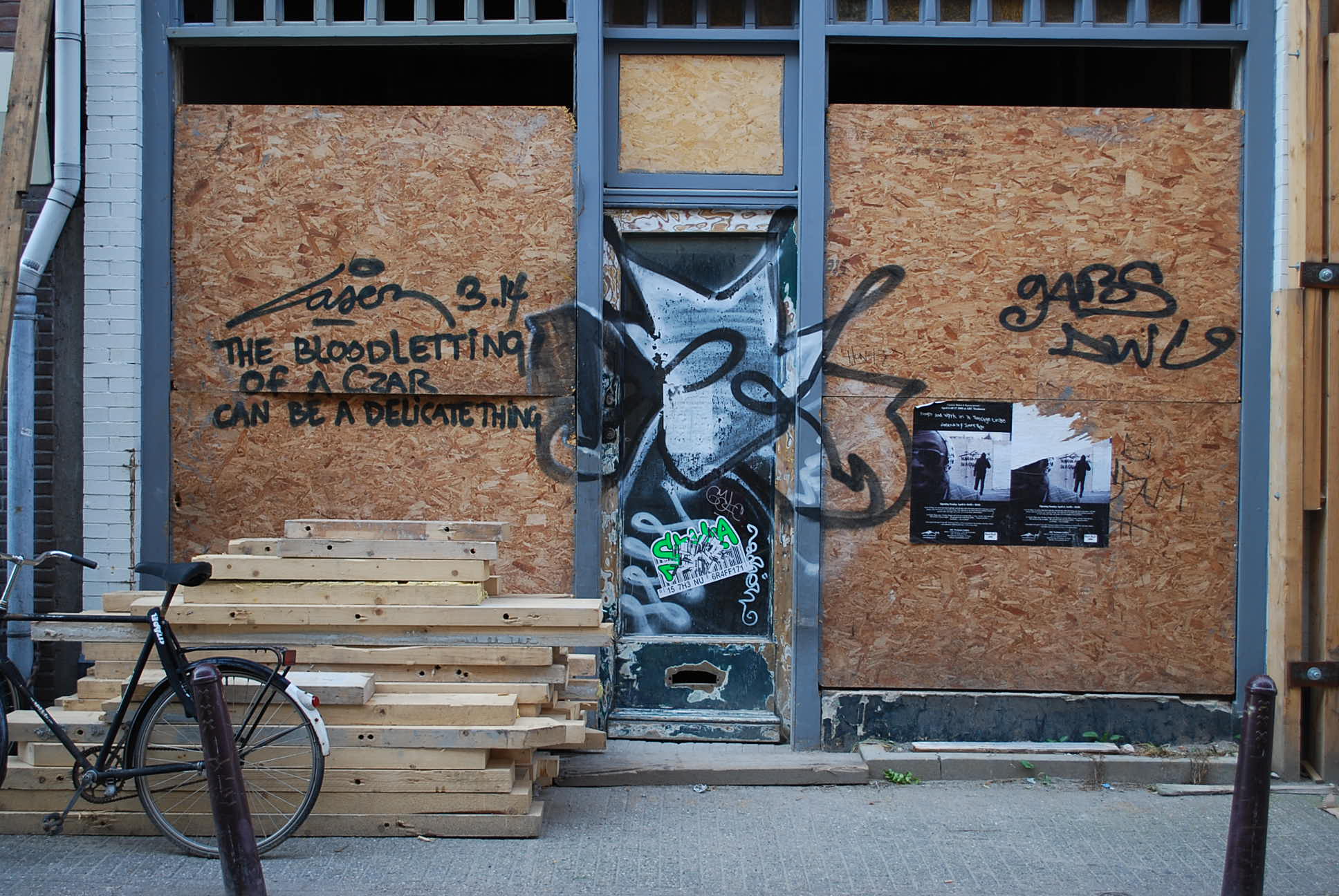
In addition to the usual pleasure that I experience when I come across a new piece of art in the streets, I felt an incredible shock of recognition. The calligraphy, the allusive style, the signature…. I realised that I had seen the work of this writer when I had been in Amsterdam two years before. On that trip, walking around the area known as the Jordaan, I had wandered down a little street and seen words on a hoarding which read: ‘As she dances in the widescreen of her existence’.

Something about about those words had really moved me at the time (and still does). The idea of there being a ‘widescreen’ to existence… and the image of a woman dancing. It embodied, for me, a sense of a way of being that bespoke lightness and joy.
I had no idea who the writer was. I felt surprised and delighted that the writer inscribed his or her words in English rather than Dutch, and, over the next few days, I came across a few more of the writer’s words upon other walls: the distinctive black lettering and the short phrases and sentences, the signature of ‘Laser 3.14’.
But I’m used to the idea that street artists and graffiti writers come and go. They move city, they stop writing on the streets – one way or another, the words left by a writer often disappear and don’t get replaced. So to come across another of Laser 3.14’s texts, two years after my first encounter, seemed like an amazing piece of good fortune.
After that, throughout my 3 week stay in Amsterdam, I saw more and more of the writer’s work. I photographed everything I could see. Some of the texts appealed to me more than others, but all were interesting. Almost all were written on temporary surfaces: hoardings, screens, sheeting. I came across one text, faded and almost too faint to read, painted on a wall (it read ‘When the streets are wet/ the colours slip into the sky’). The others had all been granted ephemerality by virtue of their host surface: they would appear, be present in the city for a while, and then be ripped down.
One day my sense of this writer’s gift to the city intensified into an even more personal encounter. During my visit, I was staying in a studio on Prinsengracht, and each day would leave the studio, and turn left down a small street called Runstraat. On this street there was construction work being carried out on a building; a hoarding covered its lower floor. And then one morning, the hoarding looked like this:
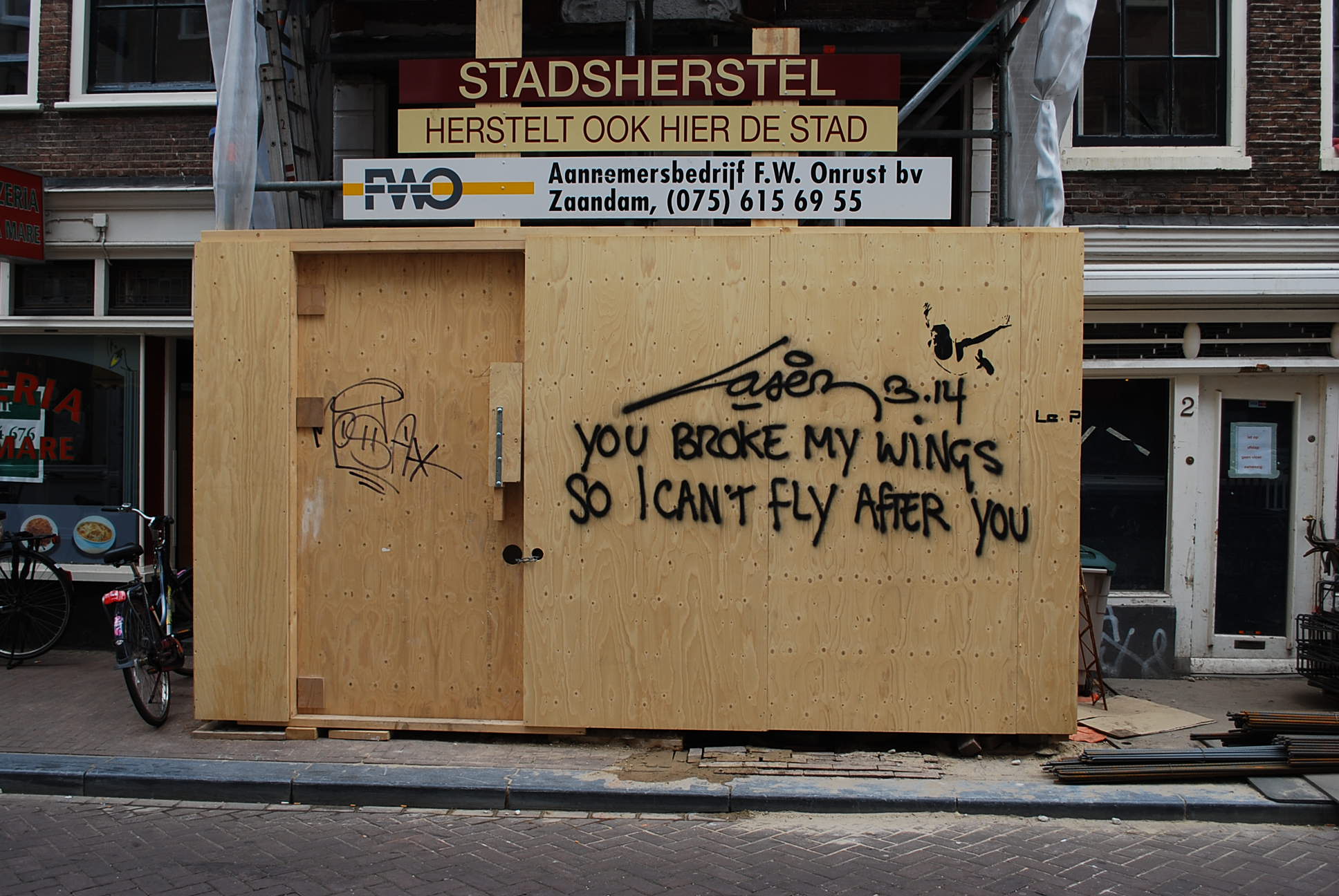
I loved the idea that, while I slept, Laser 3.14 had passed by this hoarding, on the street around the corner from where I lived, and inscribed these words. My pleasure at seeing them made me feel as though I was ‘dancing in the widescreen of my existence’, indeed.
 Images to Live By