‘All in the moment’ – revisited and illustrated!
Filed under: Art, Street Art | Tags: London Underground, sticker
 Comments (1)
 Sometimes you are in the right place at the right time, as they say – and for me, this happened one night back in October when I happened to see a guy putting up a sticker in a London Underground carriage. You may recall my delight at this right-place-right-time happening from the previous entry on this blog, ‘All in the moment’.
Sometimes you are in the right place at the right time, but without a camera. That night I had been at the theatre with a friend, and I hadn’t taken my camera with me. I sat on the train watching this guy calmly and smoothly attach the sticker to the wall and I was unable to photograph the result. Argh!
In the blog post, I wrote about imagining someone catching sight of the sticker on a busy train, and smiling because of it.
Well, not only did that indeed take place, but the person also happened to have a camera with them and take a photograph of the sticker.
And not only THAT, but this person also happens to read this blog, and she has sent me the photograph. Thanks so much, Nadia! And here it is:
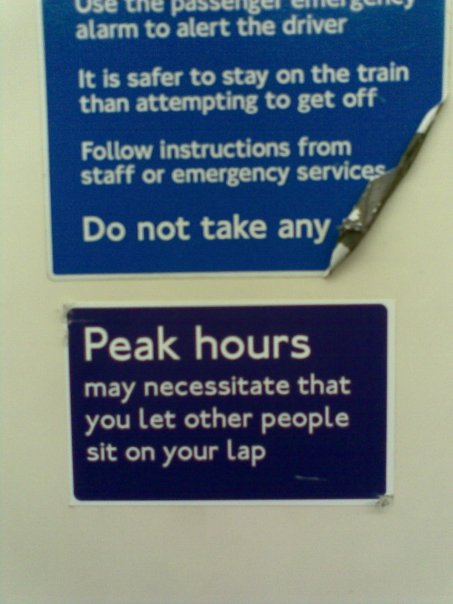
You can see in the photograph that the sticker is just starting to fray and peel a tiny bit (though not as much as the ‘official’ sticker above it). And let’s just admire what a great piece of work it is: the font, the layout, the wording, the white border, the shape and size. I wish I knew who this guy was. When I saw him put it up, I didn’t speak to him, because I somehow didn’t want to interrupt his performance: I didn’t want to be ‘the academic’, saying ‘excuse me, do you mind if I ask you why you are doing this and how long you have been doing it?’. Sometimes you just want to be the audience – admiring, appreciating, and enjoying. The consequence of that is of course that I may never know who he is or how many stickers he has put up on the Underground or elsewhere around London (imagine it! maybe he makes these ‘almost official’ stickers for loads of different sites – what a fantastic idea). But not knowing is somehow OK – I love the idea of this anonymous person carrying out this small act which beautifully resists what Nadia describes as ‘hyper-individualised and negative Tube culture’.
Thanks again for the photo, Nadia. Sometimes it almost felt like I had imagined the sticker, and it is so good to see it again.
The buff
Filed under: Art, Street Art | Tags: graffiti removal, London, San Francisco
Comments (1) Different cities, just as they have distinctive cultures of street art or graffiti, have different policies for removal of illicit images from urban spaces, and different methods of removing (buffing) graffiti and street art. Some councils employ cleaning crews who use water sprays, other paint over images. Graffiti removal is also big business – in Melbourne, there are many graffiti removal companies, such as Graffiti Eaters. Sometimes ‘concerned citizens’ get involved – Neighbourhood Watch groups, or organizations such as Graffiti Hurts Australia, or R.A.G.E. (Residents Against Graffiti Everywhere), or even individuals (such as ‘Guerilla Joe’, in Doug Pray’s fantastic documentary film Infamy).
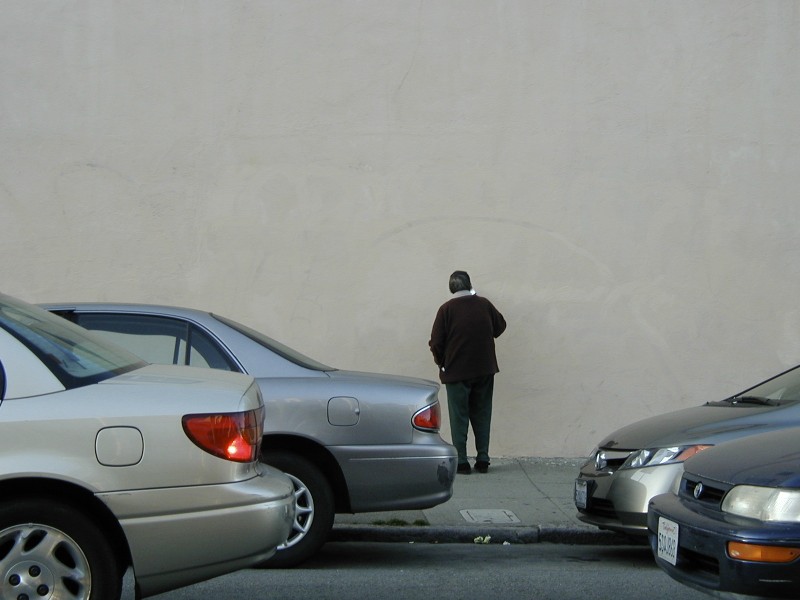
On my travels this year, I’ve been interested to see different removal ‘regimes’ in action. In San Francisco, the city has put the onus of removal upon the property owner. If graffiti appears on your property, you are under an obligation to remove it within 30 days. If you don’t, the city’s attorneys will obtain a court order against you to allow city officials to remove the graffiti themselves, and you then have to pay the costs (at least $500 US, or $775 AUD). Here’s a photograph of a man in the Mission District of San Francisco who was busy painting over a tag on his wall:
But the law that obliges the property owner to remove the graffiti doesn’t specify that any effort should be made to match the paint that the graffiti sits on top of – the objective is to make people take action by painting out the graffiti, rather than attempt to create a particular result (like restoring the wall to the condition it was previously in). So what happens is this:
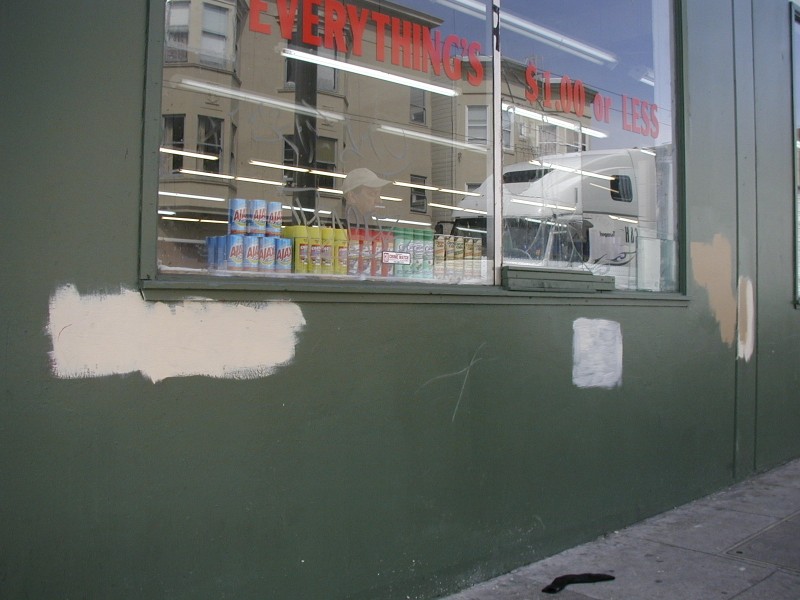
Here you can see a kind of patchwork effect, as people use just enough paint to cover a tag or stencil – and thus avoid being fined – but don’t worry about matching the paint in any way. Does it look better or worse than when the wall had a tag or stencil on it? Well, the answer to that may be in the eye of the beholder, but one thing is sure, the result is not a ‘clean’ or ‘blank’ wall…
Blank walls were what I found in many streets of London recently. In streets where, in July, there had been a lively ‘conversation’ (to use Russell Howze’s term – thanks, Russell) of stickers, tags, stencils, objects, paste-ups, by October many of them had been cleaned up, all over Shoreditch, and up and down Brick Lane. Turns out that the local councils (London Borough of Hackney and London Borough of Tower Hamlets) had decided it was time for a cleaning blitz, with the result that hundreds of images had been buffed.
I saw some of this in action:
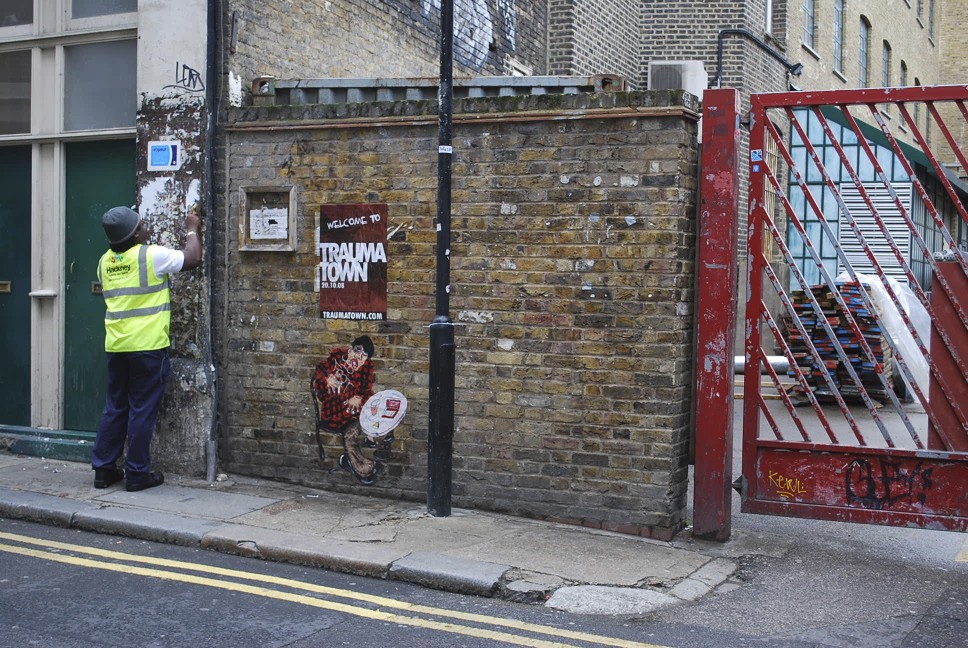
And in terms of the overall differences in how these areas look, to compare the amount of work that was up on the walls in July with what was there in October, have a look at these images. Here’s a section of Brick Lane in July:

And here’s how it looked in October:

Here’s the start of a little alleyway in Shoreditch in July:

And here it is a few weeks ago in October:

But you can see that the Invader piece is still there on the wall: whoever painted over the wall has neatly painted around the tile…
And as for all the other blank walls, I’m guessing there might be a few folks who will look at them and say, ‘Fresh canvas – thanks very much!’
Moving images: art and politics on the screen
Today I went to see a film called Hunger. I haven’t written at all yet in this blog about moving images, despite a significant part of my time revolving around thinking, teaching, and writing about cinema. Seems appropriate, then, to make the first cinema-related post on this blog about Hunger, the first film by Steve McQueen, a visual artist, photographer and sculptor who won the Turner Prize in 1999. Hunger is certainly the work of someone who understands the visual, but one of the great things about it is that it is not only outstanding for its its composition of images, with an artist’s eye for the huge image on the cinema screen. The film also shows how the visual imagination in cinema can be intermeshed with sound and narrative, so that when you are watching the film you are captured in several simultaneous ways. (Here’s a link to a very good article in The Guardian about the film and about McQueen.)
The film is about the hunger strikes organised by the IRA in the Maze prison in Belfast in 1981. Many IRA members in the prison took part in a series of protests, in an attempt to compel Thatcher’s government to recognise the political nature of IRA activities. The British government refused to do so. The prisoners, for many years, refused to wash and to wear prison uniform. The prison authorities gave them each a single blanket, rarely cleaned their cells or their bodies, beat them and tortured them. Unlike the scandals at Abu Ghraib, which led to the trials of several soldiers, as far as I’m aware no member of the Maze prison authorities ever stood trial for what was carried out there. And after the ‘no-wash’ and the ‘blanket’ protests had seen no success, a hunger strike was begun. Bobby Sands was the first to go on hunger strike; a further prisoner began a hunger strike every fortnight after the commencement of the protest. Sands was the first to die; a further nine prisoners died too.
Here’s a still showing Bobby Sands (played by Michael Fassbender), in the film’s amazing central scene (filmed in one 22-minute take), as he describes his commitment to the hunger strike in conversation with a priest visiting the prison:
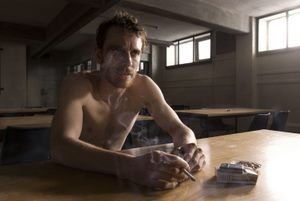
These hunger strikes were a huge part of my early years at university. The newspapers were filled with stories about the hunger strikers; Bobby Sands was elected as an MP during his hunger strike; he also was elected President of the Student Union at Glasgow University (I grew up and lived in the West of Scotland, an area filled with strongly sectarian sentiment).
Seeing Hunger today brought back many memories from that period, and it’s amazing to me that so little is now talked about the Maze hunger strikes, and the ‘dirty’ protest, and the abuse that was perpetrated within the prison walls.
The film is very difficult to watch, in that it unsparingly shows Sands’s physical decline as he starves to death. But the film-making demands that we watch. I simply want to mention the first few scenes, which show a man getting dressed in his bedroom, washing his hands, and then going downstairs to eat a plate of food prepared for him by his wife. There’s no dialogue or music in these scenes. We don’t know who this man is (later, we learn that he is a prison officer). But what is so beautifully rendered is the simplicity of these everyday activities – dressing, washing, eating – activities which have been, as the film is later to reveal, rendered absolutely impossible for the IRA prisoners (who must live in faeces-smeared cells, with maggot-infested piles of rotting food on the cell floor, naked except for a blanket, filthy and unable to wash). These scenes take only a few brief minutes at the film’s outset, and they would be easy to miss. If you see the film – and I recommend you do – take note of these scenes, and the activities they show. They’re easy to overlook, we do them everyday. How luxurious are our lives that we are able to do them without giving them a second thought. How great is Steve McQueen’s film in that it shows what life can become when that freedom (to wash, to eat, to wear our clothes) is taken away.
Street art and the museum
Filed under: Art, Street Art | Tags: museums, Street art, Tate Modern
Leave a Comment In the northern summer of 2008, from 23 May to 25 August, the Tate Modern art gallery in London hosted an exhibition called Street Art, curated by Cedar Lewisohn. The exhibition involved the installation of works by six artists on the front façade of the museum, plus film screenings, a program of talks, a walking tour around the area showcasing works in the street (a further five artists were commissioned to create works especially for the designated sites), and a Street Art Information Tunnel in the museum forecourt, showing short films, providing information, and with a tagging wall (textas and marker pens provided). There’s information about the exhibition and the artists in the Tate’s archive here. Lewisohn also produced a book on street art, which constitutes an extremely interesting account, contextualising street art in a broader way than many other commentators – see here for more details of the book.
The artists who were selected to exhibit on the Tate’s massive outer wall were: os gemeos (Brazil), Blu (Italy), Faile (the United States), Nunca (Brazil), JR (France), and Sixeart (Spain). The artists who exhibited works for the walking tour were 3TTMan, Spok, Nano 4814, El Tono and Nurla.
For all its several component parts, the most significant part of the exhibition was certainly the outer wall, featuring the works by the six international artists. These works were massive, as befits the size of Tate Modern (a former power station). The six works could be seen from a great distance: many visitors approach the Tate Modern from the north side of the Thames, walking across the elegant Millenium Bridge to the museum. These visitors were treated to an incredible view of the images and were able to watch them increase in size with each step across the bridge. You can get a sense of this in the image below:

Once in the museum forecourt, visitors gazed upwards at the outer wall, able to see the detail in each work – especially interesting in the case of the image by Blu. In this first picture, you can see the work as a whole; the second one shows the amazing detail.


Proximity to each image of course changed the perspective on it: standing beneath each one, the spectator was towered over by each image. Some, like this Faile piece below, were enormously powerful and dominating in appearance.

Others seemed to incorporate a kind of pathos despite their monumentality – like the yellowing skin and skinny limbs of the os gemeos figure, as you can see here:
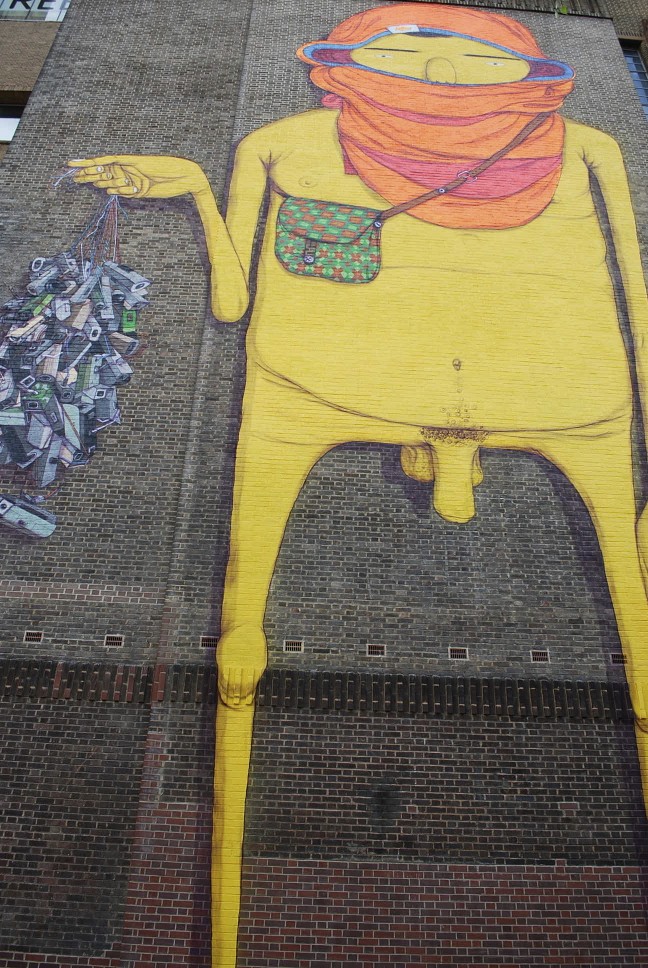
JR’s pasted up image of a young man wielding a video camera was already in peeling tatters (thanks to the rain and wind that you can get in a British summer). On the first day I visited, repair work was being done on the JR image. This actually helps to show the dominating scale of the works, since you can see how small the cherry picker looks next to the photograph:
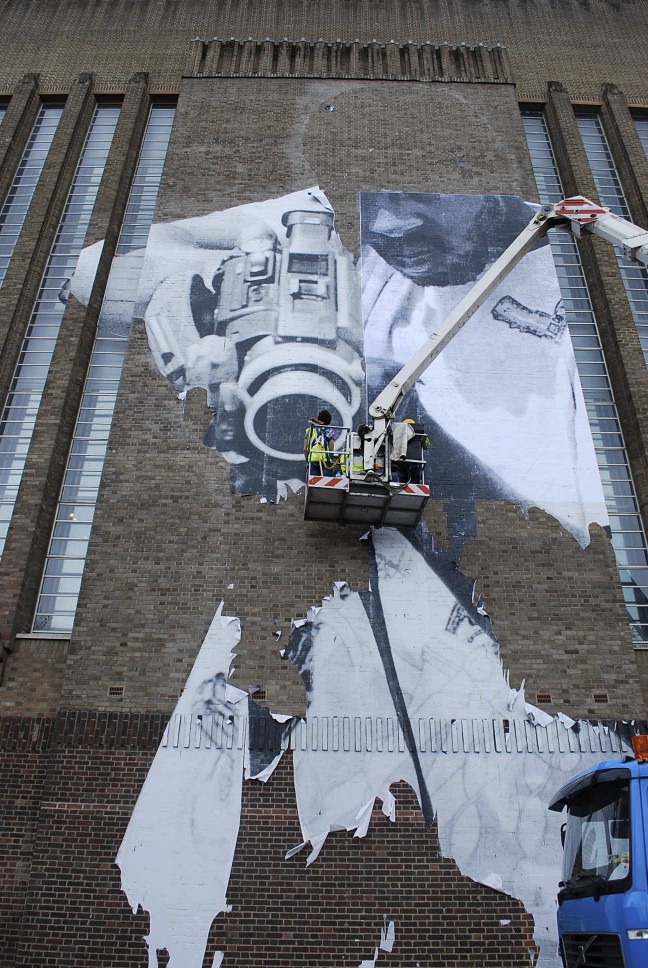
And here’s what it looked like a few days later:
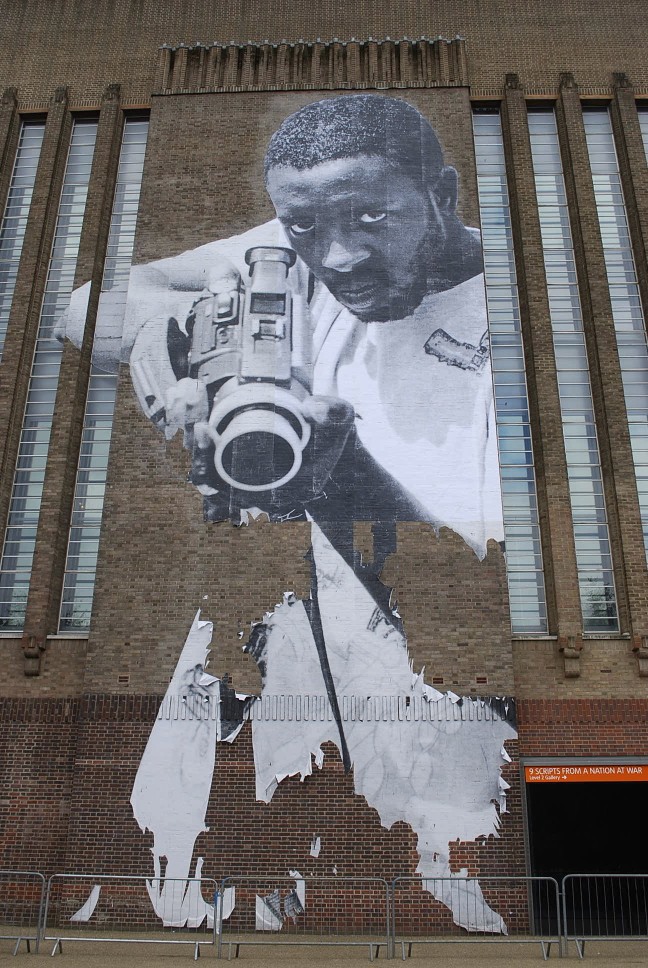
Quick glimpses of the other works:

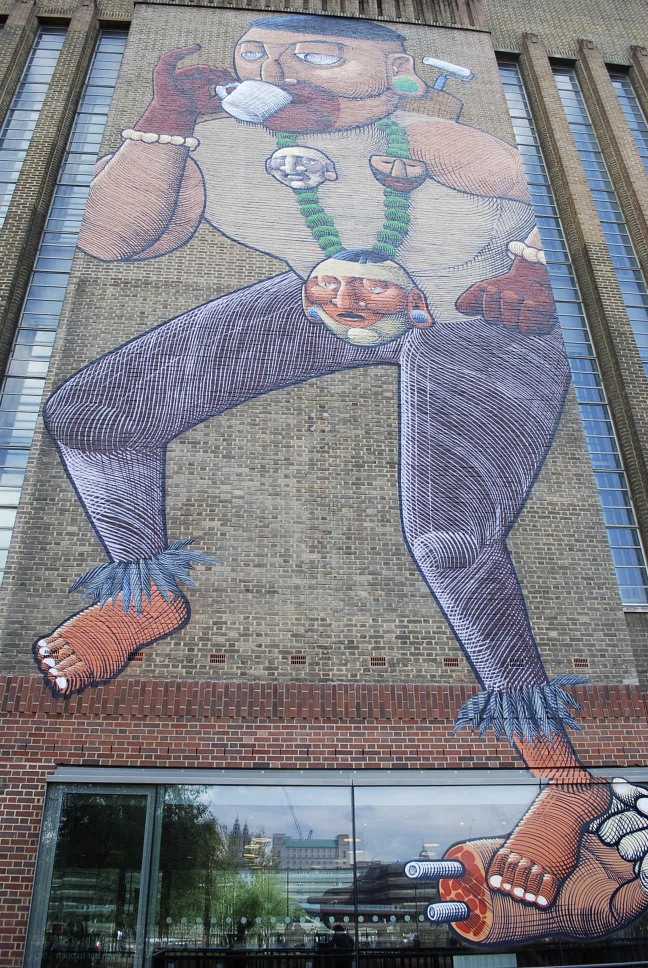
It can’t be denied that it was amazing to see such works, and to see them on the wall of as august an institution as the Tate Modern. But I have just a couple of misgivings about the experience….
First of all, the scale of the images. The sheer size of these works (as you can see, they were of course done with the assistance of cherry pickers and so on) almost takes them out of the domain of street art and puts them into the realm of something else. The work is, literally, elevated – raised up off the street, placed high on the façade of the museum. Looking at these huge, amazing works raises the question, ‘what is “street” about ‘street art”?’ Is it work done on the street? If so, then these works would obviously be excluded from that definition. Is it work done with a particular sensibility on the part of the artist? Is it work with a particular ‘look’ to it, a specific aesthetic? Is it some combination of these?
Although all six of the works had the requisite sensibility (all of the artists are well known for their previous work on the streets, legal and illegal), and although all of the works variously participated in the aesthetic that seems to characterise street art (an engagement with pop culture, contemporary politics, an awareness of spatiality, a willingness to manipulate image and genre), it’s also worth considering what happens when ‘street’ art meets the museum.
The debate around the tensions between art that is made for the streets and then exhibited in gallery space is well-rehearsed. But I think that those tensions are multiplied when artworks that are at least in some way related to the space of the streets are then brought into the realm of the museum.
Small galleries (which is where the majority of street artists exhibit their work, if they exhibit at all) really are, oftentimes, small. Of course, they are driven by lots of imperatives, some of them commercial, some of them about cementing a particular reputation for themselves within the gallery scene. But they are less often trying to make a statement about capturing the artistic zeitgeist, or cataloguing artistic worth, or building representative collections. Museums, on the other hand, are driven by exactly those objectives. That’s one of the reasons why the National Gallery of Australia’s purchase of prints of stencil art by street artists had such political and cultural significance – as a museum, the NGA’s interest in street art lends a kind of institutional validation to street art and the artists (something that is important to remember when governments attempt to pour scorn on the cultural value of street art, as has recently been happening in Melbourne).
So what cultural value is generated by the interest of the Tate Modern in street art? Well, of course, you could say it recognises something that has become hugely important in many British cities (especially London) and something which has become of particular cultural importance to young people. You could say that Lewisohn’s assembling of these particular works demonstrates an outward-looking worldview that see beyond any limited self-image of London as the global centre of street art (in his selection of six non-British artists for the exhibition).
All of these things would be correct. But there’s something else worth thinking about, in this consideration of the cultural value of the Tate’s street art exhibition, and in the encounter between street art and museum space. When I first heard that the Tate was putting on an exhibition about street art, I emailed the museum for information, and in their response, I found it very interesting that they said: ‘there is no work in the building, only on the front and in the area’.
This comment was made as part of a helpful and detailed email from the Information Department, and I initially didn’t give it much thought. But after going to the Tate and looking at the façade, and doing the walking tour, and visiting the ‘Information Tunnel’, I was struck by the fact that the ‘street art’ stayed outside the museum. And then struck again, weeks later, when I heard that the works on the outer wall had been removed when the exhibition ended in August.
Ephemerality as part of street art – a recurrent theme in the writings on this blog, and of course a key part of street art culture. But ephemerality is what we expect (and accept) when works are on the street. When they are part of a museum exhibition, why can’t the works be permitted to stick around? No-one, of course, is going to go over or tag works on the front of the Tate Modern (given that cherry pickers were needed to install the images, it seems hard to imagine other artists seriously being able to have much impact on any of these even if they wanted to). But it turns out that the museum can buff the works. The outer wall now looks the same as it ever was…
Since no works made it inside the museum as part of the exhibition, and since the outside has now been returned to its ‘normal’ appearance, there’s little evidence that the Tate ever had an exhibition showcasing street art (except for the items for sale in the gift shop). And that seems – well, ‘wrong’ is too strong a word for it. But think about it: if the Tate Modern bought an artwork by Warhol or by Rothko and then, after a few months, destroyed it… wouldn’t that seem strange? Those works by Blu, Faile, os gemeos and the others were fantastic and wonderful, and are now gone. That the museum played a part in their disappearance somehow feels disappointing to me.
Nesting and dying….
Filed under: art, Art, Street Art | Tags: Miso and Ghostpatrol, Nesting and Dying
Comments (3) Miso and Ghostpatrol, as many of you reading this blog will know, are two artists living and working in Melbourne, and making images both on and off the street. They’re two of the most interesting artists in this city, for a whole range of reasons. For one thing, although they each work as solo artists, they also work together – and their collaborations reach the kind of intense symbiosis that I mentioned in an earlier post (‘Criminal damage?’).
If you are interested in seeing something of their work in a gallery context, they have a show on until 7 November 2008, at metro 5 gallery. The show is called ‘Nesting and Dying’, and in that title you can see some of Miso and Ghostpatrol’s preoccupations: the tension between life and death, the beauty that exists in both, and the need to represent both.
One thing that’s striking about the show is its creation of a distinctive world. The artists have installed the artworks along with a series of objects and contextual items so that the space not longer feels like just a gallery, but suggests itself as something else as well. As for what that ‘something else’ is, there is a lot of ambiguity. There are shelves with objects placed on them; there are stuffed animals in the midst of the floor. It’s hard to say what kind of place is being evoked – someone’s home? a scene from a fairytale? a fantasy?
The artworks themselves are fascinating. There are works by each individual artist. Ghostpatrol has created a number of images made by drawing on pencils. That’s not drawing with pencils, but drawing on pencils. The side of each pencil contains a fragment of a larger image; when the pencils are laid side by side, the fragments create the overall image. The result is something small (only the sum of several pencils, after all), but it represents itself as larger than its components… And it is an image made from the tools used to create images – a wonderful demonstration of reflexivity in an artwork. Along with these there are some lovely drawings, containing many of the figures characteristic of Ghostpatrol’s work. a person, a rabbit, a knife. Small figures in a forest. All drawn with great precision, all extremely appealing, yet at the same time slightly odd, slightly out of kilter.
And Miso’s work – well, there are some lovely, lovely images. I stood for a long time in front of one, a large piece on wooden board, which depicts a female figure – it’s shown on the gallery website, if you would like to take a look. The work contains so many different elements – cut out paper pasted onto the wood, a sketched drawing of part of the figure, decorative textures that suggest the figure’s clothing and which also flow into the wooden backdrop. Something in this image really resonated with me – perhaps it’s because the female figure seems to be both emerging out of and receding into the background. It’s technqiue like this that explains why Miso’s paste-ups can work so well on the street – the figures look both to be an integral part of the setting in which they appear and also separate enough from it to generate a fleeting conversation with it.
In addition to their solo works, the artists have created some images together. These are interesting because one can still see the ‘hand’ of each individual artist at work within them, while the two distinctive styles mesh together really well. And overall, it is fascinating to try and think through how and why their styles, even within the exhibition as a whole, produce this gorgeously resonant collaboration. There’s a shared palette of colours (browns, grey, black, bone), for one thing, and an interest in textures (wood, paper, stone). But more than this, there’s a strong sense of a shared sensibility of the image. In trying to capture what this is, I can’t do any better than quote the words of my partner, who came to the show with me. Looking around the gallery, he said that it was as if the works were illustrations in a book of fairytales in which the stories had not yet been written. And that’s it: these strange, evocative, heartfelt, uncanny images make visible for us – momentarily – the unwritten stories that animate them.
A moment of maternal pride…
On Saturday I was walking down Brunswick Street in Fitzroy with my daughter, when I spotted one of Miso and Ghostpatrol’s paste-ups – one of the ones depicting themselves in fox masks. The image was pasted up on the side of an airconditioner, positioned high outside a hairdresser’s.
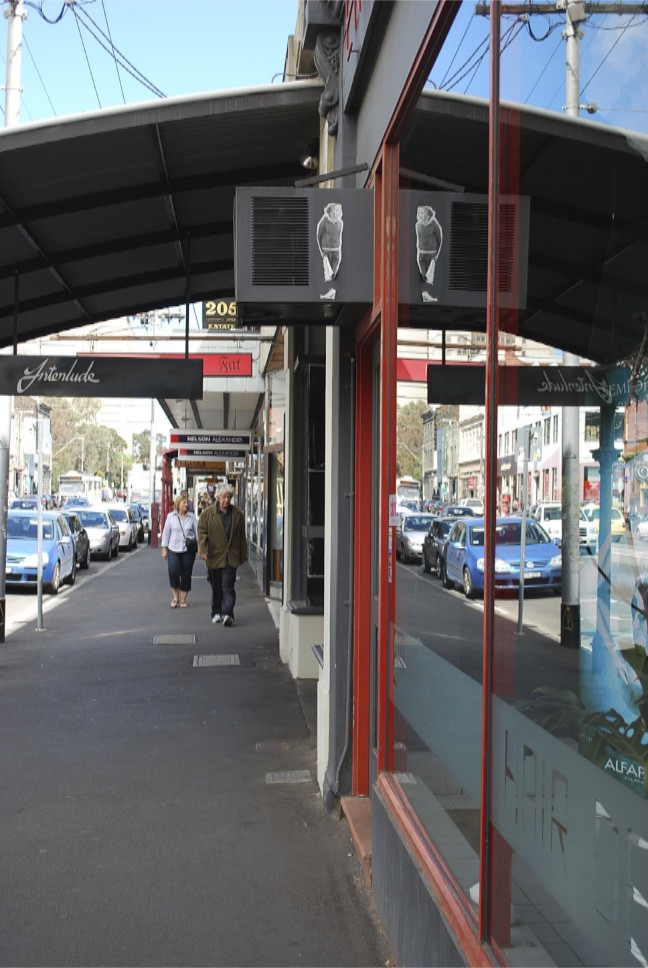
Here’s a close-up of the work:
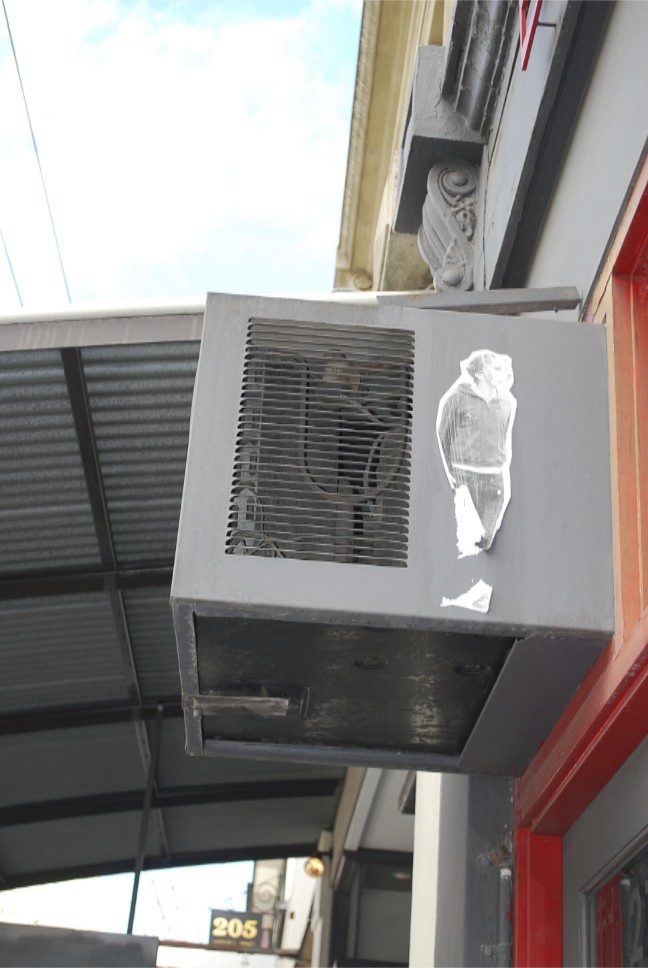
I said to my daughter, ‘Look – up there! Do you see what’s stuck up there?’ My daughter, in a very matter of fact voice, said, ‘Yes, yes, it’s by Miso and Ghostpatrol.’
In the midst of my embarassment at not realising how well-developed her awareness of street art is becoming, I felt a huge sense of delight and pride – both in her ability to recognize the artists who had made this artwork, and in her growing up with an interest in and appreciation of art in the street as well as in galleries and museums.
Mind you, knowing what happens when ‘teenage rebellion’ kicks in, she’ll probably join RAGE or something when she grows up. (Hope not!) But for now – all good!
What Banksy did next….
Filed under: Art, Street Art | Tags: Banksy, Village Pet Store and Charcoal Grill
Comments (1) Banksy is the most famous street artist in the world at present – he is a household name in Britain and an inspiration to many artists. He’s a celebrity figure, with his work selling for huge sums of money, and there’s also something of a secondary Banksy industry completely separate to the artist himself (and, it has to be said, exploiting his fame): for example, Banksy birthday cards, Banksy T-Shirts, and prints of digital photos of his works are sold at dozens of shops and market stalls around London.
His own publications (such as Wall and Piece) have sold in massive numbers and his website (here) has got to be one of the most visited street art sites on the net. He organised and funded the Cans Festivals (which I have written about in this blog already) – a massively generous gesture which put the work of street artists and graffiti artists from around the world on display in a disused tunnel in London.
His own work is distinguished by some very recognizable characteristics and motifs – rats, the balloon girl, the Tesco supermarket bag, a certain mockery of the police (for example, his ‘snorting copper’, hoovering up a massive line of cocaine as he kneels on the ground) and a facility for snappy slogans (for example, ‘One Nation Under CCTV’).

And just when you might have been thinking that his work had settled into a format so recognizable that it might almost be in danger of becoming a brand, Banksy has managed to surprise everyone again, by staging what is simultaneously an artwork, an installataion and an event, in New York City.
The Banksy Village Pet Store & Charcoal Grill is situated in a former shopfront, displaying in cages what looks at first glance like animals, as you would expect in any pet shop. Closer inspection reveals mutant creatures, fast food items behaving like animals, and animals in contexts designed to provoke discomfort in the spectator about the uses we make of animals, such as testing cosmetics upon animals such as rabbits, or turning animals into hot dogs and burgers (the very title of the work shows Banksy’s interest in interrogating the link between a pet store, which is about our desire to domesticate animals as our pets, and a restaurant, which is about our desire to flame-grill them on hot coals and eat the result).
Many people have responded to this work with delight, but also with surprise, as if it’s a huge departure for Banksy. And in some ways it is – it’s a long way from a stencil on a wall to a moving hot dog in a display case. But it’s also worth recalling Banksy’s painted, living elephant, displayed in Los Angeles – an artwork constructed to undercut the well-worn phrase, ‘the elephant in the room’ (check it out here). That piece showed Banksy’s interest in the moving image (not cinema, but the image that literally moves). And perhaps since that work attracted some criticism (people asked if it was cruel to paint the elephant), in Banksy’s Village Pet Store & Charcoal Grill the creatures are animatronic creations, and far more uncanny as a result.
For those of you lucky enough to be in or near New York City, you can see these creatures ‘in the flesh’, as it were. Those of us elsewhere will have to make do with watching the many videos uploaded onto YouTube. Enjoy!
Superheroes forever…?
Filed under: Art, Street Art | Tags: Anthony Lister, D*Face, London, masculinity, Meggs, Melbourne, Superheroes
Comments (1) I’ve been thinking a lot about superheroes lately. This might sound odd, but they seem to be in the cultural (and political) air at the moment.
Superheroes have featured in recent shows by three artists: Anthony Lister, an artist from Brisbane who now lives and works in Brooklyn; D*Face, one of the mainstays of the London street art scene; and Meggs, based in Melbourne. All of them feature superhero figures in their work – and all of these superheroic figures are in some way twisted, or subverted, or undercut in the way they are depicted by the artists.
Lister has had two shows recently, one at Elms Lesters in London (with WK Interact), and ‘This Won’t Change Anything’ at metro 5 gallery in Melbourne. I only got the briefest glimpse of the Melbourne show, but I think there are some really interesting things going on in his work right now. The figures in his works emerge out of the paint, alluded to rather than rendered in explicit detail.. Colours are sometimes thin, pale or insubstantial, almost gauzy. The combination of these inchoate figures and Lister’s ethereal brushstrokes creates a superhero who is rather less than heroic – a fleeting character rather than one with the definitive qualities of the hero.
In D*Face’s current show ‘Apopcalypse’, at Black Rat Press in London, several works feature superheroes. In one, Batman is shown hanging by the neck from a noose; in another, part of Superman’s face has been replaced by a ghastly skull. These characters, usually associated with strength, invincibility and power, are in this show made problematic. Their presence seems less to do with ‘saving the world’ (as superheroes conventionally do) and more to do with (the evils of) capitalism.
Many of the works in this show take a swipe at the institutions of capitalism (see for example ‘American Depress’, an ‘altered’, expanded replica of the Amex credit card). What then should we make of an image such as Batman hanged by the neck? Is he the victim of a corrupt system? Or is he a part of that corruption? The link between superheroes and capitalism does not, in these strange times, seem at all strained: merchant bankers have previously shown, in their uncritical adoption of Tom Wolfe’s critical epithet ‘masters of the universe’, that they are not averse to viewing themselves as all-powerful superheroes. And I write this entry on a day when I read in the London newspapers that the British Prime Minister, Gordon Brown, is being described as ‘a superhero’ by European financiers for his bailout of the banks. Perhaps the current global financial crisis gives D*Face’s critique of capitalist superheroes an unexpectedly topical edge.
in Meggs’ recent work, the ‘Own Worst Enemy’ show at Dont Come gallery in Melbourne and which can be seen here, there’s no critique of capitalism, but it’s possible to read the works as a critique of powerful masculinity. The images draw heavily on comics and their rendition of the superhero, but rather than depicting singular characters (a ‘Batman’, a ‘Phantom’ and so on), these works feature a figure who is an uncomfortable hybrid of several superheroes. His costume sometimes shows the pointed ears of Batman, sometimes the purple colours of the Phantom, sometimes a winged helmet, sometimes the features of He-Man, and so on. In looking at the figures we recognize each of these as markers of the various superheroes, and thus subscribe to the idea that by means of such markers we can identify them – only to find that the figures resist easy identification, always presenting themselves as uncertain amalgamations and alternatives.
And ‘uncertain’ is a key word here. The figure embodies uncertainty. In a number of images his face grimaces in pain or distress; in others, he cowers away from an unseen threat or attacker. In one series (‘Don’t Know, Don’t Care’), he turns his head away, eyes closed, saying, ‘Don’t…’. The depiction of a superhero in postures of distress, uncertainty, powerlessness or injury radically undercuts the standard associations we have for such figures, converting them from figurs of salvation and rescue, into characters who may need rescue themselves.
Which means that, adapting the classic question ‘who guards the guards’, we should ask, ‘who is there to save a saviour?’. When ‘white knights’ and superheroes are incomplete, corruptible, or vulnerable, it may well be time to reconsider our cultural and political assumption that there will always be someone to rescue us.
Criminal damage?
To come to public space with almost nothing, but to leave a monument.
Brad Downey
The American artist Brad Downey has often worked with collaborators – he is well known as half of Darius and Downey, who produced hundreds of works around both New York City and London as documented in a book, The Adventures of Darius and Downey, and a film, Public Discourse. (More information about both is available from Downey’s website here.)
(And in both the book and the film it’s clear that this ‘collaboration’ was in fact extremely competitive – quite unlike the kind of mystical collaboration achieved by, say, Gilbert & George, or Marina Abramovic and Ulay. In those instances one artist seems to melt into the other, creating a kind of ‘third hand’, as Charles Green calls it, which transcends the two individual artists’ own hands.)
Public Discourse shows that instead of any mystical union between Darius and Downey, a separateness constituted a strong element in their collaboration. And indeed Darius and Downey no longer work together, although both are currently based in Berlin.
Downey’s current solo work still involves working with others – this time someone who films the ‘spontaneous sculptures’ he creates in city spaces. This July, I was in the audience at the Tate Modern, when Downey presented six short films of recent work. For a piece called ‘Ladder Stick Up’, which was carried out while he was in Aberdeen, exhibiting work at Peacock Visual Arts, Downey found a building which was undergoing construction work, its outer wall covered with scaffolding under red plastic sheeting.
The film shows Downey approaching the building, carrying only a small bag. He disappears behind the sheeting, and we watch, as for a time nothing seems to happen. Then it becomes clear that Downey is standing on the scaffolding, cutting into the plastic sheeting from behind it, as a hole appears and expands into a line which stretches diagonally upwards through the sheeting. (As he showed the film, Downey commented that the small knife he used ‘cut through the architecture like it was butter’.)
Downey cuts the line as far as he can reach on one level of the scaffolding, and then climbs to the next level where the cutting begins anew. This goes on for several levels of scaffolding, and we can see on the screen that a progressively larger shape is being cut in the sheeting.
It gradually becomes apparent that Downey is cutting the shape of a heart into the sheeting, and, finally, high above the street, he cuts the last piece of sheeting holding an enormous red plastic heart in place. As the heart slowly fell out of the sheeting and billowed to the ground in a heap, I heard myself gasp, and I can’t believe I would have been the only person in the audience watching this film to do so.
After the heart had fallen to the ground, the grey granite of the building and its metal scaffolding were starkly revealed in the heart-shaped gap. (If you’d like to see what the result looked like, click here.) It seemed both a shocking architectural anatomy lesson and a sublimely beautiful performance – a spontaneous sculpture indeed, created from material that we are not supposed to notice, such as the temporary structures of plastic and scaffolds.
Downey said his aim was to do ‘a huge piece of damage’, but to make it friendly and happy through the use of an image (the heart) that everyone knows. Was it ‘damage’? The building owner thought so: Downey was arrested when he climbed back to the ground (the owner had called the police while he was working), and was fined 2000 pounds (which, fortunately for him, was paid by Peacock Visual Arts). What was ‘damaged’? Plastic sheeting (which cost someone money, I guess, and which probably had to be replaced).
But this sculpture demonstrates how fluid is the nature of ‘damage’. Downey created something which was both a performance in itself and which left behind a perfectly ephemeral piece of street art – one which looked astounding (the juxtaposition of heart shape and the now revealed innards of stone and scaffolding), which had the appeal of cuteness (like a valentine card to the city), and yet which came into being through the violence of cutting and discarding.
All in the moment
The other night, I was taking the underground back to where I’m staying in London, sitting on a Northern Line train with a friend. Just across from me was a young guy, and after a little while, he reached into his bag and pulled out… a sticker. Very calmly, he peeled off its backing, turned, and fixed it to the wall of the carriage, just behind his head. Although he did this in one fluid, and swift, movement, the sticker was perfectly lined up on the wall – it wasn’t squint, it sat exactly midway between the window frame and the glass divider before the exit door. It mirrored, at the other end of the carriage, a sticker placed there by the London Underground, about giving up your seat for others. In short, it looked official.
But this sticker read:
‘Peak Hours
may necessitate that
you let other people
sit on your lap.’
The blue wasn’t quite the same shade of blue as that used in the ‘real’ notices, but the font of the white printed text was exactly right – as was the slightly pompous wording. I’ve noticed that public notices here often have a rather more formal tone than the notices we see in Australia. The ‘real’ sticker at the other end of the carriage, for example, read: ‘Priority seat. For people who are disabled, pregnant, or less able to stand’. ‘Less able to stand’: I love that. How much less able does one have to be in order to claim the right to a priority seat? If I’m feeling footsore after walking around photographing street art, am I ‘less able to stand’?
But my favourite pompous sign is in the building I’m staying in, outside the lift. It directs the reader: ‘In case of emergency, firstly call the caretaker. Secondly, call the lift engineers. Thirdly, if the engineers cannot respond quickly, call the Fire Brigade’. I love that firstly, secondly, thirdly… The grammatical precision, the conditional clauses. Just perfect.
And this guy’s sticker seemed to have caught that exactly: ‘peak hours may necessitate that someone sits in your lap’. The juxtaposition of ‘necessitate’ and ‘lap’ – so unexpected, so funny.
What a great thing to have made, and to have seen – a sticker that will travel around the London Underground, and which will catch the eye of some commuters and not others, simply sitting on the wall of the carriage. And for those who notice it, inevitably a smile will be brought to their faces, and some of the pain of the moment – the pain of peak hours – will disappear.
 Images to Live By