Archive for the ‘Art, Street Art’ Category
“I will not draw as I am told…”
Filed under: Art, Street Art | Tags: Amsterdam, laws against graffiti
 Comments (6)
 I’m typing this in bed, where I’m supposed to be resting up, after being sick with a thoroughly unpleasant combo of sore throat and flu symptoms plus upset stomach. Lovely! I’ve spent a few days feeling too unwell to do anything, and today is supposed to be a day of doing nothing except more lying in bed resting up. But…
…that can get boring, so I’ve been reading other people’s blogs, and eventually the desire to write even a short post got too much for me. And in this little moment of not-doing-what-I-should, I wanted to write about an unknown artist in Amsterdam, whose work I saw all around the city in June. He or she writes: ‘I will not draw as I am told’.
Sometimes these words are written, in looping cursive script, as when I first came across them on a wooden hoarding on Bloemgracht, near where I was staying:
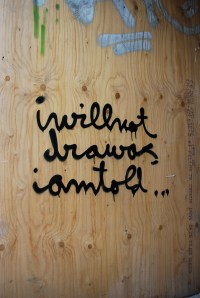
A few days later, I saw another inscription, outside a branch of the ubiquitous Albert Heijn Supermarkets. This time the letters dripped paint, the words running into each other.

Were they painted in greater haste, perhaps? Or was the writer deliberately seeking a particular effect? (There’s a genre of graffiti known as ‘drippies’, made when the writer fills a squeezy plastic ketchup bottle, or some similar container, with paint, and writes drippily on the ground or on a wall…)
Some time later, after my partner and daughter had arrived from Melbourne, we spent a day at Artis, Amsterdam’s wonderful zoo. As we made our way towards Artis’s cafe, hot and longing for an ice-cream, imagine my surprise and delight, when I spotted the same words, written upon a metal container box. The paint was peeling, and the remains of someone else’s paste-up obscured some of the lettering, marking the words as done some considerable time ago.
A few days after that encounter, I was sitting outside the Cafe Belgique in Gravenstraat, carrying out an interview with an Amsterdam artist. The walls outside this tiny bar tend to get covered with paste-ups, stickers, pieces: the bar’s owners are fond of street art and make the walls available to local and visiting artists who in turn use the bar as a kind of unofficial club, meeting there in the evenings for a drink. As I asked my questions and listened to the artist’s answers, my gaze drifted across the alleyway and settled upon a sticker on the wall opposite: “I will not draw as I am told’, it read.
Whoever the author may be, these words seem to encapsulate something about graffiti and street art. Anyone who ‘puts up’ on the street without the property owner’s permission is, by definition, committing a criminal offence, and in doing so, they are refusing to draw as they are told (which would be on canvas, in a studio, for a gallery, with permission, and so on). I’m not trying to claim that graffiti and street art has intrinsic value because of this, but the persistent refusal by its authors and artists to do as they are told seems worthy of remark. In a time when Victoria has just passed some fiercely repressive laws with the potential to criminalise many artists (the Graffiti Prevention Act 2007, about which, there will undoubtedly be more to say in this blog), I find myself to be quietly admiring of the determination to make art on and for the street.
Street memories…
I spent a few weeks in Amsterdam recently. I was there to meet artists and take photographs of art on the city streets (Amsterdam is one of the cities I’m studying as part of my research on street art). One day, I was walking along a street when I suddenly came across this:
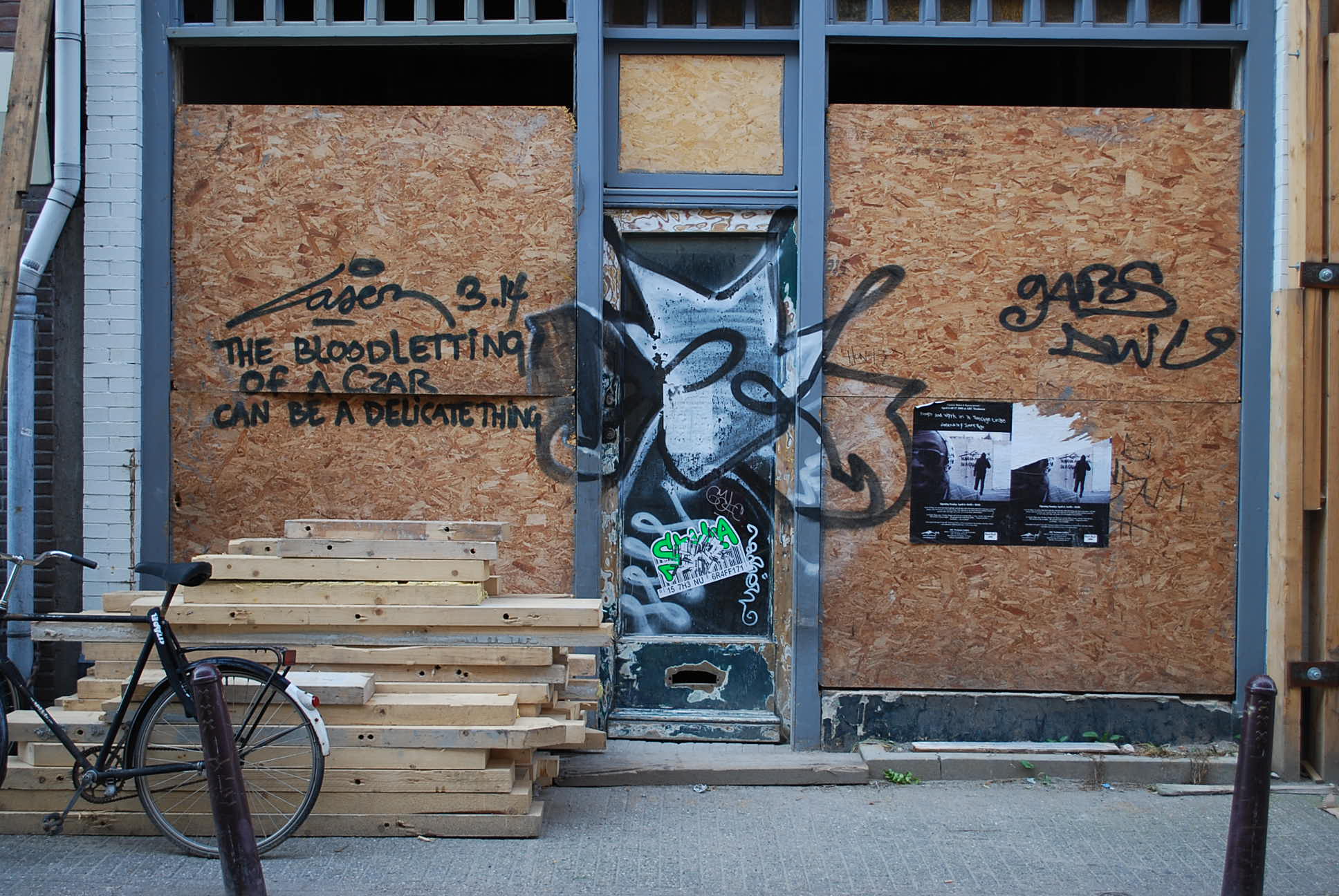
In addition to the usual pleasure that I experience when I come across a new piece of art in the streets, I felt an incredible shock of recognition. The calligraphy, the allusive style, the signature…. I realised that I had seen the work of this writer when I had been in Amsterdam two years before. On that trip, walking around the area known as the Jordaan, I had wandered down a little street and seen words on a hoarding which read: ‘As she dances in the widescreen of her existence’.

Something about about those words had really moved me at the time (and still does). The idea of there being a ‘widescreen’ to existence… and the image of a woman dancing. It embodied, for me, a sense of a way of being that bespoke lightness and joy.
I had no idea who the writer was. I felt surprised and delighted that the writer inscribed his or her words in English rather than Dutch, and, over the next few days, I came across a few more of the writer’s words upon other walls: the distinctive black lettering and the short phrases and sentences, the signature of ‘Laser 3.14’.
But I’m used to the idea that street artists and graffiti writers come and go. They move city, they stop writing on the streets – one way or another, the words left by a writer often disappear and don’t get replaced. So to come across another of Laser 3.14’s texts, two years after my first encounter, seemed like an amazing piece of good fortune.
After that, throughout my 3 week stay in Amsterdam, I saw more and more of the writer’s work. I photographed everything I could see. Some of the texts appealed to me more than others, but all were interesting. Almost all were written on temporary surfaces: hoardings, screens, sheeting. I came across one text, faded and almost too faint to read, painted on a wall (it read ‘When the streets are wet/ the colours slip into the sky’). The others had all been granted ephemerality by virtue of their host surface: they would appear, be present in the city for a while, and then be ripped down.
One day my sense of this writer’s gift to the city intensified into an even more personal encounter. During my visit, I was staying in a studio on Prinsengracht, and each day would leave the studio, and turn left down a small street called Runstraat. On this street there was construction work being carried out on a building; a hoarding covered its lower floor. And then one morning, the hoarding looked like this:
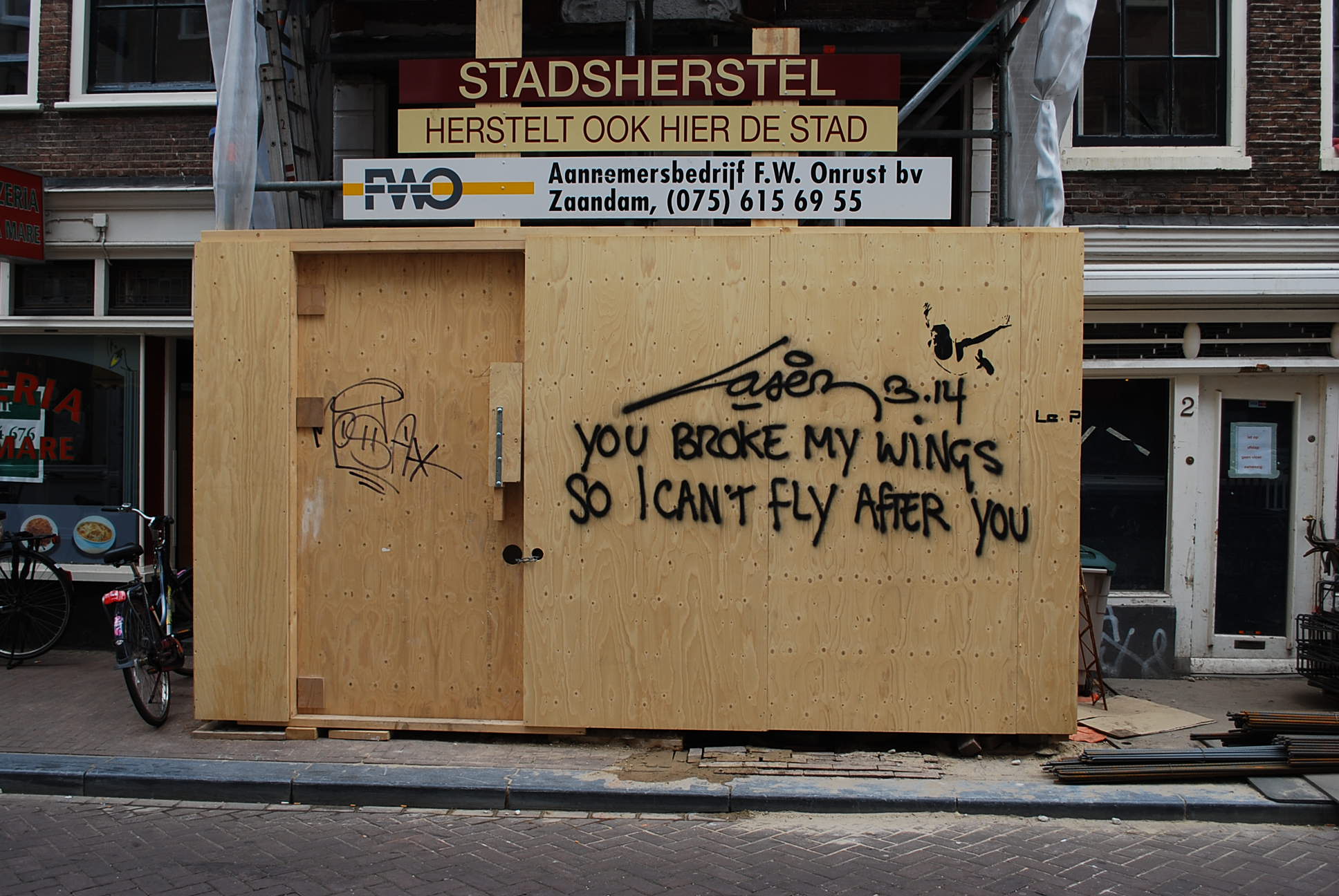
I loved the idea that, while I slept, Laser 3.14 had passed by this hoarding, on the street around the corner from where I lived, and inscribed these words. My pleasure at seeing them made me feel as though I was ‘dancing in the widescreen of my existence’, indeed.
In anticipation….
Filed under: art, Art, Street Art | Tags: Cans Festival, Logan Hicks, London, Melbourne, Street art
Leave a comment I’m writing this at a moment of great anticipation. Next week, an exhibition will open in Melbourne: Futureshock (Part 1), at the Per Square Metre Gallery in Johnston Street, Collingwood.

Three artists are exhibiting: Ha Ha, who is something of a Melbourne institution these days (a prolific, highly respected, incredibly influential, and extremely ethical street artist); Vex Ta, a Melbourne artist who is on a trajectory of international stardom and is recently returned from the Cans Festival in London, where she painted alongside some of the best known street artist in the world right now; and Logan Hicks. Logan Hicks is an American artist who has lived overseas but is now based in Brooklyn. And – what can I say – I am a fan of his work.
I had seen images of his work online. Many, many street artists like his work, and his name tends to come up in conversation. He has his own website here. On YouTube, you can watch time-lapse footage of Logan Hicks spraying a stencil:
I had looked at the online images of his work, and had admired what I had seen, but recently I had the chance to stand in the same room as 16 of his works, and that was a stunning experience.
When I was in London in July, a gallery called Black Rat Press was showing his work. The gallery space at Black Rat Press is located in a converted tunnel, so that instead of the standard ‘white cube’ there is a curved arc of exposed brick. The works were hung around this curved, vaguely subterranean room, and the mottled red brick provided a fitting backdrop to them.
Logan Hicks’s images tend to be of urban scenes: tired commuters on the New York subway, gazing into the near distance; a deserted stoop in front of a decaying building; the escalator that descends into a train station; the facade of a building. These images are rendered by means of extremely detailed stencil-making. Hicks appears to cut his intricate shapes with ease: the images appear directly painted rather than transferred through the indirection of a stencil.
His colour palette is sombre – greys, black, more grey. But these monochromal repetitions are counterposed in some of his works to a sudden, astonishingly bright, primary colour. In one image, the sky is red; in another, a window appears golden yellow. The effect, for me, is enormously pleasing: even now, several weeks after seeing them, the works hover in my memory.
I visited the gallery with my partner and our daughter. After a while they went outside, to sit in the sunny courtyard that belongs to Cargo, a tremendously hip Shoreditch bar. (One wall of Cargo’s courtyard is adorned with works by various famed street artists: Logan Hicks has a work on that wall, and so does Shepard Fairey, while two Banksys look demurely out from behind their plexiglass protective cover.)
While Peter and Sophie were outside, I chatted to the gallery staff member who was present. He said the opening night had gone well, and pointed to several red dots next to various works. ‘Wait a minute’, he said, ‘You should see the works like this…’, and he switched off the main gallery lights. In their place a number of small track lights pointed at the images. The metallic lustre of the paint emerged; the images seemed even more to fade into the brickwork. For a moment, gallery became street: image on brick, artificial light turned almost into the gloom of a tunnel.
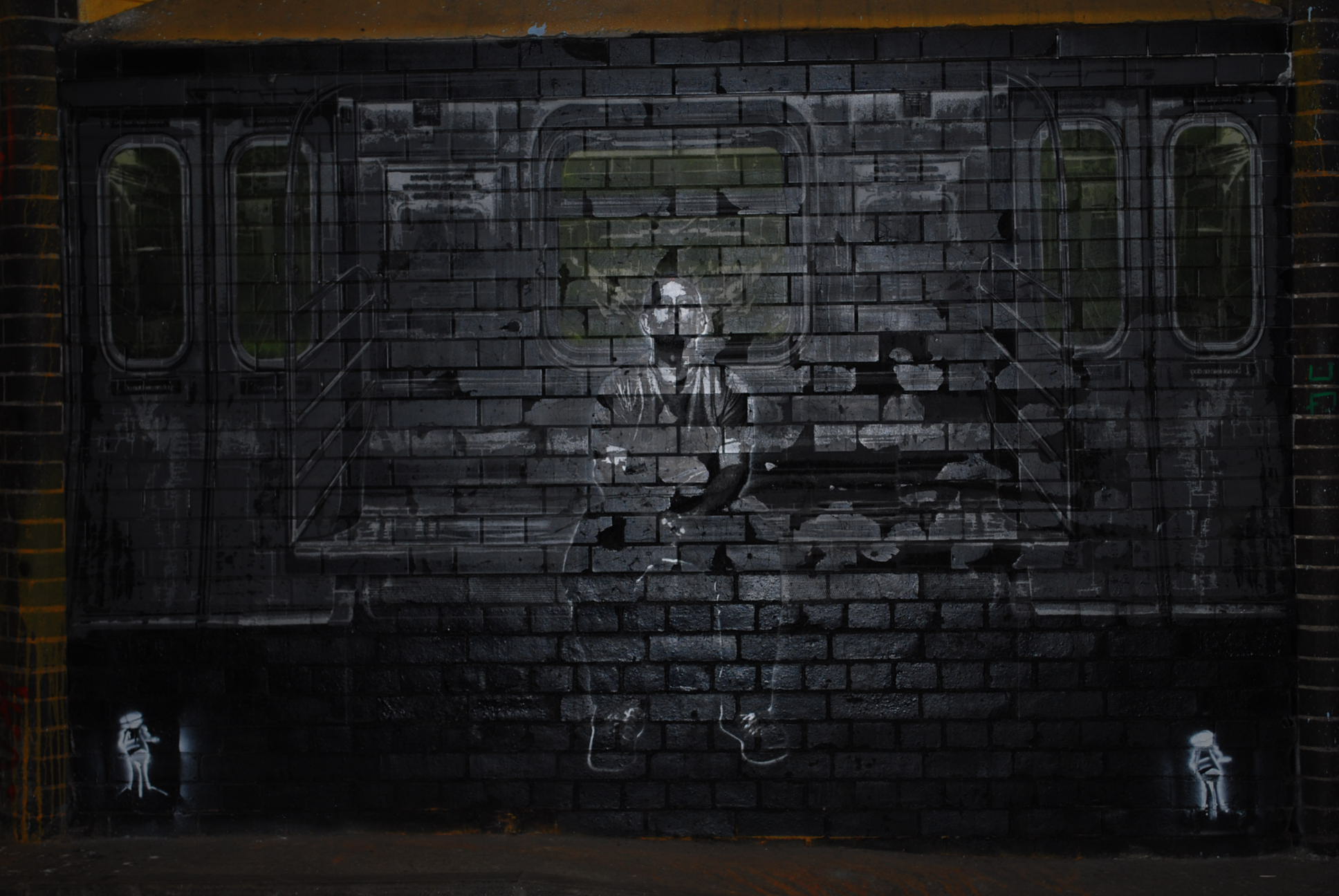
Logan Hicks’s works seem poised at that delicate moment between appearing and disappearing. I felt this acutely when I saw his contribution to the Cans Festival, Banksy’s paintfest in a disused tunnel called Leake Street, near Waterloo Station in London. Hicks was one of the artists invited to participate, and he painted two large works on the brickwork of the walls, in one of the dimmest corners of the tunnel. One is an image of Union Square subway station; another shows a solitary man on a subway train. Both works evoke the city as almost uncannily unpopulated, yet crowded with the machinery of modernity. Both are peaceful yet disquieting images. Both sink into the walls, yet insinuate their images outwards toward the spectator.
Where so much of street art is about getting noticed, Hicks’s work seems almost to be receding away from the viewer. Is it this that captivates me so much?
 Images to Live By